Israel Has Nuclear Weapons. It May Use Them.
There is little sign that Israel is achieving its war aims against Iran. But Israel is the only state in the region with nuclear weapons — and it may use them if it feels like it has run out of options.
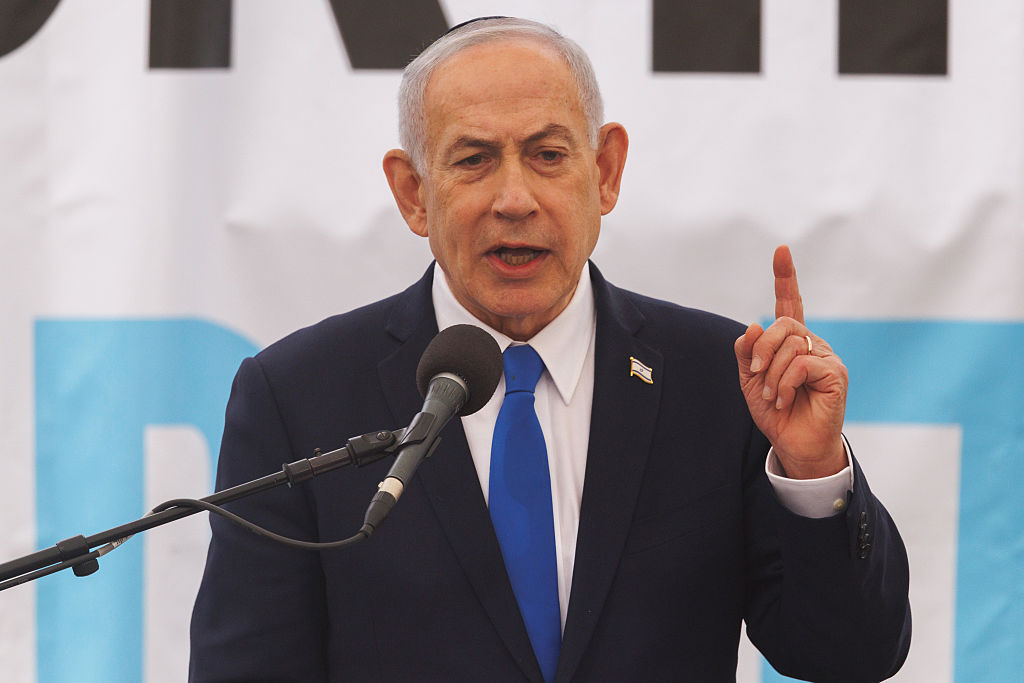
Israel has started a war with Iran that is quickly spiraling out of control. We need to take seriously the possibility that Israel could deploy nuclear weapons in the conflict. (Kobi Wolf / Bloomberg via Getty Images)
While the true extent of Iran’s retaliatory attacks on Israel remains unclear, the Islamic Republic has for two weeks managed to strike both military and civilian infrastructure across Israel. Verified video, reported by Fox News no less, shows salvos of Iranian missiles over the skies of Tel Aviv, launched in response to a US and Israeli air campaign. Many appear to be hitting their targets on the ground. The very sight of these missiles suggests that Arrow 3, the Israeli missile defense system designed to intercept ballistic missiles in the upper atmosphere, has at least partly malfunctioned.
As for the lower atmosphere, the Iron Dome and David’s Sling, which also require US ammunition, made by hand in the United States with long production times at extraordinary cost, increasingly appear to be white elephants in the face of Iran’s counterattack. In its Twelve-Day War in June, the US used up a quarter of its Terminal High Altitude Area Defense (THAAD) missiles in the defense of Israel. One does not have to be a rocket scientist to see that the myth of Israeli invincibility is being exposed.
But according to rocket scientists themselves, the picture is even worse. Ted Postol, a professor emeritus of science, technology, and international security at the Massachusetts Institute of Technology and a former adviser at the Pentagon, says that the interception rate against ballistic counterattacks is at most one in twenty. “People have been told by the Israelis it’s an 87 percent intercept rate, and that is absolutely false. It’s been below 5 percent right from the beginning,” says Postol. “So from the beginning of Iron Dome, we have seen very, very low intercept rates on that system. . . . The air defenses have had no meaningful contribution except as political theater.” Postol is just one of a number of scientists and scholars, including several Pentagon insiders as well as Israeli engineers, who have for years questioned Israel’s claims about its layered missile defense systems.
Iran’s much cruder air defense system is also in ruins, and Israeli and US jets have near free rein over the skies of Tehran; observers in Tehran have heard no air defenses since the beginning of the war. But the most powerful air forces in the world are still yet to neutralize Iran’s missile program. The main targets are “transporter erector launchers,” specialized trucks stored deep underground, which emerge from mountainsides across Iran’s vast territory to fire on Israel. Iran failed to deter this war, and it is now working to reestablish deterrence. Despite impressive penetration of Iranian intelligence, the United States and Israel have simply failed to destroy Iran’s ability to violently counterattack.
The US and Israel have also so far failed to achieve their war aims of regime change. Iran has destroyed key radar stations that sustain the US-Israeli security constellation in the area, and Iranian planners are pursuing a long war to remove US presence in the region and finally defeat Israel, which has been decisive in maintaining the belief over several US administrations that Tehran is a peerless US enemy, which should be either put forever in a box or otherwise destroyed.
But for Tehran, hopeful signs on the battlefields also pose a profound security dilemma. Of course, losing this war would likely fragment the ancient nation over which it rules. But winning against such insatiable enemies could provoke a cornered Israel to turn the war nuclear. A Trump adviser recently warned that Israel might use a nuclear weapon against Iran.
Israel has a large nuclear arsenal, officially undeclared, of over one hundred warheads that it built with the help of the French and hid for a decade from the Americans. It can be deployed by submarines as well as long range missiles and is considered by Israeli planners to be the “Samson option,” named after the last biblical judge of Israel who tore down the columns of the temple of an ancient fertility God to destroy the Philistines. It may resort to using this weapon if it feels it is existentially threatened. Tel Aviv is a city of only twenty square miles, and half of the population of Israel lives in its larger metropolitan area, so it is not difficult to imagine this threshold being passed in the mind of Benjamin Netanyahu.
His government has shown no signs of restraint since the attacks by Hamas on October 7, 2023. The logic of victimhood and revenge has deepened within Israel more broadly; most of the country’s citizens believe that they can only deal with their enemies by eradicating them. After all, Israel has so far succeeded in bringing its regional adversaries to their knees through genocide in Palestine and decapitation strikes and ongoing ethnic cleansing in Lebanon, not to mention its covert wars in Syria and Iraq.
It is unclear what Tehran could do to prevent Iran from meeting a fate perhaps even worse. Although Iran claims Pakistan would deploy nuclear weapons against Israel in the event of a nuclear strike against it, few analysts take this claim seriously. That said, the geopolitics of the Middle East would permanently shift if a bomb were to be launched by Tel Aviv. It is difficult to know how regional actors would respond.
What will happen if Iran, a country seventy-five times larger than Israel, makes Israeli military planners decide the country itself is at risk? Tehran faces a profound security dilemma: lose to an enemy that wants Iran broken apart or win a conventional war and invite escalation, which could take the form of a nuclear attack.
The former supreme leader, Ali Khamenei, successfully pursued a policy — perhaps foolish in retrospect — of becoming a threshold state. Threshold states such as Germany, Japan, and Brazil have the material and technical capacity to develop nuclear weapons in a matter of weeks if the political decision is made to weaponize. It would be entirely unsurprising if Iran has made this decision. This is the second war waged since last summer by the United States and Israel against Iran. And the US and Israel have effectively removed the diplomatic breaks by nakedly using negotiations as a weapon of war.
Though it is unclear how much of the stockpile it still has access to, Iran had 440 kilograms of uranium enriched to 60 percent purity before the International Atomic Energy Agency (IAEA) left the country following the US withdrawal from the nuclear deal, an exit lobbied for by Israel. Nuclear scientists estimate Iran could create several bombs within weeks, even if it has access only to part of the stockpile. US intelligence officials have briefed that Tehran has access to the stockpile, even though part of it is entombed under the country’s nuclear site at Isfahan.
Experts say that Iran would not need to test a bomb to use it effectively, but it may choose to do so in an attempt to establish deterrence. Even if Israel knows Iran has a bomb, it may not be deterred. Both nations are rich in myths of heroic and suicidal battles: Masada for Israel and Karabala for the Islamic Republic. Samson, the namesake of Israel’s nuclear option, brought down the temple of Dagon. But he did so at the cost of his own life.
“My concern is that [Israel] will resort to using a nuclear weapon against Iran. And if that happens, Iran will respond whether or not they now have nuclear weapons,” says Postol. “It may take a few weeks [to develop], but they will have a nuclear weapon, and they will respond. That’s what we can have. I hope the US has control over the Israelis like they say that they do.”