Israel and the US Have Been Waging War on Iran’s Development
From universities to medical research centers, Israel and the US have been systematically attacking Iran’s technical infrastructure. While claiming their only issue is with Iran’s rulers, they have targeted its entire people and their achievements.
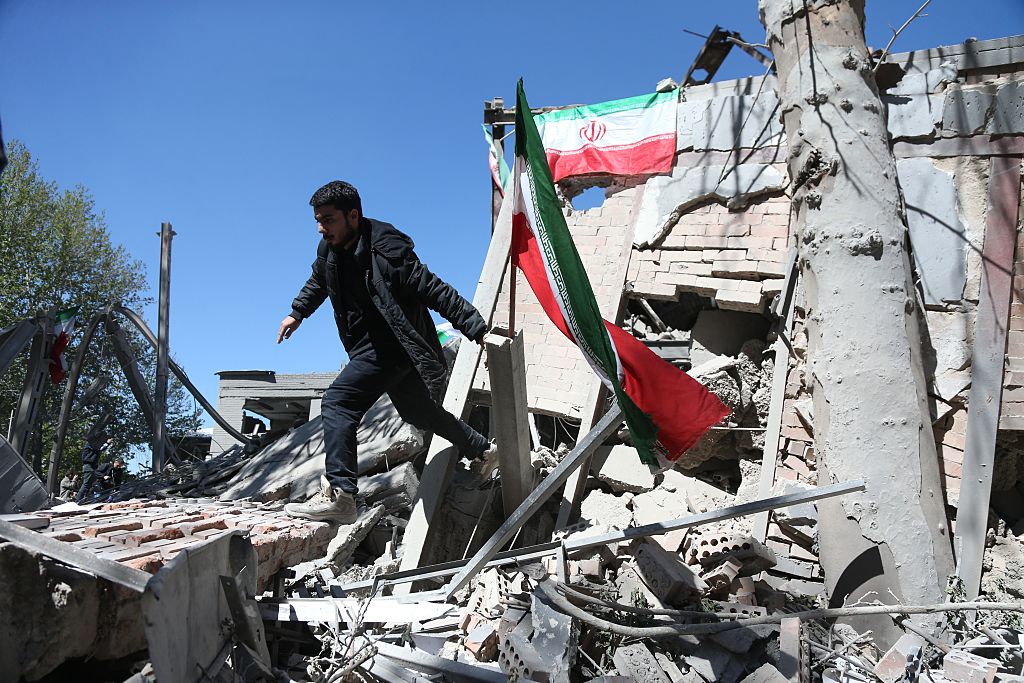
This photo, taken on April 7, 2026, shows a view of the damaged Sharif University of Technology after US and Israeli air strikes in Tehran, Iran. (Shadati / Xinhua via Getty Images)
When Israeli Defense Minister Israel Katz announced, with the satisfied air of an industrialist surveying demolished competition, that Israeli strikes had destroyed around 70 percent of Iran’s steel production capacity, he was not describing a military achievement. He was boasting about an act of economic destruction: one aimed not at soldiers or weapons systems, but at furnaces, factories, and the accumulated industrial labor of millions of Iranians over decades.
“We have severely damaged Iran’s steel and petrochemical sectors,” Katz said, ordering the military to continue striking what he called “the national infrastructure of the Iranian terror regime.” The framing is deliberate: strikes on a country’s industrial base are presented as strikes on a government, as though the two could be neatly separated. They cannot.
The fates of a government and its people are never entirely separable, and Iran is no exception: the Islamic Republic’s industrial policies, planning institutions, and state investment have all played a real part in building what now exists. But the insistence of Israeli and American officials that these strikes are directed at “the regime” rather than at Iran’s people performs a sleight of hand that cannot go unchallenged.
Whatever role the state played in constructing refineries, pharmaceutical plants, and research institutions, it is Iranian workers, engineers, scientists, and patients who depend on them, who built their careers inside them, and who will suffer most from their destruction. Bombing a country’s industrial and scientific base is an act of violence against its people, regardless of what one thinks of its government.
Systematic Destruction
The petrochemical strikes of late March and early April 2026 were breathtaking in their scope. In the space of a few days, Israeli forces struck the Bandar Imam Petrochemical Complex at Mahshahr in Khuzestan, which Iranian officials described as producing seventy-two million metric tons of petrochemical products annually and supplying electricity to five hundred thousand residents of the province, and then the Asaluyeh complex at South Pars, the largest natural gas field in the world, shared with Qatar.
Katz confirmed that together the two facilities accounted for approximately 85 percent of Iran’s petrochemical exports, and that both had been “taken out of use and are not functioning,” with declared economic damage running to tens of billions of dollars. Whatever Israel says about these targets, they were not missile launchers. Petrochemicals are the material basis of fertilizers, plastics, textiles, and pharmaceuticals, and Iran’s non-oil export economy, built painstakingly over decades under the most grueling conditions of international financial isolation, rests on them as a foundation.
Steel tells the same story. Benjamin Netanyahu claimed Israeli strikes had destroyed 70 percent of Iranian steel production capacity, offering as justification the familiar pretext that steel is “used in missiles and drones,” as though this somehow justified the obliteration of an entire industrial sector that employs hundreds of thousands of engineers and workers and underwrites the physical infrastructure of Iranian life.
Among the first to identify the significance of the steel strikes was Ali Kadivar, a sociologist at Boston College who studies Iranian political economy: writing on March 28, days after Khuzestan Steel and Mobarakeh Steel were hit, Kadivar argued that the attacks should be understood not as tactical military decisions but as the latest iteration of a pattern stretching back more than eighty years — a persistent Western effort to prevent Iran from achieving industrial self-sufficiency regardless of who governs the country.
The strikes extended beyond these sectors to airports and seaports, to railways and research centers, so that the full list of targets reads less like a military campaign and more like a map of Iranian modernity, a catalog of every category of infrastructure that connects a society, moves its goods, and enables its people to work and live.
What is being destroyed, despite the insistence of Israeli officials, is not “the Iranian regime’s economic backbone.” It is the industrial capacity of a nation of ninety-three million people, built by Iranian engineers, planners, workers, and scientists over more than a century of effort, much of it conducted under conditions of extreme external pressure and siege, and now being systematically destroyed in a matter of weeks.
A War on Vaccines
On the morning of April 2, 2026, an explosion tore through the Pasteur Institute of Iran in central Tehran. According to the Institute’s director, epidemiologist Ehsan Mostafavi, it was the third strike on the facility and the most destructive, obliterating key laboratories, national reference labs, World Health Organization (WHO) collaborating centers for rabies and vector-borne diseases, the virology lab and vaccination unit, and irreplaceable collections of tissue samples and recombinant bacterial and viral strains: infrastructure that, as Mostafavi put it, “had taken decades of effort to establish and equip.”
The Institute had been founded in 1920, and it is worth dwelling on what this means. In the aftermath of World War I and the catastrophic 1918–19 influenza pandemic, which killed hundreds of thousands in a country of barely ten million, Iran negotiated directly with the Institut Pasteur in Paris to establish a bacteriological research and vaccination center in Tehran.
The initiative came from Firuz Mirza Nosrat-al-Dawla, head of the Persian delegation at the Paris Peace Conference of 1919, and land for the new institution was donated by Abdol-Hossein Farman Farma, whose stated intention was to ensure that “smallpox inoculum could be produced, and rabid animal bitten ones could be treated.” Within the first two years of operation, the Institute produced nineteen types of sera and vaccines and approximately 190,000 doses of smallpox inoculum, and by the mid-twentieth century its Bacillus Calmette-Guérin (BCG) vaccines had been administered to 238 million children across twenty-two countries.
The Pasteur Institute predates the Islamic Republic by nearly six decades. It was built under the Qajar dynasty, developed under the Pahlavis, and carried forward after 1979, belonging in any meaningful historical sense not to any particular government but to Iran and to Iranians, and indeed to the wider world, given its long-standing membership in the international Pasteur Network, its role as a WHO collaborating center for rabies control since 1973, its contributions to the global eradication of smallpox, and its service during the COVID-19 pandemic as Iran’s national reference laboratory and a center of domestic vaccine development.
WHO Director-General Tedros Adhanom Ghebreyesus confirmed that the Institute “sustained significant damage and was rendered unable to continue delivering health services,” and that two of its departments had been working closely with the WHO on public health programs. By early April, the WHO had verified over twenty attacks on health care infrastructure in Iran since March 1, resulting in at least nine deaths.
Criminal Action
What pretext did Israel offer for destroying an institution of this standing? Effectively none. The Israel Defense Forces did not respond to requests for comment from journalists. Some analysts recklessly speculated about possible secret tunnels beneath the building or noted its geographical proximity to the office of the supreme leader. These are not justifications, but rather the manufacturing of pretexts for a criminal action after the fact.
A public health institution of this age and this global standing, which had spent a century producing vaccines, training epidemiologists, and serving as a node in international disease surveillance networks, could not meaningfully be described as a military target. Its destruction could have no purpose beyond degrading Iran’s capacity to protect its own people from infectious disease and assaulting the historical record of what those people have built.
Two days before the Pasteur strike, on March 31, Israeli forces hit the Tofigh Daru Research and Engineering Company in Tehran, one of Iran’s largest pharmaceutical manufacturers, which produced active pharmaceutical ingredients for cancer treatment, multiple sclerosis, anesthetics, and cardiovascular and immunomodulatory medicine. The Iranian government reported that the drug production line had been destroyed, and Foreign Minister Abbas Araghchi posted a photograph of the gutted facility with the comment: “The war criminals in Israel are now openly and unashamedly bombing pharmaceutical companies.”
Israel’s stated justification was that the facility had been supplying fentanyl to Iran’s Organization of Defensive Innovation and Research for use in chemical weapons development, but no evidence for this claim was made public. What was publicly documented was what Tofigh Daru actually made: pharmaceutical ingredients critical to the functioning of hospital operating theaters and oncology wards across the country.
Esfandyar Batmanghelidj, founder of the Bourse and Bazaar Foundation and a keen observer of Iran’s political economy, cut through the Israeli framing with precision:
Iran manufactures 90 percent of the drug doses it needs and mainly imports advanced therapies. Companies like Tofigh Daru produce ingredients and precursors which can then be used to make a wide range of drugs domestically. The only reason you would hit this target is to try to limit medicine production in Iran.
Dual-Use Alibis
The concept of “dual-use” does an enormous amount of work in Israeli and American justifications for targeting civilian infrastructure, and it is worth examining exactly how elastic it has become. Vaccines involve biological materials that could theoretically be repurposed. Pharmaceutical ingredients capable of treating cancer are also, in principle, capable of other applications. Petrochemicals underpin both agricultural fertilizers and explosive compounds. Steel goes into apartment buildings and into weapons alike.
By the logic now being applied to Iran, any modern industrial economy constitutes a legitimate military target, and the “dual-use” designation functions not as a legal standard with defined criteria but as a roving license for total warfare conducted under the rhetorical cover of nonproliferation. Iran’s Foreign Ministry spokesperson Esmail Baqai made the connection explicit when he called the pharmaceutical strikes “yet another dimension of their criminal sanctions — the very same sanctions that have long deprived Iranians of lifesaving medicines.” The observation is worth taking seriously, because it points toward a history that has to be understood if the present destruction is to be properly assessed.
Before a single bomb fell in 2026, Iran’s pharmaceutical and health care infrastructure was already operating under conditions of extreme stress; stress that had been deliberately engineered through decades of American and allied sanctions. The systematic review of the health impacts of sanctions published across peer-reviewed medical journals over the past decade tells a consistent and damning story.
Following the tightening of multilateral sanctions in 2012, imports of medicines and raw medical materials fell by between 30 and 55 percent, and the number of drug shortages increased from fewer than thirty types to over 144. Some 44 percent of the scarce medicines were classified by the WHO as essential, meaning the minimum required for a functioning health system, and prices for some antiepileptic drugs rose by up to 300 percent, while an estimated six million Iranian patients found themselves with limited or no access to treatment for a range of conditions.
The particular cruelty of this regime lay in its indirectness. Medicines were, formally, exempt from sanctions. But the financial transactions required to purchase them were not, and international banks, terrified of American penalties, routinely refused to process even payments that were technically legal. Major pharmaceutical companies, including Novartis, which conceded that its exports to Iran had been “severely affected, if not fully ceased,” withdrew from the market.
What lawyers call “overcompliance” — namely, the tendency of institutions to restrict their activities far beyond what sanctions technically require, out of fear of falling afoul of their complex and unpredictable application — deepened the humanitarian crisis beyond what any explicit prohibition could have achieved on its own. Writing in the Lancet following the reimposition of UN sanctions in September 2025, Mohammad Reza Farzanegan, Ruth Gibson, and Maziar Moradi-Lakeh described the result as economic warfare that kills “not through bombs or bullets, but through the slow erosion of health systems, medicines, and human dignity.”
Peer-reviewed research has found that sanctions of this character reduce life expectancy by between 1.2 and 1.4 years across the affected population. Iran’s cancer patients bore some of the heaviest costs, given that the country has the highest cancer incidence in the Middle East and that sanctions had already created drastic shortages of chemotherapy drugs, leaving the country’s National Cancer Control Program, in the assessment of one major clinical review, with “substantial deficits” across every dimension of care from prevention through to palliative treatment.
All of this was the baseline — the condition of Iran’s health system when the bombing campaign began. It is the context in which the destruction of Tofigh Daru’s production lines, the obliteration of the Pasteur Institute’s laboratories, the strikes on hospitals in Tehran, Khuzestan, and Kermanshah, and the drone attack on a Red Crescent warehouse in Bushehr province have to be understood: not as isolated military incidents, but as the kinetic continuation of an economic war that had already been running for decades.
“Remember That Name”
The current war is not the beginning of Israel’s campaign against Iranian sovereignty and knowledge, but rather its most open and extensive phase to date. For more than fifteen years before the bombs began falling, Israel conducted a systematic program of assassination against Iranian scientists and engineers.
Between 2010 and 2012, at the height of international pressure over Iran’s nuclear program, at least four nuclear physicists and engineers were murdered on the streets of Tehran, killed by magnetic bombs attached to their cars or by motorcycle assassins operating in broad daylight: among them Massoud Ali-Mohammadi, a professor of particle physics at Tehran University; Majid Shahriari, a nuclear engineer; and Mostafa Ahmadi Roshan, a supervisor at the Natanz enrichment facility. Israel neither confirmed nor denied responsibility, but former Israeli Defense Minister Moshe Ya’alon made the underlying strategic logic explicit in an interview with Der Spiegel, in which he declared that he was not responsible “for the life expectancy of Iranian scientists.”
Alongside the assassinations, the Stuxnet computer worm, jointly developed by Israel and the United States and first detected in 2010, destroyed hundreds of centrifuges at the Natanz enrichment facility by causing the motors of the machines themselves to tear them apart from within — the first known instance of a cyber-weapon being deployed against physical critical infrastructure at scale. It was followed by the Flame malware, which mapped and monitored Iranian computer networks for years.
In November 2020, the nuclear scientist Mohsen Fakhrizadeh — “remember that name,” Netanyahu had once instructed the Israeli public — was killed in an elaborate remote-controlled attack on a road east of Tehran. Then, on the opening night of the current war, in what Israeli media dubbed “Operation Narnia,” nine of Iran’s most senior nuclear scientists were killed simultaneously in their homes, among them Fereydoon Abbasi, who had survived an assassination attempt in 2010 before being killed sixteen years later in the Israeli strikes of June 2025.
Taken together, these actions constitute something beyond tactical targeting. The systematic killing of scientists and engineers, the destruction of centrifuges and computer networks, the bombing of research universities and pharmaceutical facilities: all of it reflects a coherent strategic objective, which is to erase the embodied knowledge, the accumulated expertise, and the institutional memory that make Iranian technological development possible.
The logic is, at its core, colonial — the familiar ambition to keep a subordinate nation dependent, to deny it the capacity to master its own material future, to ensure that its people remain consumers of the technology of other nations rather than producers in their own right.
Forced De-Development
The argument consistently advanced in Israeli and American official discourse — that these are strikes against “the Iranian regime,” against the Islamic Republic’s economic infrastructure, against the Islamic Revolutionary Guard Corps’s revenue streams — performs a fundamental ideological sleight of hand by displacing an entire people from their own history and their own achievements. Iran’s petrochemical industry was not the creation of the Islamic Republic alone — its roots lie in earlier periods of nationalist ambition and state-directed development — but the republic oversaw its most dramatic expansion, and what was built across those decades was built by Iranian engineers, planners, and workers under conditions of extraordinary adversity.
That history runs from the oil nationalization movement of the early 1950s under Mohammad Mosaddegh through the development programs of the 1960s and ’70s, and then, after the revolution, through a sustained industrial effort conducted under the most punishing conditions imaginable: an eight-year war with Iraq, prolonged international isolation, and successive waves of escalating economic sanctions.
Iran was able to develop, under these conditions, to the point where it manufactured approximately 90 percent of its own pharmaceutical requirements, ranked among the top ten vaccine-producing nations in the world, and had built steel and petrochemical sectors capable of generating tens of billions of dollars in non-oil export revenues. This constitutes a remarkable national achievement, the product of the labor and ingenuity of Iranian engineers, scientists, factory workers, professors, and planners across generations. The Islamic Republic’s industrial policies shaped part of it; so did what came before the republic. It belongs, in any historically honest sense, to the Iranian people.
The Pasteur Institute predates the Islamic Republic by nearly sixty years. Tofigh Daru’s cancer drug production lines existed to serve Iranian cancer patients, not the Revolutionary Guard. The national reference laboratories for cholera and tuberculosis housed in the Pasteur Institute’s compounds served a population exposed to infectious disease. The steel plants employed workers and built the infrastructure of cities. The petrochemical facilities supplied electricity to half a million households in Khuzestan.
The destruction of all of this is deliberate, and it needs to be named for what it is: a program of forced de-development, intended to ensure that Iran emerges from this conflict economically shattered, industrially incapacitated, and stripped of the capacity for independent development. Unable to produce its own medicines, to manufacture its own vaccines, to process its own natural gas or smelt its own steel. Dependent, in short, on others — on foreign suppliers who can be pressured, on international markets whose terms are set elsewhere — in exactly the condition of permanent subordination that a century of Iranian development, carried forward under conditions of immense adversity, had been working to overcome.
A Dispersed Tradition
There is something that the strikes cannot reach, and it matters to say so clearly. Bombs can destroy laboratories, incinerate production lines, and collapse university buildings along with the collections inside them. What they cannot destroy is the intellectual and scientific tradition that produced those institutions — a tradition that does not reside only within Iran’s borders but extends to a vast, dispersed, and extraordinarily accomplished community of Iranians who carry it with them wherever they have gone.
Decades of brain drain, intensified by the political restrictions of the Islamic Republic and the economic pressures of sanctions and economic turbulence, have drawn enormous numbers of Iran’s most gifted scientists, engineers, mathematicians, and physicians to universities and research institutions across the world. This is a genuine loss, and Iranian society has paid a heavy price for it.
But it is not an extinction of the tradition — it is a dispersal of it, one that leaves the intellectual formation intact even as the institutional infrastructure is attacked. The system of rigorous mathematics education, competitive olympiad training, and demanding technical universities that produced so many of these individuals has not been destroyed, and the knowledge it has generated lives on in the people it formed.
Consider what that system produced in Maryam Mirzakhani, who grew up in Tehran and won gold medals at the International Mathematical Olympiad in both 1994 and 1995 before completing her undergraduate education at Sharif University of Technology and going on to become, in 2014, the first woman and the first Iranian to be awarded the Fields Medal, the highest honour in mathematics.
Her work on the dynamics and geometry of Riemann surfaces was described by her colleagues as work of extraordinary originality and depth, and while she died tragically young in 2017, her trajectory from the classrooms of Tehran to the pinnacle of the discipline she loved tells you something essential about the capacity of Iranian intellectual culture when it is given the conditions to flourish.
Sharif University of Technology itself, which was struck in the course of the current campaign along with its engineering departments and institutes for nanoscience and environmental science, is not simply a building or a campus. It is one of the most demanding and internationally regarded technical universities in the world, sometimes described as the MIT of Iran, and its graduates have made significant contributions to semiconductor design, cryptography, aerospace engineering, and artificial intelligence research across the global technology industry. Bombing Sharif means bombing an institution whose alumni are at work in virtually every serious technology ecosystem on earth, an institution that has continued, in spite of sanctions and isolation and now open warfare, to form world-class technical minds.
The deeper point is that Iran’s intellectual resilience cannot be reduced to the infrastructure that is currently being destroyed. The laboratories will eventually be rebuilt. New generations of scientists will be trained to replace those who have been murdered. The pharmaceutical production capacity will, in time, be reconstructed. Iran has a long and self-renewing tradition of learning and technical accomplishment that has survived far greater catastrophes than this one, and there is no serious reason to doubt that it will survive this too.
Clarifying the Stakes
But survival on its own is not enough, and there is an obligation here that deserves to be named directly: one that falls not on Israel or the United States, whose intentions in this conflict are plain, but on Iran itself and on the broader Iranian world. The Islamic Republic has, for decades, driven away some of its most gifted people through political repression, economic mismanagement, and a cultural and institutional environment that proved intolerable to many with the ability to leave.
The diaspora scientists and engineers who might, in different circumstances, have rebuilt the Pasteur Institute’s reference laboratories, staffed Tofigh Daru’s research departments, and taught at Sharif largely left not out of indifference to Iran but because the conditions inside it made staying impossible. The country has borne an enormous price for this, and the bombing campaign has made the cost of that price more visible than ever.
If there is any obligation that arises from this catastrophe, it is that in the reconstruction to come, Iran finds ways not simply to endure but to reach outward — to draw on the immense, globally distributed reserve of Iranian expertise that the country’s own educational and scientific institutions helped cultivate. The engineers in California, the mathematicians in Paris, the physicians in London and Toronto: many of them carry a deep attachment to Iran and would contribute to its reconstruction if the political and material conditions for doing so could be created.
The war has made vivid, in the most brutal possible terms, what is at stake in Iran’s sovereign scientific and industrial capacity. Whether that clarity produces a different kind of opening — one that reconnects the diaspora to the country that formed it — remains to be seen, but the need for it has rarely been more obvious.
The strikes on Iran’s industrial, scientific, and health infrastructure do not fit within even the most permissive frameworks of the laws of armed conflict. The WHO has verified more than twenty attacks on health care facilities since March 1. A century-old biomedical research institution has been rendered nonfunctional. One of the country’s largest manufacturers of cancer and anesthetic drugs has been destroyed.
The two petrochemical complexes responsible for approximately 85 percent of Iran’s petrochemical exports have been, in the words of Israel’s own Defense Minister, “taken out of operation.” Seventy percent of steel production capacity has been eliminated. Airports, seaports, bridges, universities — Sharif University of Technology, Shahid Beheshti University, and others — have been struck, in a campaign whose declared aim is to destroy what the Israeli government calls the regime’s economic backbone.
The deliberate destruction of a people’s productive capacity, their institutions of learning and health, and their material conditions of life constitute war crimes and should be named as such. What can and should be made explicit is that this is not a military campaign in any meaningful sense of the term. It is a program of forced de-development: an attempt, through bombs where sanctions have been insufficient, to ensure that Iran cannot be what Iranians have worked across a century of extraordinary effort and adversity to build.
The campaign constitutes an assault on Iran’s history: on the engineers who built the refineries, the scientists who developed the vaccines, the workers who ran the steel plants, the professors in the universities that now lie in rubble. These achievements do not belong to any government. They belong to a people and their myriad struggles. Their destruction is a crime against that people, one whose consequences will outlast whatever political order eventually emerges from the ruins of this war, and one that the world, largely silent, is permitting to unfold.