The US Is Fighting Israel’s War on Iran

American political leaders are openly stating that the United States is fighting Iran for Israel.
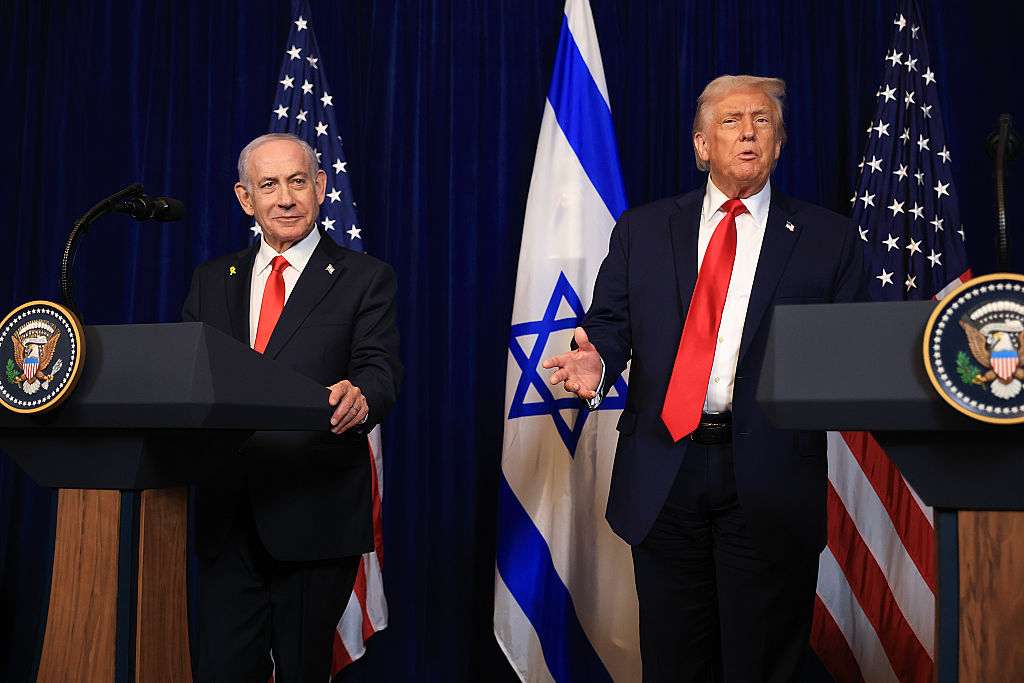
At least three separate, high-ranking US officials close to Donald Trump have now publicly said that the United States was forced into starting this war by Israel. (Joe Raedle / Getty Images)

For decades, journalists, analysts, and activists worked painstakingly to uncover and prove the way that Israel leverages its “special relationship” with the United States to drive US policy. They traced the money spent by its lobbying arm, uncovered stories of its political meddling, and carefully mapped out the networks of influence it used to get its way in Washington.

And then Trump officials just came out and admitted it earlier this week.

Many commentators have made the case that the rapidly escalating war with Iran that Donald Trump has plunged the country into has little to do with defending US interests but is instead being fought, paid, and died for by Americans because Israel wanted it. Thanks to a combination of reporting, public statements, and several open admissions by people close to the White House, we can now say that’s objectively true.

At least three separate, high-ranking US officials close to Trump have now publicly said that the United States was forced into starting this war by Israel. Explaining to reporters on Monday why Trump had decided to launch the war this past weekend, Secretary of State Marco Rubio put it in remarkably explicit detail:

it was abundantly clear that if Iran came under attack by anyone — the United States, Israel, or anyone — they were going to respond, and respond against the United States. The orders had been delegated down to the field commanders. . . . We knew that there was going to be an Israeli action, we knew that that would precipitate an attack against American forces, and we knew that if we didn’t preemptively go after them before they launched those attacks, we would suffer higher casualties.

Later that day, coming out of a classified briefing on the war, House Speaker Mike Johnson told reporters something almost identical:

Because Israel was determined to act with or without the US, our commander in chief, and the administration, and the officials I just named had a very difficult decision to make. . . . And they determined, because of the exquisite intelligence that we had, that if Israel fired upon Iran and took action against Iran to take out the missiles, then they would have immediately retaliated against US personnel and assets. . . . If we had waited for all those eventualities to take place, the consequence of inaction on our part could have been devastating.

Yesterday morning, ultrahawk Sen. Tom Cotton (R-AK), one of Trump’s most loyal allies in Congress, went on Fox News where he was teed up by the host to refute these statements — and confirmed them instead:

Israel faced an existential risk, and they were prepared to strike Iran alone. If that happened, Iran was very likely to target our troops.

This is, needless to say, not a good look for an “America First” administration. So, naturally, Trump, Rubio, and others are now doing damage control, walking back and finessing these statements to now claim that, actually, this was entirely Trump’s decision; he wasn’t dragged into anything.

When they made them, there was more than a hint that US officials were trying to play hot potato with the responsibility for what was looking more and more like an unpopular fiasco. But anyone hoping to dismiss this and move on will be frustrated by Trump’s own comments earlier today, as he sat down to update reporters on the war and went into the threat that Iran posed.

“I think if we didn’t do it first, they would have done it to Israel and give us a shot if that was possible,” he said.

It also happens that something mirroring Trump allies’ original claims about Israel’s role were also detailed in an extensive New York Times report pieced together from various White House advisers, US and Israeli officials, and military and intelligence personnel. Detailing the behind-the-scenes work by Israeli prime minister Benjamin Netanyahu “to keep the American president on the path to war” and “make sure that the new diplomatic effort did not undermine the plans,” the paper outlined a conversation between the president and the war-skeptical right-wing podcast host Tucker Carlson, who tried to convince him not to go to war.

“The president said he understood the risks of an attack, but he conveyed to Mr. Carlson that he had no choice but to join a strike that Israel would launch,” states the report.

Netanyahu himself made clear his central role in convincing Trump to launch the war in a Fox News interview that aired a few hours after Rubio and Johnson talked to reporters.

“I have spoken about it for decades, and I tried to persuade successive administrations to take firm action,” Netanyahu told Sean Hannity. But “you needed a resolute president like Donald J. Trump to take that action,” because, he implied, every other president he had tried to push into the war had refused.

In other statements, Netanyahu dropped the careful decorum and simply took a victory lap.

“This coalition of forces allows us to do what I have yearned to do for forty years: smite the terror regime hip and thigh,” he said the day Trump launched the war. “This is what I promised — and this is what we shall do.”

Other, earlier reports backed up the Times sources’ claims that the war has been planned out for months jointly with Netanyahu and the Israeli government, right down to specifically picking the highly significant date it was launched: on the eve of the Jewish holiday of Purim, which Netanyahu giddily called attention to upon starting the war.

“Twenty-five hundred years ago, in ancient Persia, a tyrant rose against us with the very same goal, to utterly destroy our people,” he said. “Today as well, on Purim, the lot has fallen, and in the end this evil regime will fall too.”

Depending on the account, that date had been picked a week or mulitple weeks in advance of the US and Israeli attack. In either case, it suggests the start date of Trump’s war was not pegged to any urgent US security needs but rather was dictated by Israel.

That the Israeli government is effectively determining if, when, and where US troops are deployed is taken as such a given that Israeli officials are now being interviewed about future US operations, as if they are the ones calling the shots. Just look at this recent Sky News interview with an Israeli member of the Knesset, Benny Gantz:

REPORTER: Do you think eventually there will be a need for boots on the ground?

GANTZ: I would not exclude it for those reasons and others, but we have to see how it goes.

REPORTER: And will that include Israeli boots on the ground, do you think?

GANTZ: I — I exclude nothing. We’ve been waiting for forty-seven years.

Read that again. The Sky News reporter only asks the Israeli politician about Israeli troops specifically after she asks him first whether there will be a need for ground troops. There are only two countries at war with Iran right now. That means she was asking an Israeli politician if American troops would be deployed, and his response was that he wouldn’t rule it out.

Having a foreign country’s politician commenting on whether or not he will have you and your countrymen sent to fight a foreign war is surreal and might only seem normal to someone who lived in an imperial colony in a bygone era. What makes it particularly bizarre here is that it’s the superpower in this situation, the United States, that is being treated as the colony.

Together with the administration’s inability to formulate a consistent rationale for the war, its invention of threats to the US mainland that leaking officials quickly dispel as lies, and its constantly shifting war aims, all of this leads to an inescapable conclusion: that America is fighting this dreadful and rapidly escalating war not with Israel but on its behalf.

At best, it is doing so because US politicians have unhealthily come to identify their own interests with that of a foreign country. At worst, it’s because their hand was forced by that foreign country threatening to take military action alone, action that is almost entirely underwritten by US support in the first place — in other words, the US government providing the exact means used to pull it into a war the country doesn’t want. Neither scenario suggests the “special relationship” between the United States and Israel is now anything but a liability for a US public desperately tired of war.