Is There a Way Out From Trump’s Iran Ultimatum?
Panicked, Donald Trump has threatened to destroy Iran’s energy infrastructure by 8 p.m. today unless concessions are made. But Iran’s position is stronger than the president is willing to admit.
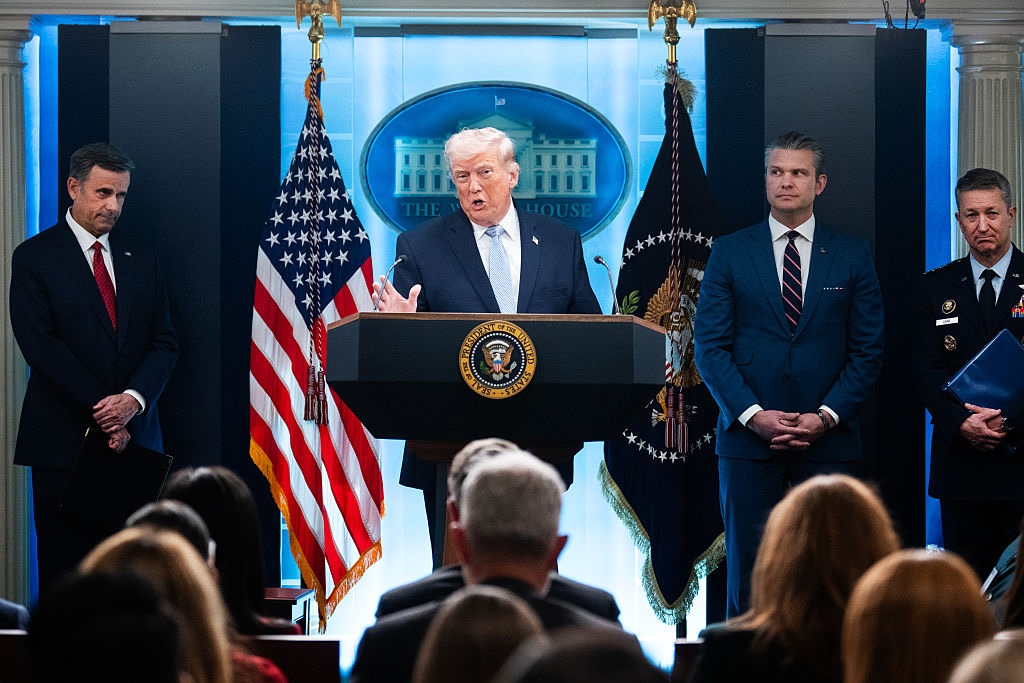
Iranian analysts believe Donald Trump will follow through on his threat unless Iran issues a statement that can be sold in the US as a “win” for the president. (Tom Williams / CQ Roll Call via Getty Images)
Even by his own standards, Donald Trump’s Easter Sunday ultimatum, posted on Truth Social, was shocking for its recklessness and the panic it betrayed — to say nothing of its Islamophobic clash-of-civilizations assumptions. Tuesday will be Power Plant Day, and Bridge Day, all wrapped up in one, in Iran,” the president wrote. “There will be nothing like it!!! Open the Fuckin’ Strait, you crazy bastards, or you’ll be living in Hell – JUST WATCH! Praise be to Allah. President DONALD J. TRUMP.”
In a follow-up message posted the same day, Trump clarified that Iran must either “MAKE A DEAL or OPEN UP THE HORMUZ STRAIT. Time is running out – 48 hours before all Hell will reign down on them. Glory be to GOD!”
The Strait of Hormuz, the choke point through which a fifth of global oil and gas supplies passes, has effectively been closed by Iran for over five weeks. Oil prices have almost doubled, and the closure has precipitated a shortage in the supply of fertilizer and helium — byproducts of gas production — in global markets, portending a crisis for global harvests and microchip production. There is a broad consensus among analysts that Iran can keep the strait closed indefinitely simply by spooking shipping insurers.
A US ground war, touted by hawks as a solution to the crisis, will simply deepen the US quagmire. The calculation behind Trump’s ultimatum, to the extent that he has made one, appears to be that Tehran will surrender its leverage out of fear of escalation. This seems dubious: so far, Tehran has quickly met the United States and Israel on the escalation ladder by mimicking attacks, principally against the Persian Gulf monarchies but also against Israel.
Such a brazen strike against civilian infrastructure in Iran — an unmistakable war crime — would likely provoke a retaliatory response against similar infrastructure in the Gulf littoral states. Once considered a deterrent against attack, American bases in the gulf have been identified by Tehran as a casus belli for war against the monarchies across the water. The monarchs of Saudi Arabia, the United Arab Emirates, Bahrain, Qatar, and Kuwait have hosted US bases for decades; while their perspectives differ, all are deeply ambivalent about their territories being used to prosecute this war. While they want Iran weakened, they are acutely aware that they pay the price when the US escalates. Despite being armed with advanced weaponry, none have so much as fired a drone into Iranian airspace.
Trump is well aware that his putative Arab allies are in a bind. He recently told an audience filled with lieutenants of the Saudi crown prince that Mohammed bin Salman was “kissing his *ss,” a vivid demonstration of the extent to which, in Trump’s eyes, the Kingdom relies on him. Riyadh offered no public statement in reply. The vulgarity of these comments implies that Trump may ignore lobbying efforts by Gulf leaders to avoid escalation. He appears to have no compunction about fighting Iran to the last Arab.
The consensus among Iran analysts is that Trump will follow through on his threat unless Iran issues a statement that can be sold in the United States as a “win” for the president. However, judging by their actions so far, Iran is unlikely to blink; a foreign office spokesperson of the Islamic republic noted that “negotiations are entirely incompatible with ultimatums, crimes, and threats of war crimes,” explicitly stating that Tehran would not accept a deadline imposed by Washington.
Instead, Iran aims to transform the Strait of Hormuz from a free-access international waterway into a maritime corridor from which war reparations can be extracted by both Iran and Oman (whose territorial waters comprise the strait). This model would have much in common with the economic settlement that is the Suez Canal, a narrow man-made waterway that connects the Red Sea to the Mediterranean through Egypt.
Cairo extracts billions of dollars in tolls from shipping that seeks to avoid going around the African continent. This system was also the unforeseen consequence of a failed war waged by Israel, the UK, and France in 1956 against the Egyptian nationalist Gamal Abdel Nasser, who planned to nationalize the canal.
Iranian commentators have floated a levy of $1-2 million for every ship that passes through, with waivers for friendly allies. This would effectively be a tax on the Persian Gulf Arabs, whom Tehran views as cobelligerents, as well as on the United States and European economies.
Ironically, this “Suezification” of the strait is not necessarily incompatible with Trump’s ultimatum. The announcement of such a system would be tantamount to “OPENING” the strait, and the United States would not, directly at least, pay a penny of what Iran labels as reparations. Trump could simply ignore the tolls and claim he forced the “crazy bastards” to open the water.
As the war currently stands, this seems to be the most likely endgame for the conflict, even if Trump attacks a number of Iran’s 150 power stations and Iran counterstrikes in the Persian Gulf. If we take for a moment this scenario as a foregone conclusion, the war in Iran will transform several assumptions within both the integrated systems of geopolitics and global capitalism.
First, American bases in nations such as within Europe, Japan, and South Korea may no longer be seen as a deterrent against third nations but as a strategic hazard. Both China and its neighboring US-aligned states will look at the failure of US military deterrence in the Persian Gulf as a portent for any future conflict between China and the United States.
Second, capitalism’s relationship with Israel might be rethought. Israel fought a regime-change war against Iran that was supposed to open up Iranian markets to Western capital, but it instead might strengthen Iran to tax the energy source of, at least in the West, commerce itself.