The Innovation Cult
"Innovation" is one of capitalism’s most popular buzzwords. Its function is to sustain the myth that business genius creates society’s wealth.
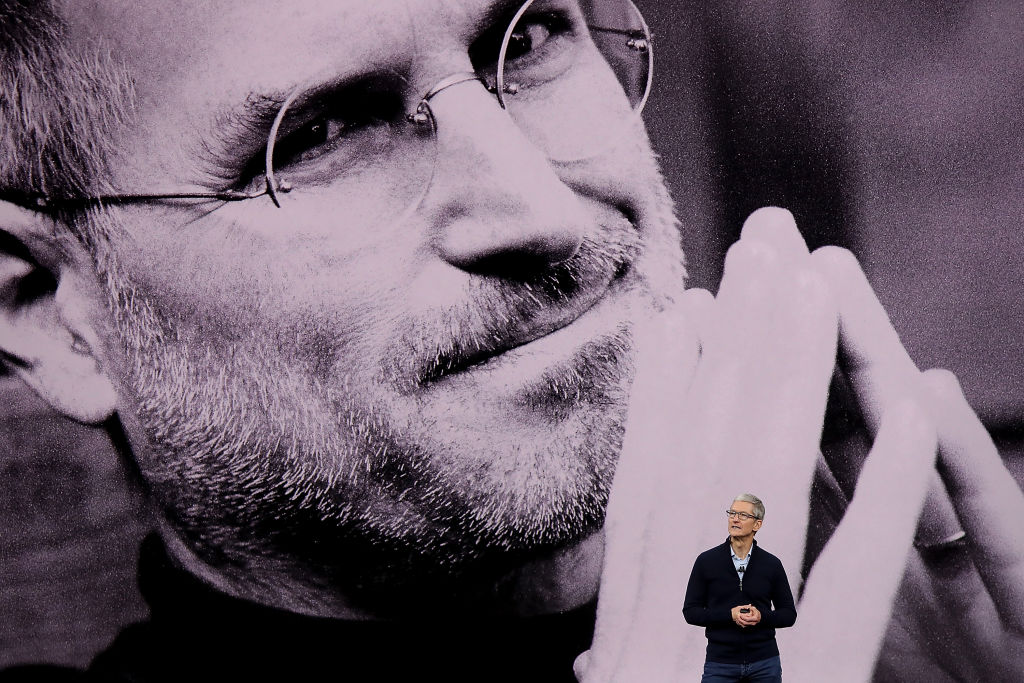
Apple CEO Tim Cook speaks during an Apple special event at the Steve Jobs Theatre on the Apple Park campus on September 12, 2017 in Cupertino, CA. Justin Sullivan / Getty
For most of its early life, the word “innovation” was a pejorative, used to denounce false prophets and political dissidents. Thomas Hobbes used innovator in the seventeenth century as a synonym for a vain conspirator; Edmund Burke decried the innovators of revolutionary Paris as wreckers and miscreants; in 1837, a Catholic priest in Vermont devoted 320 pages to denouncing “the Innovator,” an archetypal heretic he summarized as an “infidel and a sceptick at heart.” The innovator’s skepticism was a destructive conspiracy against the established order, whether in heaven or on Earth. And if the innovator styled himself a seer, he was a false prophet.
By the turn of the last century, though, the practice of innovation had begun to shed these associations with plotting and heresy. A milestone may have been achieved around 1914, when Vernon Castle, America’s foremost dance instructor, invented a “decent,” simplified American version of the Argentine tango and named it “the Innovation.”
“We are now in a state of transmission to more beautiful dancing,” said Mamie Fish, the famed New York socialite credited with naming the dance. She told the Omaha Bee in 1914 that “this latest is a remarkably pretty dance, lacking in all the eccentricities and abandon of the ‘tango,’ and it is not at all difficult to do.” No longer a deviant sin, innovation — and “The Innovation” — had become positively decent.