Donald Trump’s Greenland Obsession Is Growing More Dangerous
When Donald Trump first started talking about turning Greenland into US property, he pretended to care about what its people would like to see happen. Trump and his associates are now dropping the pretense and threatening to use brute force.
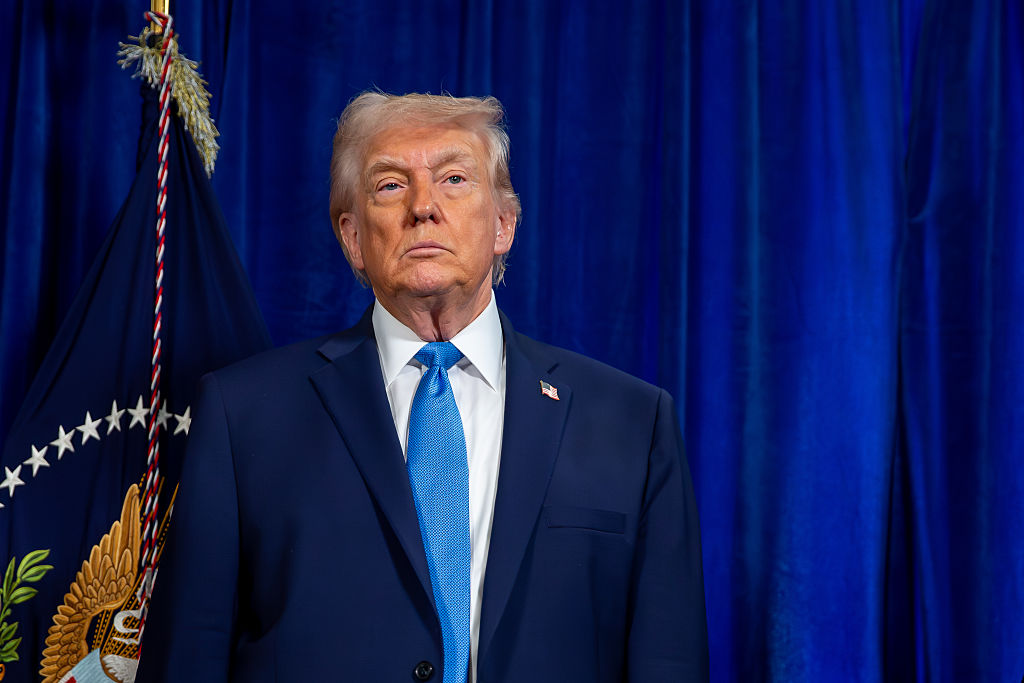
A poll last January showed 85 percent of Greenlanders are against becoming part of the US. Efforts to influence the Greenlandic people since then haven’t shifted the dial enough for Donald Trump’s liking, so he’s ramping up the coercive pressure. (Nicole Combeau / Bloomberg via Getty Images
It’s that time of year again. On December 22, 2025, exactly twelve months after appointing venture capitalist Ken Howery as US ambassador to Denmark with the message that US “ownership and control of Greenland is an absolute necessity,” Donald Trump named Jeff Landry as his special envoy to Greenland and brought the Arctic island back to the front pages.
Since then, in a repeat of last January’s pattern, a one-sided war of words has escalated, with various figures close to Trump attempting to present a takeover of Greenland as an inevitability, and the Kingdom of Denmark, of which Greenland is one part, as a liability.
Landry, the governor of Louisiana, is a stalwart of the current Republican Party. As his state’s attorney general, he fought against efforts to limit air pollution in “Cancer Alley,” an eighty-five-mile stretch of chemical industry in a majority Black area of southeast Louisiana.
Since becoming governor, he has attempted to force every public school classroom in his state to display the Ten Commandments, classified two abortion pills as “controlled and dangerous substances,” and appointed fossil fuel executives to key state environmental jobs.
After calling for Nicolás Maduro’s execution, he offered an ICE facility that he had renamed Camp 57 in honor of himself, the fifty-seventh governor of Louisiana, as a potential future home for the kidnapped Venezuelan president.
Landry’s illustrious history of personal loyalty to Donald Trump seems to have overridden his complete lack of foreign policy experience. Then again, the role of special envoy to Greenland doesn’t come with many responsibilities, as the positions of the US, Greenlandic, and Danish governments are so far apart as to be almost unbridgeable.
Two Motivations, Neither of Them Coherent
The United States, as far as we can ascertain from various interviews with Trump and his advisers, wants complete control over Greenland for the sake of “national security.” This desire has provoked worries over an invasion, or what the BBC (among others) uncritically referred to as a plan to “acquire Greenland” using the US military.
The United States effectively has this military control already, with the Pituffik Space Base in Greenland’s north and a long history of engagement. However, the Trump administration now expects greater recompense for its foreign commitments. That, and the logic of “getting” Greenland, seems to come at the expense of existing alliances.
Mette Frederiksen, the Danish prime minister, warned on January 5 that “if the US chooses to attack another NATO country militarily, everything stops, including NATO and thus the security that has been provided since the end of World War II.” A month prior, the Danish intelligence services had labeled the United States a threat to the country over its use of economic power “including against allies and partners.”
Arguments of security threats around Greenland from Russia and China are illogical. Russia has no great presence in the vicinity of Greenland, and China’s motivations in the Arctic center around the reduction in shipping time and costs offered by the Northern Sea Route along the Russian coast. In any case, China has backed off far more in Greenland in recent years than it has in, for example, Alaska.
Jeppe Strandsbjerg, associate professor at the Royal Danish Defence College and University of Greenland, argues that the status quo is no obstacle to achieving US objectives in security. “The defence of North America has never been a Danish task or a Greenlandic task. It was something that the US did in Greenland, and that was part of the defence agreement,” he says.
If national security is no justification, what could be? Control of rare earth minerals has been cited as a driving force behind Trump’s foreign policy in genera, and his advances on Greenland in particular.
Strandsbjerg says the current discussion demonstrates either a lack of knowledge or a lack of respect for Greenlandic autonomy, as “the conditions for mining have been decided by the Greenlandic parliament.” As such, US companies are already free to apply to the pro-business Greenlandic government for licenses to mine.
Standing in their way is the fact that mineral deposits in Greenland would be extremely expensive to develop, since the country lacks the infrastructure to develop mining and is still struggling to construct its first ever road between two settlements. Ownership, other than likely eradicating environmental restrictions, wouldn’t change that fundamental fact.
On security and minerals, Strandsbjerg says, “if those were the issues, these things can be dealt with. The only thing that is left, logically, is a desire to take over.”
Domestic Concerns
All this commentary ignores events in Greenland itself. Assuming — and this is no longer as safe an assumption as it once was — that the United States doesn’t invade Greenland, Greenlanders will have at least some say in their nation’s future. Having granted Greenland self-rule in 2009, and being keen to maintain its Arctic presence in the face of US pressure, Denmark is highly unlikely to sell the territory.
Therefore, Greenlanders would have to vote for independence and accept some form of arrangement with the United States to come anywhere close to Trump’s vision. Under the current government, led by the center-right Demokraatit, that seems highly unlikely any time soon.
Demokraatit were elected on a platform of economic liberalization and a cautious approach to independence. Their manifesto advocated for a referendum at some point in the future, without offering a time frame and with economic self-sufficiency in place first.
The limited progress to date on diversifying the Greenlandic economy away from seafood exports has illustrated the difficulty of developing a rare-earth mining industry largely from scratch. Under those conditions, such self-sufficiency won’t be reached any time soon.
Some Greenlanders might be receptive to a US offer to replace the current Danish block grant, which makes up around half of the Greenlandic national budget. However, Trump’s rhetoric of “ownership” is highly counterproductive to any such aim. A poll last January showed 85 percent of Greenlanders are against becoming part of the United States, and that seems to be the only “deal” Trump is offering. Efforts to influence the Greenlandic people in the intervening months clearly haven’t shifted the dial enough for Trump’s liking.
If the Greenlandic government and the Greenlandic people aren’t interested now, they are unlikely to change their minds before the end of Trump’s second term as US president. For a notoriously impatient man, with an apparent desire to create a legacy for himself with a territorial purchase like that of Alaska during the presidency of Andrew Johnson, this may not be good enough.
Ignoring Greenlandic Will
The foreign ministers of both Denmark and Greenland will meet US Secretary of State Marco Rubio next week, but such meetings are no guarantee of stability.
Strandsbjerg of the University of Greenland says that before Landry’s appointment, Ambassador Howery had failed to mention the imminent creation of a “special envoy” to Greenlandic officials during a visit to the capital Nuuk. Denmark and Greenland have made efforts to reason with the US administration, he says, but “every time you try to normalize lines of communication, something else happens that disrupts it.”
The same poll that revealed the extent of Greenlandic opposition to US ownership also showed a roughly equal split between those viewing Trump’s interest as a “threat” (45 percent) and those who viewed it as an “opportunity” (43 percent). But those hoping to leverage US interest to obtain a more equal relationship with Denmark, or an independent country free from colonial influence, have been disappointed.
The current pressure campaign on Denmark appears designed to use brute force to compel some sort of “deal” over the heads of Greenland’s government and people. Last year, when discussing Greenland, Trump said that the Greenlandic people “want to be with us.” Now, he just says “we need it.”
The idea of Greenlanders welcoming American saviors with open arms was always a fabrication, but there was a sense that it mattered to pretend otherwise, and efforts were clearly being made to bring reality in line with Trump’s declarations. In this new world order of naked displays of power, the United States doesn’t even see the need to tell such lies anymore.