Social Democracy’s Last Dance
Whether in or outside a grand coalition, Germany’s Social Democratic Party lacks the political imagination and organization to revive itself.
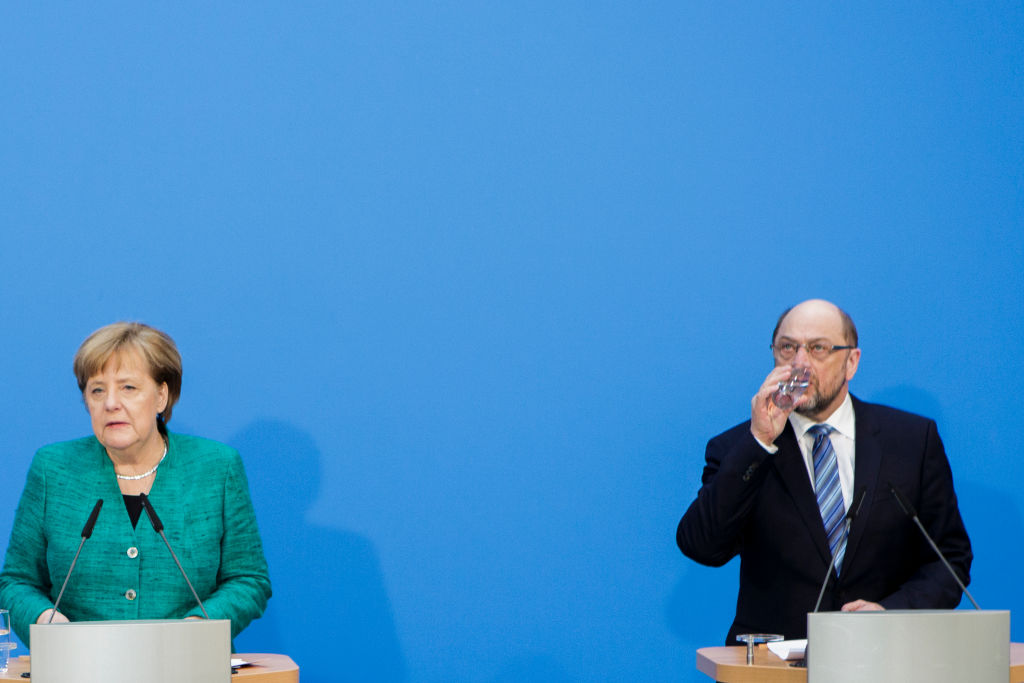
Angela Merkel and Martin Schulz in Berlin on February 7. Carsten Koall / Getty Images
German chancellor Angela Merkel’s conflict-avoidance strategy has again proved successful. After failed — and lengthy — negotiations between the Greens, Liberals, and Christian Democrats, she seems to have put together another coalition agreement, once again securing her chancellorship by leaving key ministries, such as finance and the foreign ministry, to the Social Democrats.
Yet both the coalition and the chancellor herself are already in trouble. Not only has the once-overwhelming grand coalition shrunk to two parties, but it is now torn between the Right’s growing strength, the government’s commitment to neoliberal, pro-market policies, and popular demands for social security and stability. And that’s if the Social Democratic Party ends up going along with the deal. SPD members began voting on the coalition agreement this week, and it’s unclear what the result will be.
Though many regard the 2015 “refugee crisis” as a turning point in German politics, in reality it only exposed long-standing and unresolved structural problems. Political discourse has since shifted largely to the right, as feelings of frustration and helplessness are directed against “foreigners” rather than a progressive alternative. The grand coalition will only reinforce this trend, as all the agreed spending cuts impact refugees, and the few planned improvements are marginal compared to actual need, such as in the health-care sector and housing.