Egypt’s Decade of Revolution and Counterrevolution
The fall of the Egyptian dictator, Hosni Mubarak, ten years ago today, was a triumph for popular mobilization. But the revolutionary forces lacked the political organization and vision needed to head off a counterrevolutionary backlash that restored the authoritarian state’s power.
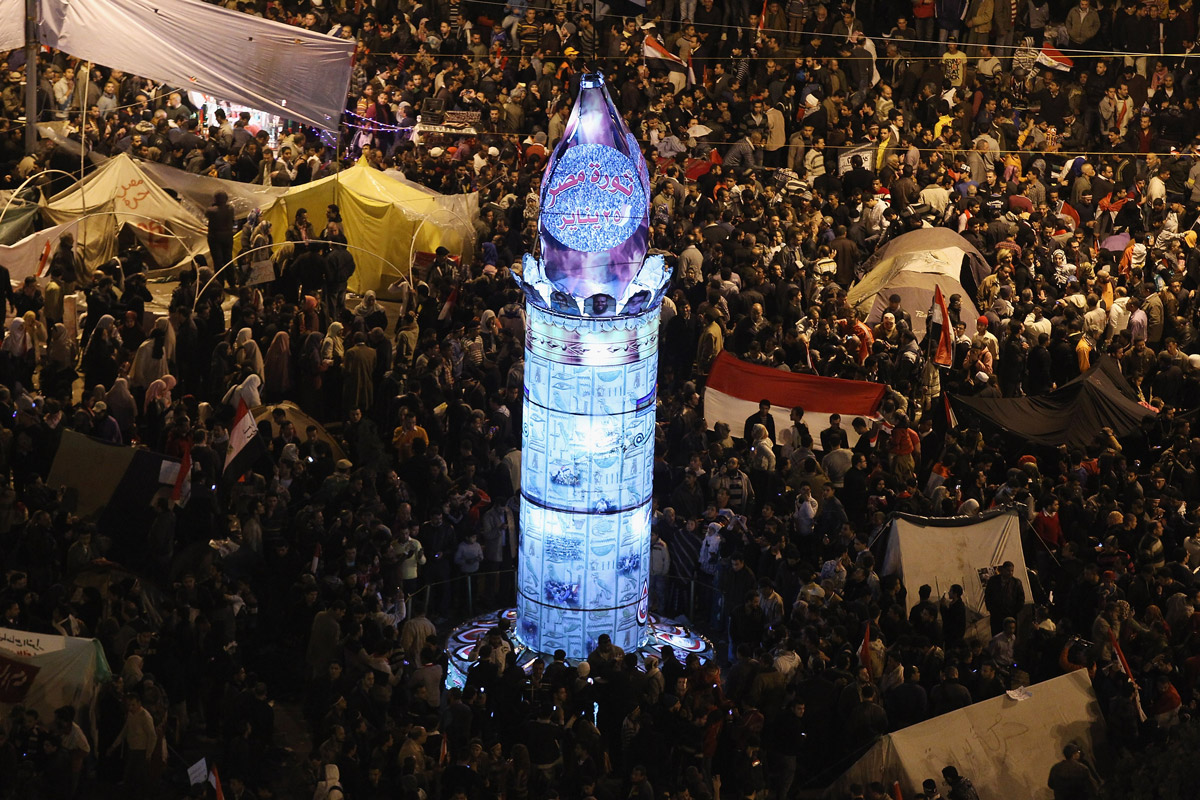
Temporary monuments are erected in Tahrir Square as thousands of Egyptians gather to mark the one-year anniversary of the revolution on January 25, 2012 in Cairo, Egypt. (Jeff J. Mitchell / Getty Images)
On October 17, 2010, I was sitting with a man I will call S.O., a prominent Egyptian labor organizer, on the banks of the Suez Canal. A massive oil tanker slowly made its way through the water while we sipped from our teas.
We were talking about labor struggles past and present in the Canal zone for higher wages, better working conditions, and the right to establish independent trade union committees. Already before the 2011 uprising, a vibrant and combative labor movement had started reintroducing ideas and practices of resistance to the wider Egyptian population, especially in marginalized spaces that lay outside the field of middle-class political activism in Cairo and its environs.
The 2006–8 strikes in the Misr Spinning and Weaving Company of Mahalla el-Kubra, a provincial town in the Nile Delta, engulfed the whole Egyptian labor movement, also inspiring workers in the Canal zone to strike, from the cement sector to steel and food processing. Progressive human rights activists, journalists, and lawyers offered their support and solidarity to these often-isolated struggles that received little or no media coverage.