In Britain, Palestine Action Prisoners Starve for Freedom
Jailed Palestine Action activists in Britain have been on hunger strike for eight weeks already. They are being treated as terrorists, even though they have committed no violent crime.
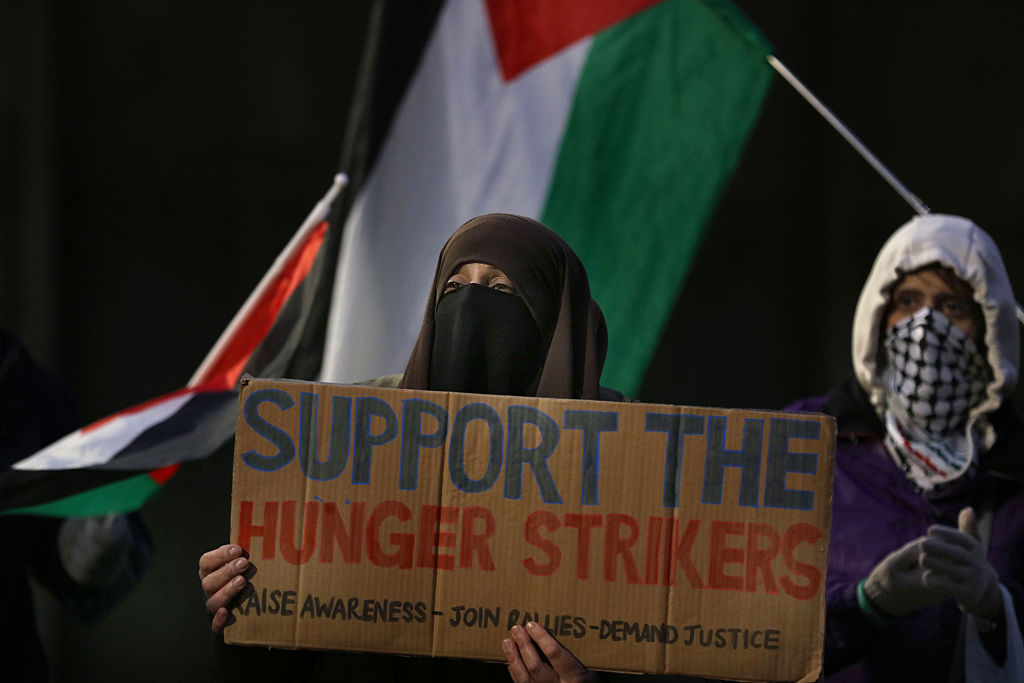
Britain’s government is refusing negotiations with Palestine Action prisoners, eight weeks into their hunger strike. The action has highlighted the cruelty of Keir Starmer’s administration, which has used anti-terrorism powers to suppress protest. (Martin Pope / Getty Images)
It’s New Year’s Eve in central London, and a group of several hundred demonstrators has gathered outside Pentonville Prison to see out the year with drums and raised voices. They are here to offer company and solidarity to an inmate who is, in medical terms, dying. Entering his fifty-fourth day of hunger strike, twenty-eight-year-old Kamran Ahmed now struggles to stand and to articulate coherent sentences. His hearing is fading: some days, he reports being deaf to the regular chanting from the street outside his cell.
Ahmed is one of four young Brits continuing a hunger strike started in November by eight imprisoned activists from the direct-action group Palestine Action. The organization was proscribed this past July by Keir Starmer’s Labour government, under the Terrorism Act (the ban is currently under judicial review). All have been detained on remand for over a year without trial — even though in Britain, pretrial remand is typically capped at six months — and some of their hearings are scheduled as late as 2027.
The individual strikers were arrested for participating in direct actions at a site of Israel’s largest private arms manufacturer, Elbit Systems, and a Royal Airforce Base in Oxfordshire, before the ban on Palestine Action. Although their charges amount to no more than criminal damage and trespass, all were arrested under the Terrorism Act. Through punitive detention conditions and a denial of legal rights, they are effectively being treated as terrorists — what Ahmed calls “punishment by process.”
“The core principle of justice in the UK is ‘innocent until proven guilty,’ but they are already paying the price,” says Ahmed’s sister, Shahmina Alam. She describes her brother being called a “terrorist” by prison staff, violently assaulted during efforts to pray, and now being handcuffed to three security guards while receiving treatment throughout his five hospital admissions (the most recent on New Year’s Day). “They are being dehumanized.”
The strikers have issued five key demands: immediate bail, the right to a fair trial (including rightful access to laptops, lawyers, and redacted documents suggesting Israeli and British political interference in their trials), an end to censorship of their communications, the de-proscription of Palestine Action, and the closure of Elbit Systems’ UK factories. A sixth demand was added in December for the relocation of fellow striker, Heba Muraisi, who was transferred to a prison some four hours from her home, making it impossible for her unwell mother to visit her.
Despite all four strikers being deemed at imminent risk of death, Justice Secretary David Lammy has repeatedly refused requests for a meeting by their lawyers on the grounds that doing so would create “perverse incentives.” Minister of state for prisons, James Timpson, has meanwhile sought to downplay the strike, claiming that the UK has a “robust system” for dealing with the alleged two hundred hunger strikes its facilities see each year. Meeting with prisoners or their representatives, he said, would risk “differential treatment” — a starkly hypocritical claim, given the manifestly differential treatment of Palestine Action detainees.
As the strike reached a critical phase in late December, the group’s lawyers sent a letter to the government claiming that its refusal to meet constituted a breach of its own policy for dealing with hunger strikes — and threatening legal action unless it replied within a week. No response was received.
But neither political denialism nor the national media’s willful neglect of the strike have succeeded in silencing the movement. The government’s response has in recent weeks drawn criticism from MPs, medical experts, leading human rights lawyers, and even the United Nations. A Boxing Day statement by UN experts including Francesca Albanese warned that the situation raised “serious questions about compliance with international human rights law and standards,” such as obligations to protect life and prevent cruel, inhuman, or degrading treatment. “Preventable deaths in custody are never acceptable. The State bears full responsibility for the lives and wellbeing of those it detains,” it concluded. “Urgent action is required now.”
The Cruelest Government
The hunger strike is the biggest in the UK’s prisons since the historic movement led by the Irish Republican Army’s Bobby Sands in 1981. Then, ten prisoners died on the watch of Margaret Thatcher’s government, one of them after forty-six days. Although some of the current strikers have been without food for more than sixty days, no sense of urgency appears to be weighing on the conscience of authorities. When one former participant in the strike, Qesser Zuhrah, suffered critical chest pains in mid-December, prison officials at the privately-run HMP Bronzefield denied her an ambulance for over eighteen hours. It was only following sustained protest at the facility, including by MP Zarah Sultana, that she was finally admitted to a hospital. Similarly, when Ahmed was hospitalized on the advice of prison medical staff, the facility declined to notify his family. His phone PIN was blocked, so they were unable to have contact with him until he was returned to the prison twenty-four hours later.
“We are literally just waiting every day for the phone to ring,” says his sister Alam. “And if we don’t receive that call, we feel a state of panic. When you’re not able to get updates on Kamran or hear his voice, you are thinking the worst. You think that you are being denied access to someone you love — you might even be denied your last words with them.”
With each day, the warning from the group’s lawyers that “young British citizens will die in prison, having never even been convicted of an offence” inches closer to a reality. Indeed, the strikers themselves appear to have few illusions about quite how willing the government is to put politics before human life. As one of the strike participants, Amu Gib, stated when announcing a pause to their strike in late December, “we have never trusted the government with our lives, and we will not start now . . . We will be the ones to decide how we give our lives to justice and liberation.”
In the face of such governmental intransigence, questions have been raised about the possible efficacy of the strike. As the renowned Trinidadian American civil rights activist Kwame Ture noted in 1966, regarding the resistance efforts at the time, “in order for non-violence to work, your opponent must have a conscience. The US has none.” At a bare minimum, the hunger strike has proven the same to be true of the UK’s present rulers. And this, say supporters of the detainees, already represents a success.
“The strike has made clear how far the government is willing to go, that they couldn’t care less if people die in prison on their watch,” says Saeed Farouky, a British Palestinian member of the collective Prisoners for Palestine, who himself took action with Palestine Action prior to its proscription. “It has made clear how little they care about their own laws and procedures in prison. It has made clear the cruelty of the state’s policies. It has made clear the hypocrisy of proscribing Palestine Action and of continuing to make deals with Elbit Systems while treating these prisoners as though they were already convicted.”
As Farouky notes, even Thatcher’s notoriously hard-line government ultimately conceded to secret negotiations with the IRA hunger strikers, whose actions were incomparably more extreme than Palestine Action. “What we are witnessing now is a so-called Labor government that is even more cruel than the cruelest government in my life,” he says. “That’s quite an achievement, but it also indicates a government in desperation, a government with no principles. They do whatever the opinion polls tell them to do, whatever will keep them in power.”
A Movement Revitalized
As the New Year’s Eve demonstrators defied a police blockade to march all the way from Pentonville to Piccadilly Circus, bringing the hub to a standstill, another effect of the strike was apparent: the Palestinian solidarity movement has been galvanized. Hunger striking may be a strategy of desperation from those denied any other means. But it has breathed new life into a movement whose strategies have in some ways been stymied by the crackdown on direct action, despite the thousands of demonstrators across the UK who have been willingly arrested in mass protests against the Palestine Action ban.
“The government’s response has made the campaign catapult and grow even bigger,” says Alam, noting the solidarity messages to the strikers sent by demonstrators from Manhattan to Ramallah. “People internationally are outraged that the government seems happy to let these guys deteriorate to a point of no return for standing against genocide. And if anything, this has brought us forward.”
So too, the flagrant corrosion of democracy that has emerged in the UK government’s treatment of Palestine Action detainees and their supporters has highlighted the links between injustice in the Palestinian and British contexts.
“The attack on all of these activists and protesters is a direct attack on all of our liberties and rights in the UK,” says Alam. “People are really starting to understand that the liberation of Palestine is also our own liberation in this country.”
Whatever the course of the hunger strike over the coming days, it’s clear that its legacy will be far bigger than the handful of individuals putting their lives on the line.
“Since I’ve been on hunger strike, the nurses and officers tell me that I’m shrinking, and it’s funny because they don’t actually see what’s growing on the outside,” Ahmed told demonstrators outside the prison via a recorded message in December. “A nurse came to ask me why I’m hunger striking and when I went to her office and you open the window and all you can hear is drums and the voices, I’m like, that is what we are doing it for — we are hunger striking so we can grow this movement, we are hunger striking to show this government that we won’t sit idle while Israel is still ethnically cleansing Gaza.”