Political Corruption Is Being Normalized
A little-known Supreme Court case that just vacated the corruption conviction of a local official raises a crucial question: Will the kind of influence peddling now ubiquitous in politics become unprosecutable simply because it has become so commonplace?
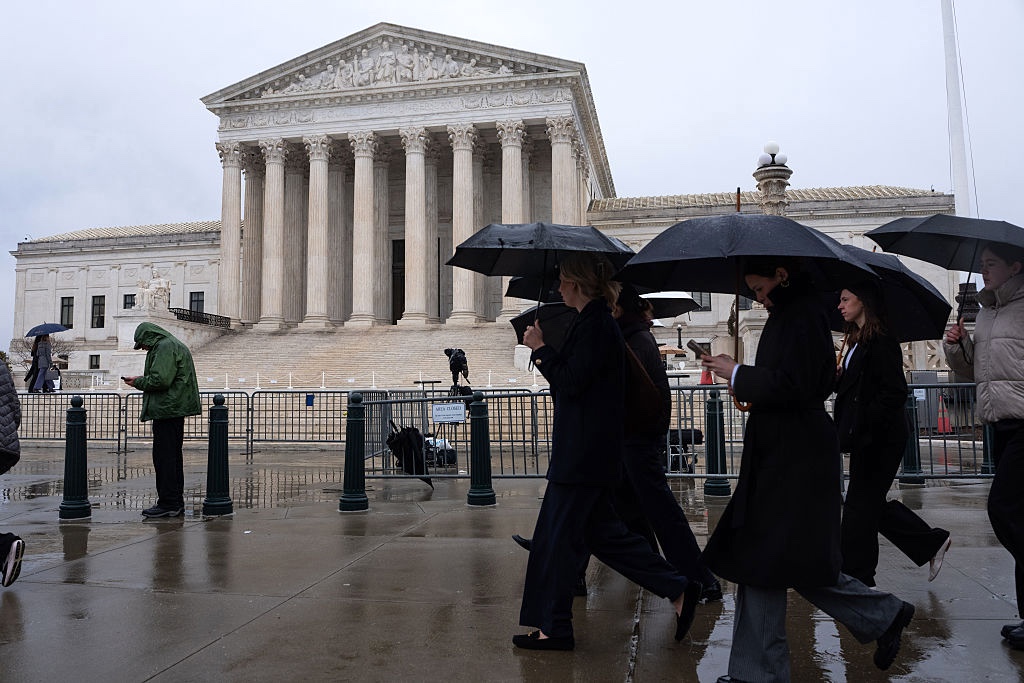
The recent ruling in the Roberts Court is part of a long string of Supreme Court interventions in corruption cases. (Aaron Schwartz / Getty Images)
In an easy-to-miss two-line order in its shadow docket, the US Supreme Court just vacated the corruption conviction of a local official, raising a question: Will the kind of influence peddling that’s now ubiquitous in politics eventually end up being explicitly deemed unprosecutable simply because it’s so ubiquitous?
Cincinnati Democratic councilperson P. G. Sittenfeld had been convicted of allegedly accepting tens of thousands of dollars’ worth of campaign contributions in exchange for his support for a local development project. Law enforcement had Sittenfeld on tape promising an undercover FBI agent, “I can deliver the votes,” and Sittenfeld was charged by a Trump-appointed career prosecutor, David DeVillers, who was also prosecuting top Republicans in Ohio and cast such cases as important deterrents against corruption:
I hope that these investigations and prosecutions coming to light really kind of help the next generation of politicians and public servants. And that, you know, the idea that you can accept money with a “wink, wink, nudge, nudge” promise to do something that in your capacity as a politician or as a public servant for money — whether it’s going into pockets or whether it’s going into your campaign fund — if you’re making that promise in return for it, that’s a federal crime, always has been. I think that that culture of people coming into service thinking, “Oh, this is the way it’s supposed to be,” hopefully now realize that it’s not.
But after Sittenfeld was convicted, President Donald Trump ignored DeVillers’s deterrent argument and pardoned Sittenfeld in a deal that reportedly circumvented the normal pardon process and that was opposed by the Biden-appointed US attorney who oversaw much of the case.
The pardon, though, wasn’t enough for Sittenfeld. He still wanted his conviction formally expunged. And so last year, he appealed his conviction to the Roberts Court, which has been overturning bribery convictions in a string of jurisprudence that the Lever detailed in Master Plan and that has effectively legalized corruption in America.
The Supreme Court has now vacated the conviction and is telling lower courts to consider the Trump administration’s request to dismiss the entire case.
So what does it all mean? On one hand, you can view this as one weird, isolated, and ambiguous ruling — a politician caught in a tough situation trying to raise campaign money and inadvertently stepping over the line, and a court order merely agreeing with the administration’s request to let lower courts provide the “full relief” that Trump’s pardon supposedly promised.
In other words: you can conclude that this is just an anomalous spat with no far-reaching implications, especially since the Trump administration is opposing a similar outcome in the other major Ohio corruption case at the court right now.
Then again, you can instead view the court’s ruling as part of a long string of Supreme Court interventions in corruption cases and thus conclude the appeal is far more than an isolated local conflict.
There are certainly signs the conservative movement sees it that way: Trump opted to intervene in a local case to pardon a Democrat, conservative groups filed a flood of amicus briefs, a Trump-connected law firm reportedly provided pro bono legal support for Sittenfeld’s appeal, and the Roberts Court opted to intervene when it could have just done nothing.
There are also signs others see something bigger at play too: a lawyer representing a defendant in a similar public corruption case said the Sittenfeld decision “shows to me at least that the government does not want these cases to go to the Supreme Court.”
I’d like to believe what happened this week is the former: a small shadow docket blip and nothing more. But it’s hard to ignore all the context, all the history, and all the signs that the master planners see this case as having big stakes that could reverberate far beyond Cincinnati.
“Jurors Hostile to Money in Politics”
For those of us who believe money in politics is a big problem, what’s notable is that the high court has sided with the particular legal argument made by Sittenfeld’s lawyer, a former Trump official now at one of America’s most Trumpy law firms.
In Sittenfeld’s petition, his legal team cast politicians soliciting money from big donors doing government business as the same as politicians asking for support from grassroots donors who support their broader agenda. From there flowed their argument that juries fed up with corruption cannot be allowed to convict politicians who accept large sums of money in exchange for government favors:
Every day, American citizens participate in our democracy by contributing to political candidates precisely because of the policies the candidates have supported, the actions they have taken in office, or the actions they pledge to pursue if elected. Candidates thus routinely raise money based on pledges of official action: “Donate to me and I will vote to repeal the law my opponent supported!” “Send me a campaign check and I will cut your taxes — I can’t do it without you!”
Such campaign solicitations are the lifeblood of our representative democracy, and they lie at the heart of the First Amendment’s protection. But ambitious prosecutors can easily paint the same donations as corrupt agreements — a picture that many jurors hostile to money in politics will eagerly accept.
Sittenfeld’s Supreme Court petition also cited Trump reportedly asking oil executives for $1 billion in campaign cash in exchange for government favors as the kind of thing that could be prosecutable if Sittenfeld’s conviction is allowed to stand.
“An aggressive prosecutor could doubtless present this meeting alone as at least ambiguous evidence of a quid pro quo,” they wrote, adding that if Sittenfeld isn’t exonerated, “Politicians are open to prosecution if they say anything during these often informal, unscripted conversations that can be read to even hint at a possible quid pro quo.”
It’s hardly a stretch to intuit that the Supreme Court seems to have now validated the petition’s tautology: the corrupting influence of money in politics is no longer necessarily prosecutable in part because the corrupting influence of money is now so pervasive. By this logic, the problem that needs fixing is not the corruption and influence but the pesky jurors who are too angry about the corrosive effects of money in politics.
Celebrating the decision, Sittenfeld’s lawyer, former Trump Solicitor General Noel Francisco, wrote: “Elected officials accept campaign contributions from supporters every day, and prosecuting them for engaging in this type of routine political activity based on an ‘implicit bribery’ theory is a dangerous step toward the criminalization of politics.”
In other words, the argument is: Donor influence is so routine that it is now what politics just is — and so implicit exchanges of money for government policy cannot be criminalized.
Sure, the high court may still uphold the occasional corruption conviction in the most cartoonishly flagrant episodes. But when it comes to the more mundane and common forms of corruption, justices have now validated a legal argument for future defendants, who can now stride into court and confidently say, “Hey, I was just doing what everyone else in politics does, so it’s all good.”
The Shadow Docket Offers No Clarity
Of course, Sittenfeld challenged the entire notion that his accepting money was an explicit “quid pro quo” — but when a federal appeals court reviewed that claim, judges rejected it.
Now the Supreme Court rejected the rejection in a two-line order that is notable for what it doesn’t say: It doesn’t bother to carefully arbitrate that core dispute over quid pro quo, it doesn’t specify that the court is only ruling on the idiosyncrasies of one particular dispute, and it doesn’t make clear whether it is validating Sittenfeld’s larger ideological argument, the government’s narrow process argument, or both.
It’s certainly good that the justices didn’t use the case to explicitly invalidate what remains of anti-bribery precedents or formally create new precedents, which conservative amicus filers may have been hoping for. But the ruling doesn’t offer legislators or prosecutors any guidance or insight about how they might approach and apply existing anti-corruption laws and how they should understand what is — and what is not — illegal pay-to-play corruption.
This is the problem with the shadow docket. Rulings that don’t offer a rationale leave everyone guessing. By throwing out this case via the shadow docket without any explanation, the justices are leaving it to our imagination exactly what they are trying to say about corruption prosecutions.
And so, without a precise explanation, the order could easily be interpreted downstream in the legal system as a high-and-tight brushback pitch at prosecutors considering bringing public corruption cases now and in the future.
You might argue that such a message is necessary these days because, in the Trump era of political retribution, you can imagine partisan prosecutors selectively weaponizing anti-bribery laws against their political opponents in an attempt to criminalize political opposition.
But as Trump guts the Justice Department’s anti-corruption unit and as public corruption prosecutions have declined over decades, ask yourself: Is the problem in America overly aggressive prosecution of corruption? Or is the problem that corruption is so widespread that it has now been normalized?
If you think it is the latter, then you probably believe the Supreme Court’s decision could end up making that problem worse.
“The Lifeblood of Our Representative Democracy”
But then, Sittenfeld’s lawyers — and perhaps the Supreme Court — don’t seem to see money’s influence on politics as a problem. They seem to see transactions between donors and politicians as an integral part of democracy. Indeed, Sittenfeld’s petition insisted that “campaign solicitations are the lifeblood of our representative democracy.”
Read that over and over again and you realize how problematic that argument is. The process of politicians begging for cash from donors undermines representative democracy by encouraging them to disproportionately represent the interests of a handful of donors rather than their whole constituencies. And yet we’re told that the process is the “lifeblood of our representative democracy.” It’s Orwellian.
But it’s also a reminder that it is long past time to construct a system that does not force politicians who can’t self-finance their election campaigns to rely on cash from donors seeking favors. If Sittenfeld is really a victim here, as his legal team claims, then he’s a victim of an entire system that forces politicians to raise the election campaign money they need from private donors seeking favors. That’s why he was in that fateful donor negotiation in the first place.
If — as critics of Sittenfeld’s prosecution suggest — the existing campaign finance laws and court rulings now make it impossible for a good-faith politician to discern what is and what is not an impermissible campaign contribution, then that’s not a sign that all the money has to be legalized and all donations should be deemed unprosecutable. It’s a sign that the whole rotted system needs to be overhauled.
The best overhaul would be publicly financed campaigns — which may seem like a pie-in-the-sky idea, but it’s not. Versions of such public financing systems — which the Supreme Court’s Citizens United decision leaves intact — already exist in some states and cities. And in the not-so-distant past, popular anger at corruption almost forced government leaders to make that kind of system the national standard.
That anger at endemic corruption is once again simmering. So the answer to the Sittenfeld case and the legalization of corruption shouldn’t be despair — it should prompt a renewed focus on much bigger changes to the entire campaign finance system.