Anwar Shaikh Shows Us How Capitalism Works and How It Fails

Throughout his prolific career as a left-wing economist, Anwar Shaikh has kept asking the right questions about the dynamics of capitalism. Shaikh has given us a powerful framework for understanding the system and its fundamental flaws.
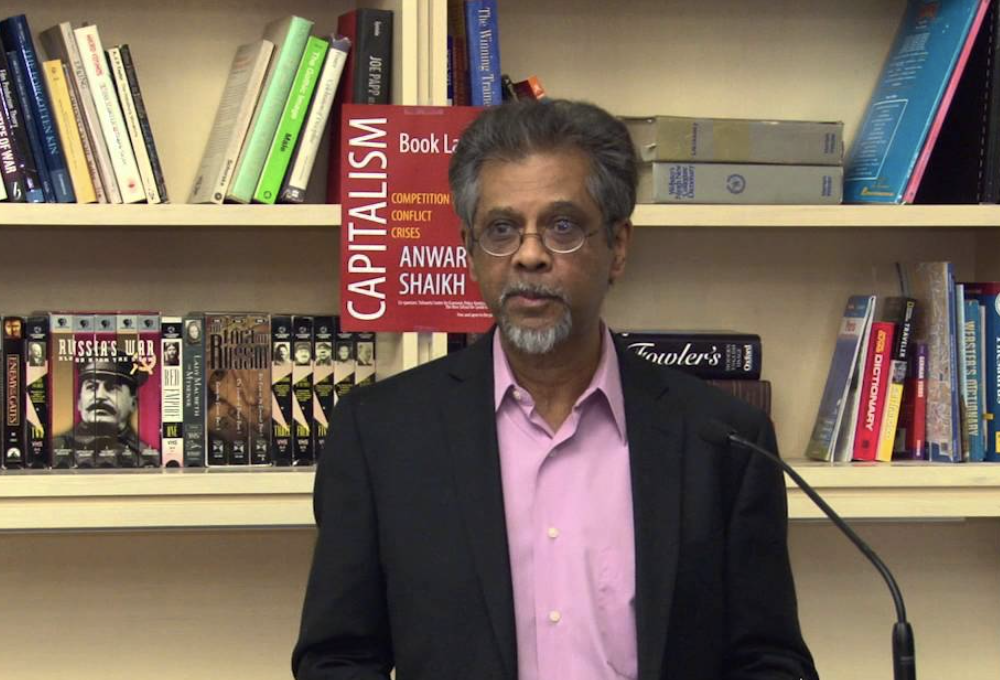
Economist Anwar Shaikh’s approach is distinctive due to its combination of theory and empirical inquiry. (Henry George School of Social Science / Youtube)

“Heretics always remain tied to the church. To break out, what you do is nail your theses on the door, turn around and develop your own framework.” Most students of Anwar Shaikh, including the coauthors of this piece, will have heard this bold statement in his classes.

As one of the most important radical economists, Shaikh has not only advanced fierce criticisms of mainstream economic theory’s dogmas but also provided his own consistent framework with which to analyze capitalism, grounded in the works of classical political economists and especially Karl Marx.

Shaikh’s 2016 book, Capitalism: Competition, Conflict, Crises, combines his radical theorizing over the course of four decades into an integrated, coherent framework. At the heart of it is his unique reconstruction of real competition from the writings of Marx and the identification of the turbulent patterns that characterize capitalism — in other words, his understanding of why capitalism is rooted in conflict rather than harmony.

Four Phases

Another distinctive feature of Shaikh’s approach is the combination of theory and empirical inquiry. Throughout his work, the leading themes remain the centrality of profits for capitalist economies and real competition as their regulating principle.

Shaikh’s thinking has evolved alongside the political struggles of the last fifty years. With nearly a hundred academic papers and many more public articles to his name, it is a challenge to generalize about his ideas. But we can broadly categorize Shaikh’s contribution into four phases.

The first phase involved criticizing the economic mainstream and reconstructing Marxist concepts as alternatives in the 1970s and ’80s. The second was his development of a consistent approach to macro-dynamics and international trade in the 1980s and ’90s.

The third phase saw the construction of appropriate empirical grounds on which to test Shaikh’s hypotheses and to challenge the way mainstream economics constructs and employs data. The latest phase, in the period since the publication of Capitalism, has broadened the application of real competition and turbulent dynamics to the study of inequality, econo-physics, trade imbalances, and macroeconomics.

Humbug Economics

Shaikh entered the academic stage in 1974, only one year after finishing his PhD at Columbia University, when he attacked Robert Solow’s predominant model of capitalist development in a paper titled “The Humbug Production Function.” Solow’s perspective, according to which capital and labor would be rewarded at their marginal productivities, was the backbone of neoclassical economics at the time (and would remain the textbook model for decades to come).

This framework claims to explain why poor countries stay poor while rich countries get richer, thereby legitimizing (or ignoring) imperialist power structures. Shaikh’s cheekily named paper demonstrated that the purported success of the model in fitting empirical data stems from an underlying accounting identity and that it would fit a diagram spelling out “humbug” just as well.

Since 1972, Shaikh had been working at the New School for Social Research, a hotbed for radical and Marxist economics at the time. His publications in the 1970s recovered some classical analyses and constructed new syntheses, a basis on which real capitalism, rather than an idealized, harmonious version of it, could be understood.

Shaikh provided a solution to the transformation problem, one of the key issues associated with Marx’s analysis of production prices. In doing so, he rebutted the claim that Marx’s theory of competition, value, and price was inconsistent. He also elaborated on Marx’s theory of capitalist crisis.

In 1983, Shaikh provided the entries on concentration and centralization of capital, economic crises, the falling rate of profit, pauperization, and the reserve army of labor in A Dictionary of Marxist Thought. After a follow up to the “humbug” paper, he also engaged in debates on the theory of competition put forward by Maurice Dobb as well as with the followers of Piero Sraffa on neo-Ricardianism.

These contributions are central to an understanding of capitalism as a social system fueled by the exploitation of human labor, as they reconstruct Marx’s categories and classical analyses to provide an understanding of the dynamics that govern the world we live in. Shaikh’s approach treats capitalism as a historically specific social system, with a beginning and a potential end. A rigorous analysis of capitalism therefore is indispensable for overcoming it.

On the surface, the contributions in these early years attacked the foundations of mainstream economics and defended Marx’s framework on multiple fronts. They mainly spoke to academics and students, at a time when there were many more people actively engaged with Marxism as well as socialist organizing than there are today.

However, if we look at this first phase in the context of the following decades, we can say that it laid the groundwork for understanding the fundamental workings of capitalism and what propelled them. Without this understanding, the Left is defenseless against claims that capitalism is natural, eternal, or simply in need of better regulation.

Real Competition

If the humbug paper showed profit to be the fuel for capitalist growth, Shaikh’s 1978 and 1980 papers revealed real competition as the inner mechanism of its engine. The basic argument is that competition has nothing to do with passive-price taking, which lies at heart of neoclassical perfect competition.

In fact, firms within industries dynamically and strategically underbid each other on prices in order to eliminate rivals from the market. Meanwhile, the relationship between industries sees investment being diverted toward the ones where the highest above-average profit rates on new capital are expected. The intensifying competition in these sectors pushes market prices down, with profit rates falling back to the normal level or even below it.

Both dimensions of competition, within and between industries, are turbulent and dynamic. In Shaikh’s words, they resemble a brutal war rather than a decorous ballet. This is the opposite of the free-market fairytale expressed by perfect competition theory. “Real competition” became a cornerstone of Shaikh’s work.

It also marks the transition to a second phase in his work. Building on methodological discussions and his fundamental criticisms of predominant economic thinking, which targeted the neoclassical school without sparing Post-Keynesian or Marxist authors, he extended his analysis toward the field of macroeconomic dynamics.

The 1980s and ’90s witnessed accelerated globalization with well-known ramifications: significant asymmetries in growth and international trade, higher levels of inequality, and the growing prominence of finance, accompanied by turbulence and crises. Shaikh’s contributions at that time constructed a new understanding of macro-dynamics with a special emphasis on international trade, revealing its benefits for the imperialist core at the expense of the neocolonial periphery.

His seminal papers in this period discussed the role of finance and the stock markets, effective demand, exchange rates, and competition. He never lost his interest in theorizing economic crises and published work that linked profit-rate dynamics to the downturns of the global economy. Another recurrent theme is real competition, this time in the context of international trade, which drives exchange rate fluctuations and international value transfers.

This is a key factor to take account of when we are studying global capitalism and imperialist power structures, as the global division of labor is not actually shaped by the harmony that comparative advantage is supposed to bring about between countries. Instead, in the relentless competitive struggle between capitals, the strong extend their power, while countries with weaker capitals are trapped in perpetual debt. International inequalities are not inefficiencies inherited from precapitalist structures — they express the functioning of the capitalist machine in its best-oiled state.

Data and Empirical Categories

Shaikh also understood that mainstream economics doesn’t just theorize capitalism incorrectly — it also measures it incorrectly. Around the turn of the century, after laying out his understanding of global macro-dynamics, his publications shifted to empirical analysis and the appropriate data sources for it. In contrast to many orthodox as well as heterodox economists, Shaikh’s work has always been marked by the co-development of analysis in theory and data.

In his classes, he would describe this as a fundamentally Marxist method: to look at the data and construct basic economic categories from it; to set these in relation, explore their dynamics, and provide a theory explaining the relations at hand, then to check if the results fit the data and validate one’s explanation of it. Neither a nihilistic empiricist nor a bloodless theorist, Shaikh would often warn: “If the data does not agree with your theory, it is usually not the data that is wrong.”

Be that as it may, economic data is often constructed to exactly fit the neoclassical models that predominate in economic institutions and central banks. Profits are conceptualized as factor incomes on capital, rather than the difference between market prices and total cost; capital stock and labor hours are constructed to fit the same production function that Shaikh attacked as humbug in his first paper.

His landmark 1994 book with Ahmet Tonak, Measuring the Wealth of Nations, can still serve as a reference work helping us to understand how the construction of data is entwined with theory, and how to formulate the categories necessary for real economic analysis from national accounts. Numerous papers and books on the question of data, modeling, and applications followed.

This period coincides with the emergence of the anti-globalization movement and renewed crises of international capitalism at the turn of the century. There was an appetite for alternatives to Reaganite economic policies, especially when it came to the consequences of those policies around the globe. But finding concrete answers required an independent methodological apparatus, and Shaikh’s work on empirically testing competition between industries and economic policy in the area of growth enabled a lively literature of international comparisons.

Capitalism

In 2016, Oxford University Press published Capitalism: Competition, Conflict, Crises. Nearly a thousand pages long, Shaikh’s magnum opus offers a coherent framework with which to confront the mainstream economic paradigm as well as its satellites that only challenge and deviate from the orthodoxy on limited grounds.

Shaikh’s framework reveals that we can derive recurrent aggregate patterns from foundations that do not idealize capitalism as a perfectly harmonious society populated by hyperrational individuals. This isn’t just a case of academic hair-splitting: it poses a direct challenge to the myths that justify wage suppression, deregulation, and the gutting of public services. If capitalism’s crises are systemic, not accidental, then reformist tweaks (like higher interest rates or “competition policy”) are doomed to fail. 

In fact, growth and sudden crises, accumulation and exploitation, order and disorder coexist as two sides of the same coin, bound together by the antagonistic social relations that define capitalism. Real competition is the dynamic, conflictual process establishing and regulating the coherence of microeconomic structures and macro-dynamics, and recurrent crises are the expression of the underlying contradictions.

The book contains five chapters on competition (theory, debates, prices, finance, and international markets), and every one of its seventeen chapters engages in a (highly) critical survey of the existing schools of thought. What makes it remarkable is the balancing act in terms of theoretical consistency, with each chapter revealing new fundamental structures, while at the same time locating them within the broader foundational framework.

It could even be argued that shortly before the book’s publication date, Shaikh shifted gears once again, opening up a fourth phase. In the aftermath of the global financial crisis, the theory of real competition could be applied to a wider range of questions. Shaikh published many papers on economic inequality, labor markets and unemployment, trade imbalances and development, and the theory of exchange rates. His work on the turbulence of real competition generating stable aggregate patterns found expression in econo-physics models, while his investigation of capitalism’s structural features prompted new work on the underlying statistical properties of large matrices.

After Capitalism

This fourth phase is just as consistent (or just as variegated) as the ones that came before. After laying out the fundamentals for the whole economy in Capitalism, Shaikh has applied his work more broadly to pressing issues of the time, while at the same time engaging with the existing literature on these issues.

As before, his striving for a consistent analysis through an integrated framework moved in parallel with the political discussions of these years. Politically, struggles against austerity around the globe coincided with Shaikh’s essay on the 2008 crash for the Socialist Register, “The First Great Depression of the 21st Century.” Resistance to labor market deregulation was the backdrop to his work on the social structure of wages, and protests against the 1 percent illuminated his discussion of inequality as a class-based phenomenon.

While the scope, profundity, and consistence of his work were widely lauded, Shaikh received some friendly criticism for not explicitly addressing some other topics. For example, in a 2020 panel, Prabhat Patnaik complained about the lack of a real competition theory of imperialism. Students at the New School hoped for an analysis of the ecological crisis as well as the development of crypto and digital currencies, the AI bubble, or the increasing tensions in global trade.

It would certainly be unfair to expect a single person to address all these topics. At the same time, it comes as no surprise that many political economists have built on Shaikh’s writings to address seemingly distinct questions. Shaikh’s rigorous theoretical framework, coupled with extensive empirical research, has empowered scholars and activists alike to study their areas of interest without succumbing to eclecticism or the impulse to construct new stages of capitalism for each emerging phenomenon, such as growing financial markets or the digital economy.

Indeed, working on the basis of Shaikh’s analytical tools, cohorts of political economists have advanced major lines of research on topics such as wage inequality and labor market discrimination, industrial organization, growth and the digital economy, the welfare state, and privatizations, not to mention development and imperialism. Our own recent book, Marx’s Theory of Value at the Frontiers, was produced in that context, building on Shaikh’s concepts of real competition and production prices to investigate competition, imperialism, and ecological breakdown with a large and novel dataset.

A Unique Contribution

This evaluation of Shaikh’s work has drawn upon approximately eighty academic papers and book chapters while omitting many others. His biography has been explored in the course of many interviews, while his ideas have been discussed and criticized in special issues — a whole body of secondary literature that interesting in its own right.

Looking at the bigger picture, however, one can see that Shaikh’s project revolves around clear principles: the search for capitalism’s fundamental structures, an appreciation of empirical methods within an unapologetically theoretical approach, the identification of profits as the fuel for capital accumulation, and real competition as its structure. These principles serve all political economists well, and Shaikh’s insights about how capitalism really works can be very useful for those who want to overcome it.

Share this article

Contributors

Güney Işıkarais is an associate professor of liberal studies at New York University and the author, with Patrick Mokre, of Marx’s Theory of Value at the Frontiers: Classical Political Economics, Imperialism and Ecological Breakdown.

Patrick Mokre is an economist at the Austrian Federal Chamber of Labor and the author, with Güney Işıkara, of Marx’s Theory of Value at the Frontiers: Classical Political Economics, Imperialism and Ecological Breakdown.

Filed Under