Trump Accounts Offer Little to Families That Aren’t Rich
Instead of restoring or increasing funding to programs with a proven record of strengthening children’s long-term prospects, the Trump administration is creating investment accounts for kids that offer marginal benefit while widening income inequality.
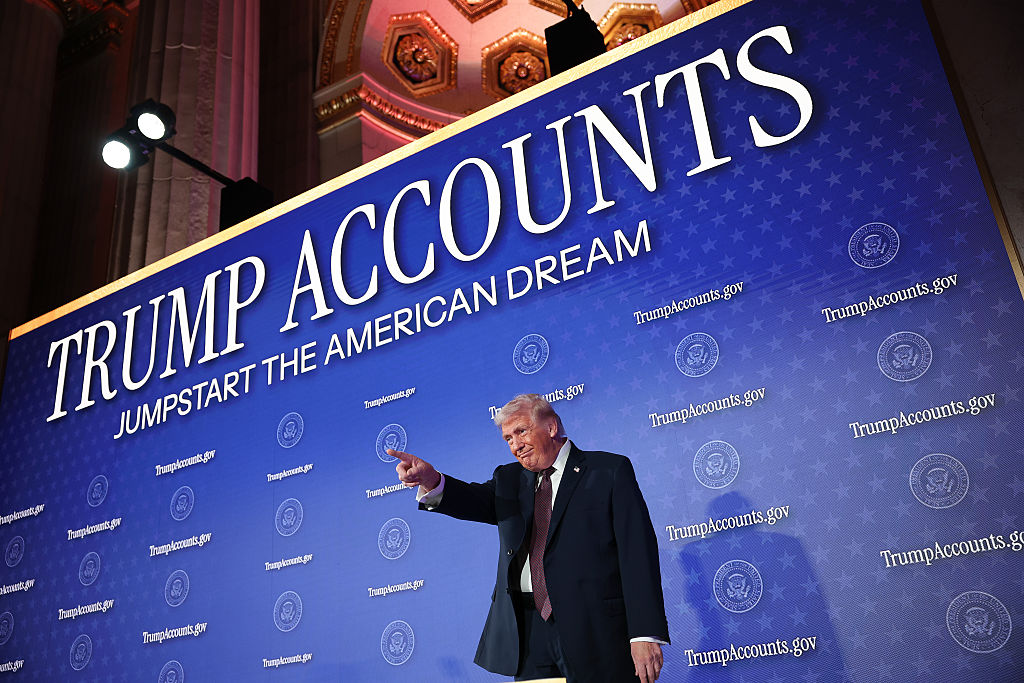
President Donald Trump arrives on stage before delivering remarks during the Treasury Department’s Trump Accounts Summit at Andrew W. Mellon Auditorium on January 28, 2026, in Washington, DC. (Win McNamee / Getty Images)
“Free money.” That’s what the Trump administration promised to millions of US children during the Super Bowl. The windfall would come courtesy of Trump Accounts, the new investment accounts for children under eighteen, which people can sign up for online or when filing their 2025 taxes.
On paper, the program, established by President Donald Trump’s One Big Beautiful Bill Act, appears promising. The government will provide $1,000 seed deposits for children born between 2025 and 2028, and tech CEO Michael Dell and his wife, Susan, will add another $250 each for twenty-five million children aged ten and under who live in areas with median incomes below $150,000. Other big-name companies, from Nvidia to Chipotle, have also pledged to chip in to employees’ Trump Accounts.
More than four million parents and custodians have already created accounts for their children. And with Bank of New York Mellon Corporation and Robinhood recently tapped to run the program, Trump Accounts now appear poised to launch — on the Fourth of July, of course.
But in truth, like everything else Trump has emblazoned with his name, Trump Accounts are far from an act of unqualified benevolence.
What sounds like free money carries real financial risks, costs, and serious concerns for any society that calls itself a democracy. Instead of restoring or increasing funding to programs with a proven record of strengthening children’s long-term prospects, the administration has created a distraction that offers marginal benefit while widening the already inequitable income gap.
So why launch Trump Accounts at all? Perhaps, as Arthur MacEwan, University of Massachusetts Boston professor emeritus and cofounder of the economics nonprofit Dollars & Sense, suggests, “Trump Accounts seem to be a publicity stunt aimed at, in effect, an effort to buy votes.”
Embedded Risks
The design of Trump Accounts has inherent risks.
For example, unlike other child savings vehicles, such as a Roth IRA, a 529 education savings plan, or an education savings bond, that can shift investments into safer assets over time, Trump Accounts can only be invested in low-fee US equity index funds.
“Limiting accounts to low-fee US equity index funds is defensible on cost grounds,” says Olivia Mitchell, professor of economics at the Wharton School of the University of Pennsylvania. But “a 100 percent equity portfolio that cannot adjust over time exposes beneficiaries to substantial risks.”
This is especially true because the value of a beneficiary’s earliest possible withdrawal, at age eighteen, will be entirely dependent on market conditions. A downturn that year could erase much of its value; a strong market year would inflate it. Either way, the outcome depends on timing.
Typically, such volatility is mitigated over time. Keeping money invested over decades helps weather the market’s highs and lows, which will likely be so for Trump Accounts that are eventually transferred to other types of retirement accounts.
But therein lies another concern. “Funds can and will be withdrawn at age eighteen,” argues Chuck Jaffe, financial writer and host of the podcast Money Life with Chuck Jaffe. Not only will the money then be exposed to the market’s ups and downs, but it will also cut into the investment’s earnings.
“Let’s say,” Jaffe explains, “you set up a custodial Roth IRA that earns 9 percent a year. It would double in value roughly every eight years, so your $1,000 doubles twice in sixteen years and will grow a little past $5,000 when the child turns eighteen. If the money stays in place until age sixty-five, it will grow to about half a million dollars. The key factor, therefore, is not achieving the first double; it’s achieving the last one.”
But few struggling families can afford this luxury. Only those who are financially stable can afford to leave money untouched for decades. Trump Accounts’ promise of closing the wealth gap, thus, remains just that — a promise. A promise that most likely will only do the opposite: widen the economic divide.
In the meantime, Trump Accounts also impose stiff penalties for noncompliance. Earnings from contributions over $5,000 per year, for instance, include a 100 percent net income penalty.
A Twelve-Year Hole
History has shown that assigning custodians to similar government programs has often resulted in conflicts of interest. Government-backed student loan programs, for example, have been plagued by mistakes and conflicts of interest.
The announcement last week that Bank of New York Mellon Corporation and Robinhood will manage Trump Accounts isn’t likely to assuage such concerns.
Over the past several decades, the long-standing Bank of New York Mellon Corporation has faced numerous penalties for allegedly deceiving municipalities and pension owners, improperly handling financial trades, violating financial disclosure regulations, failing to keep proper records, running afoul of anti-foreign-bribery laws, and embroiling its clients in Bernie Madoff’s Ponzi scheme.
Most recently, the bank faced a now-dismissed lawsuit and a congressional investigation for allegedly facilitating hundreds of millions in suspicious transactions for sex predator Jeffrey Epstein.
Meanwhile, Robinhood, best known for its commission-free stock-trading app that allows people to trade in cryptocurrencies, agreed to pay $65 million in 2020 to settle regulatory charges of repeated misstatements, including using “inferior trade prices,” which allegedly cost its customers $34.1 million. The following year, the company revealed that nearly five million of its customers’ emails had been stolen.
Then, in 2025, Robinhood was ordered by the government to pay $45 million to settle various penalties, including for failing to safeguard customer information and submit timely suspicious-activity reports.
Besides these issues with Bank of New York Mellon Corporation and Robinhood, there’s another problem: To date, the government has allocated $410 million for the program’s day-to-day administrative fees up through September 30, 2034. But the last accounts, opened in 2028, will not mature until 2046 — leaving the program’s management in doubt for twelve additional years. After that, for instance, new high fees could be introduced. And in the best-case scenario, without guaranteed funding, beneficiaries’ income could stagnate. At worst, the investments could risk losses.
For people with the means, custodial IRAs and 529 savings accounts instead offer the advantage of strong fiduciary protections, such as legal oversight, risk limits, and audits by independent firms. These safeguards have yet to be determined for Trump Accounts.
“Departing from this framework,” Mitchell points out, leaves “these accounts with avoidable design and governance weaknesses.”
Expanding the Inequity Gap
Although the Trump administration has pitched Trump Accounts as a way to help close the wealth inequality gap, claiming they will “lift up the next generation” and “jump start the American Dream,” the inherent inequality built into the program belies such aims.
Parents or guardians can deposit up to $5,000 annually into Trump accounts. But that means children from wealthier families will see far larger gains than those who cannot afford such expenditures.
As the White House’s Trump Account web page for the Trump Account boasts, those who contribute $5,000 annually have the potential to see their child’s funds grow to $271,000 at age eighteen; those who cannot afford to add more than the $1,000 starting amount will only end up with $6,000. Over time, the situation grows worse. If — and this is a big if — the plan stays stable, at age fifty-five, the earnings gap between these two hypothetical beneficiaries will exceed $12 million.
A 2023 paper published in the journal Social Policy & Administration studied the impact of a similar UK savings account and found the accounts created “at best modest and not materially life changing [results] for almost anyone who wasn’t already likely to have been so privileged by birth already.”
“But they are very nice for people who have a good deal of money and pay higher tax rates,” said MacEwan at Dollars & Sense. “They provide higher-income families with one more opportunity to get a tax break. This is consistent with the general Trump pattern — i.e., tax breaks for the well-off.”
Employers can also contribute to Trump Accounts. According to the pro-tax-cut advocacy group Americans for Tax Reform, dozens of companies have promised to contribute hundreds or thousands to their employees’ accounts. (The crypto exchange Coinbase has indicated it hopes its contributions can be made in cryptocurrency.)
Many of these firms, however, are large financial institutions or major corporations whose employees already have access to wealth-building tools and investment expertise. If employer contributions continue to primarily come from such large corporations without reaching low-income communities, Trump Accounts, again, may do little to close the wealth gap they purport to address.
Instead, they risk widening it by adding to the compounding advantage of the households already positioned to benefit most.
While the Dells’ much-touted $6.25 billion Trump Account donation will target low-income families, future donors may impose geographic or age restrictions on who receives the benefits, which could create more inequality. Donors typically have a say in such programs’ direction, as demonstrated by education donations from the Walmart family empire, which it used to help accelerate the growth of charter schools and private school voucher programs.
The Real Winners
Trump Accounts, by their very nature, also raise ethical concerns. They can exert pressure on companies and individuals to use their donations and savings contributions to demonstrate support for an agenda aligned with a particular administration, raising questions of favoritism.
Dell, it’s worth noting, enjoys billions in government contracts, including an $18.8 million contract it won last year to support Trump’s immigration crackdown. News of the Dells’ Trump Account donation boosted the company’s stock price, as investors predicted the giving could lead to additional government largesse.
Dell isn’t the only Trump ally poised to reap rewards from Trump Accounts. Both Bank of New York Mellon Corporation and Robinhood will earn fees for administering the program, ensuring they will make money regardless of market conditions — and so far, there’s nothing capping the fees these firms can charge.
The CEO of Robinhood, which donated $2 million to Trump’s 2025 inaugural fund, is also boasting that the arrangement put the company in front of the next generation of investors.
Make no mistake: those who created and will run Trump Accounts stand to gain far more than the millions of children they are meant to serve.