Viktor Orbán’s Hungarian Model Has Collapsed
Hungarian leader Viktor Orbán combined talk of defending Hungary’s traditions with a promise of prosperity. When he stopped delivering workers good economic news, culture-war messaging wasn’t enough to save him.
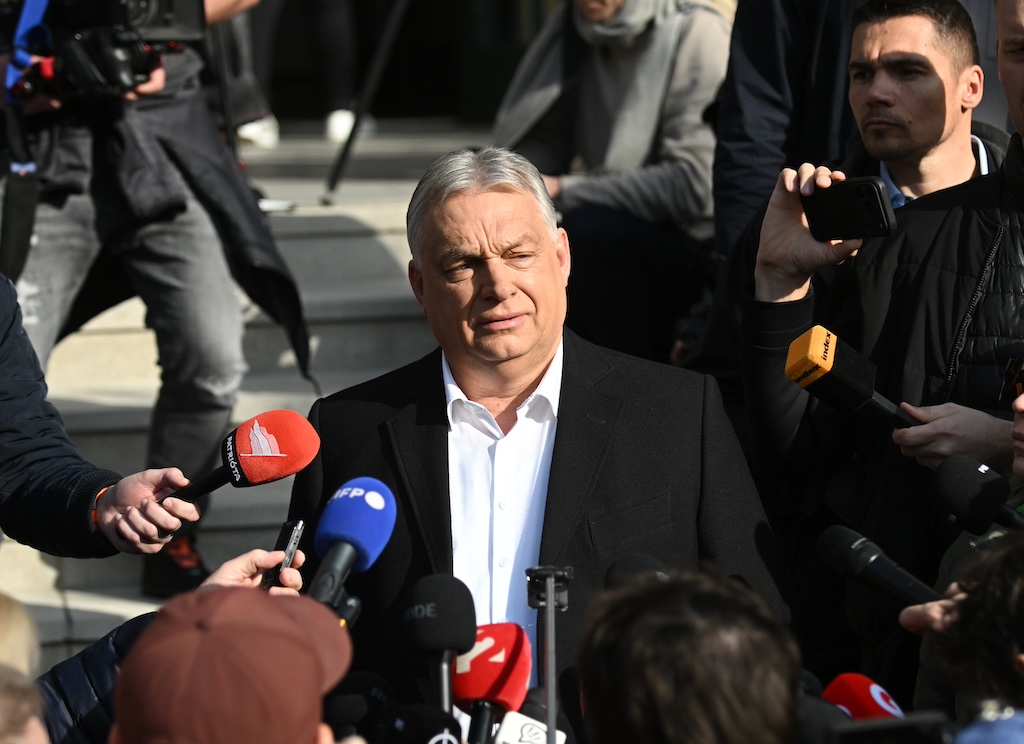
Hungary’s Viktor Orbán lost the election because of splits in his own base. (Balint Szentgallay / NurPhoto via Getty Images)
Reacting to news of Viktor Orbán’s defeat in Sunday’s Hungarian election, many of his admirers insisted that he had, after all, done a good job. Jordan Bardella, president of France’s Rassemblement National, wrote that Orbán had “led Hungary’s economic recovery, promoted family policies that helped maintain the birth rate, and defended his country and Europe’s borders against migration.” Dutch nationalist leader Geert Wilders insisted Orbán was “the only leader with balls in the EU”; for others, the fact that he had admitted defeat proved his democratic spirit.
Many accounts focus on Orbán’s authoritarian hold on power, whether rewriting the state’s Fundamental Law or packing the Constitutional Court. His Fidesz party’s influence on public media and the education system was also an important tool for shaping opinion.
Yet the fact that Orbán has now been ousted at the ballot box tells us that he had relied on a more organic kind of support that has been exhausted. While voter turnout soared on Sunday, his Fidesz party’s base shrank from 3.1 to 2.3 million.
In a preelection article, I wrote of Orbán’s promise of a “work-based society” and an economy based on job creation. Putting Hungarians in work, he argued after the 2008 economic crisis, would make them more self-reliant than if they counted on credit or on welfare benefits. In rallies ahead of Sunday’s vote, Orbán spoke of increasing job numbers by more than one million since returning to office in 2010 (the rise, per official data, was more like 750,000). Yet if there was rapid progress by this indicator leading up to the 2022 election, it then stalled badly.
The COVID-19 pandemic and Russia’s invasion of Ukraine undermined the social compact on which Orbánomics was built. As Dávid Karas points out, while Orbán’s post-2008-crisis rhetoric focused on regaining “sovereignty,” Hungary’s jobs plan remained dependent on foreign direct investment, from German automakers to Chinese electric battery firms.
Government policy worked not to strengthen labor rights but to create a low-wage workforce attractive to private, multinational investors. This model remained vulnerable to global shocks, ranging from EU (but also Trumpian) pressure to decouple from Russian gas to more recent US-Israeli warmongering.
Headline economic data isn’t the only key to understanding Orbán’s defeat. The fact that the eventual winner, Péter Magyar, originally hailed from Orbán’s Fidesz party before helping to reveal one of its great scandals (the state cover-up of child sexual abuse) also shows how the party’s moral authority crumbled.
Yet Orbán’s rise and decline can, in its most basic terms, be reduced to parameters also useful to understanding other contexts, and even Trumpism. This right-winger built a new electoral coalition spanning the middle and working classes, even integrating a large ethnic-minority vote, but he ultimately exhausted these supporters’ faith in him.
Foreign Admirers
For Orbán’s international admirers, the results mattered less than the narrative behind them. His vituperation against “globalists” and claims to defend sovereignty against neoliberalism offered a heroic story for their own struggles. It was a civilizational narrative about dark threats to the West and the resistance against them.
At conservative meetups like the NatCon rallies, sponsored by Budapest-aligned think tankers, Orbán impressed foreign audiences by posing as a David fighting globalist Goliaths — George Soros, or “cultural Marxism,” or even finance itself. Orbán wanted to fight the 1989 anti-communist revolution again and offered other right-wingers a place at his side.
Was Hungary a conservative utopia? Orbánism’s acolytes were easily impressed by billboards at Budapest’s airport proclaiming Hungary’s pro-family policies and the safety of the city center. Visiting the tourist districts of the capital (since 2019 controlled by a Green, opposition mayor) always offered a limited understanding of Orbánism. The construction boom and rising Roma job numbers surely did more for Orbán’s support than students enthused by conservative ideologue Roger Scruton. In practice, famed pro-natalist policies like tax breaks for working families did little to resist the long-term decline in birth rates.
Ahead of this election, it seemed that the culture war was all Orbán was left with, and it was enough to earn endorsements from Donald Trump and J. D. Vance. Issues like the poor state of the public health system and the reversal of the economic trends that Orbán had previously boasted about became mere embarrassments for the supposed strongman.
Efforts to paint Magyar as a tool of the European Commission and Ukrainian president Volodymyr Zelensky may have rallied the Fidesz party faithful but were seemingly distant from the concerns that motivated most voters.
Yet the failure of Orbán’s attempts to demonize Magyar as a dangerous radical also points to another aspect of this result: this electoral shift doesn’t represent a drastic overhaul of policy assumptions. Magyar is a conservative and, in his own campaign, stuck close to many of Fidesz’s own promises, notably with regard to welfare policy and immigration. Relations with the European Union represent a more obvious shift, not so much because Orbán resisted the bloc’s turn to increased arms spending (he didn’t) but insfoar as he has often held up EU aid to Ukraine.
Magyar’s success could be taken as evidence for an argument that this magazine has always rejected in the US context: that the way to beat Orbán’s hard right was to stand as a moderate, competent alternative occupying the center ground. In the long buildup to these elections, Magyar’s center-right Tisza Party managed to fold the liberal-left space into itself, while remaining aloof from conflicts such as the banning of the Pride parade in Budapest; Magyar also took a strong anti-immigration line. Orbánism had offered its voters a path to middle-class prosperity, and it was in this same spirit that many of them turned to Tisza.
Yet Orbán’s past successes also show the limits of this centrist approach. Like other contemporary right-wing populist forces, Fidesz won when it expanded its base with a promise of economic redemption. When Orbánism claimed to defy neoliberalism and boost jobs, this worked because of the failures of the crisis-era governments led by the Social Democrats and their centrist allies. Magyar won not just because he seemed more competent but because after sixteen years, Orbán’s alternative model of “work-based economy” had been tested to exhaustion.
Some Hungarian socialists with whom I spoke during this campaign were not thrilled to have to vote for this lesser evil but were thrilled by Orbán’s defeat. The rise of Magyar offers neither overnight change nor even the promise of it: the global shocks that helped kill off Orbán’s model are getting worse rather than better, and it seems unlikely that this defeat will chasten Trump.
What we did at least get was a display of the hollowness of “pro-worker” conservatism and a blow to one of the main centers of today’s nationalist international.