The Making of Egypt’s Counterrevolution

After the failed Arab revolutions of the 2010s, Egypt’s elite set out to prevent future resistance. But the violent counterrevolution pushed by Abdel el-Sisi did more than restore the old regime — it consolidated a new form of state terror.
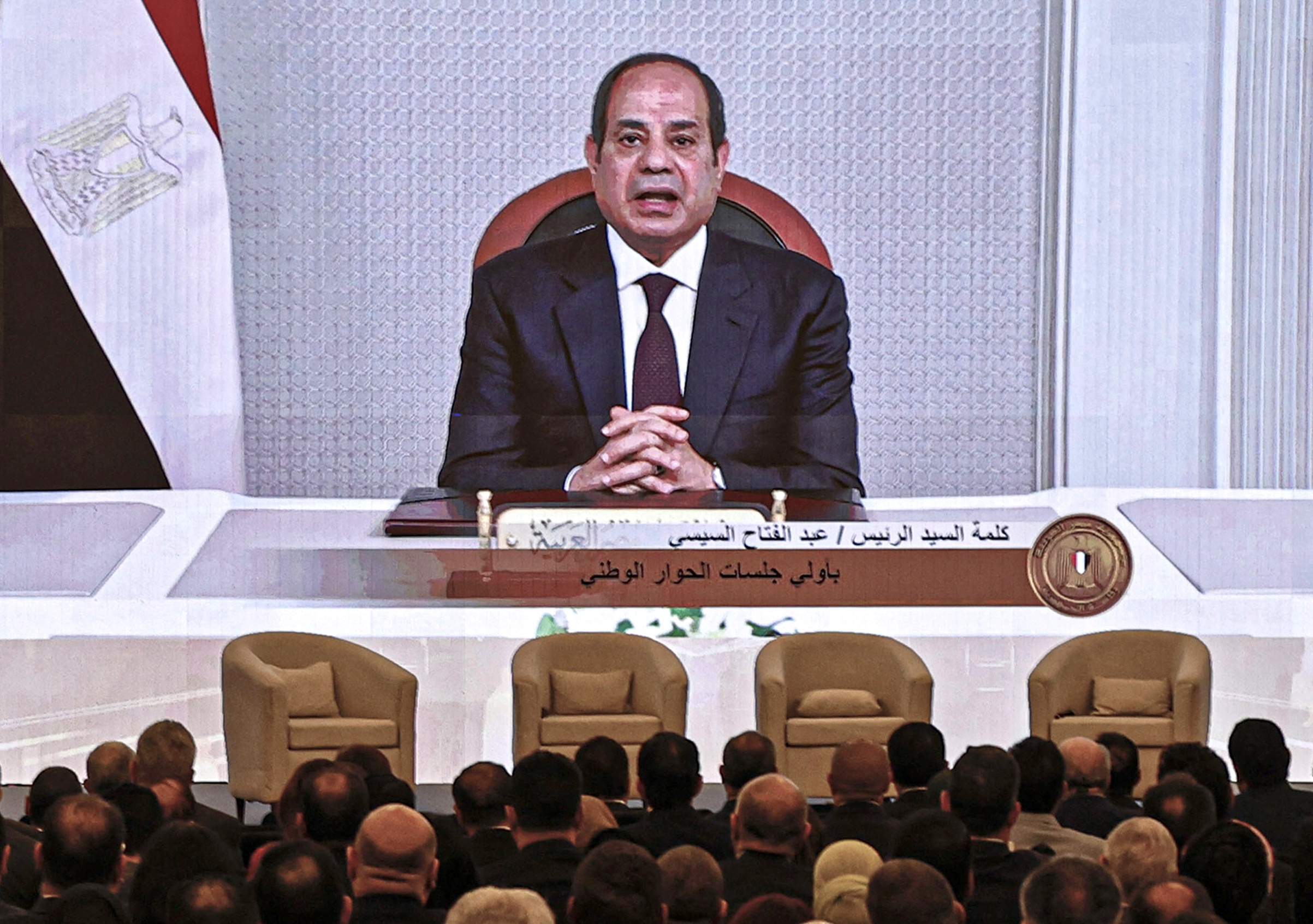
Abdel Fattah al-Sisi sitting on a chair at a table on a screen in front of a crowd.

Abdel Fattah al-Sisi addresses the representatives of syndicates, political forces, and NGOs via video conference in Cairo on May 3, 2023. (Khaled Desouki / AFP via Getty Images)


On the night of October 8, 2000, I left my university campus in downtown Cairo and drove to Giza, where I was to meet for the first time Ahmed Fouad Negm, the legendary leftist colloquial poet whose words had inspired some of the most iconic Egyptian and Arab protest songs since the late 1960s.

Negm had heard of me and asked to meet after learning of my role in organizing the mass student protests that swept the country with the outbreak of the second Palestinian intifada. As I made my way through the crowded streets, I realized I was being followed. Suddenly, two cars cut across the road, and gunmen in plain clothes dragged me from my car, blindfolded me with the Palestinian scarf I was wearing, and shoved me into the back seat of one of their vehicles. They sped off to Lazoghly Square in central Cairo, to the compound housing the Ministry of Interior and its secret police, the State Security Investigations Service (SS).

For four days, I endured a torture odyssey of beatings, sleep deprivation, and verbal abuse, blindfolded and stripped naked, threatened with rape. The final two nights were spent in a cramped underground cell with detainees labeled “jihadi” suspects. My SS interrogators believed they could intensify the pressure by locking a Marxist in with “Islamist terrorists,” hoping those hours between torture sessions would be unbearable. They would likely have been disappointed: I was treated with kindness.

The detainees shared food and tried to make space in the overcrowded cell. As we spoke, their stories emerged and were strikingly similar. None belonged to militant groups, but many had relatives who had joined one — or were simply suspected of doing so. SS arrested those relatives, then swept up all the men in their families, subjecting them to torture and indefinite detention without trial. The aim was not intelligence-gathering; the officers knew most were innocent. It was about sending a message: anyone who dared to resist the state would see not only themselves but their entire families, friends, and colleagues punished. This was Egypt’s “war on terror” — backed, armed, financed, and enabled by the West.

It was not my last detention. Over the next decade, as I pursued activism within the socialist movement, I remained a constant target of state violence. My political engagement began in 1996, during my sophomore year, and deepened when I joined the Revolutionary Socialists in 1998. I belonged to a generation that helped rebuild the Left on university campuses after the collapse of the “Third Wave of Egyptian Communism” and the suppression of the 1977 “bread uprising.” As a student activist — and later as a journalist, photographer, and labor organizer — I regularly faced the security services, from raids, arrests, and torture to surveillance, intimidation, blacklisting, and smear campaigns. These experiences sharpened my determination to study the enemy and to deconstruct the war on terror, whose destructive impact I had witnessed both as a teenager in the 1990s and again in the aftermath of the 2011 revolution’s defeat.

Hosni Mubarak’s war on terror was long hailed as a success by local media and Western officials, providing a key rationale for sustained international support despite his failures in governance. After the suppression of the Arab revolutions (2010–13), counterrevolutionary regimes — including Abdel el-Sisi’s — revived this discourse to legitimize their rule at home and abroad.

My interest gradually shifted toward the faceless enablers of this “war” — the army, police, and General Intelligence Service — examining their ideology, interests, and interactions with both each other and the wider population. Together these institutions form one of the oldest and most powerful repressive apparatuses in the Middle East. Yet for decades, they remained fragmented, often competing even as they safeguarded regime survival. Understanding their internal dynamics is essential to grasping their role before, during, and after the 2011 uprisings.

Counterrevolutions are often assumed to restore the ancien régime, but Egypt’s trajectory under Sisi challenges this notion. While the counterrevolution triumphed, its leader set out to construct an entirely new order — what he called a “New Republic” or “Second Republic.” Figures from the Mubarak era may still linger, but their influence has steadily waned as they adapt to new rules in an unfamiliar political landscape.

My book Counterrevolution in Egypt: Sisi’s New Republic does not attempt a full anatomy of this order; instead, it traces its evolution through the lens of repression. I argue that Sisi, for the first time since 1952, succeeded in unifying Egypt’s coercive apparatus and empowering it to dominate the state. The result is a republic without a social contract, devoid of hegemony, locked in an existential war against its own people, and operating more like a colonial occupier than a national government.