The Many Casualties of Precision Warfare
Reporting from Hawija, Iraq, our correspondent traces how the United States built a system of coalition warfare sold as precise, in which bombs fall, civilians die, and accountability is diffused across allied states.
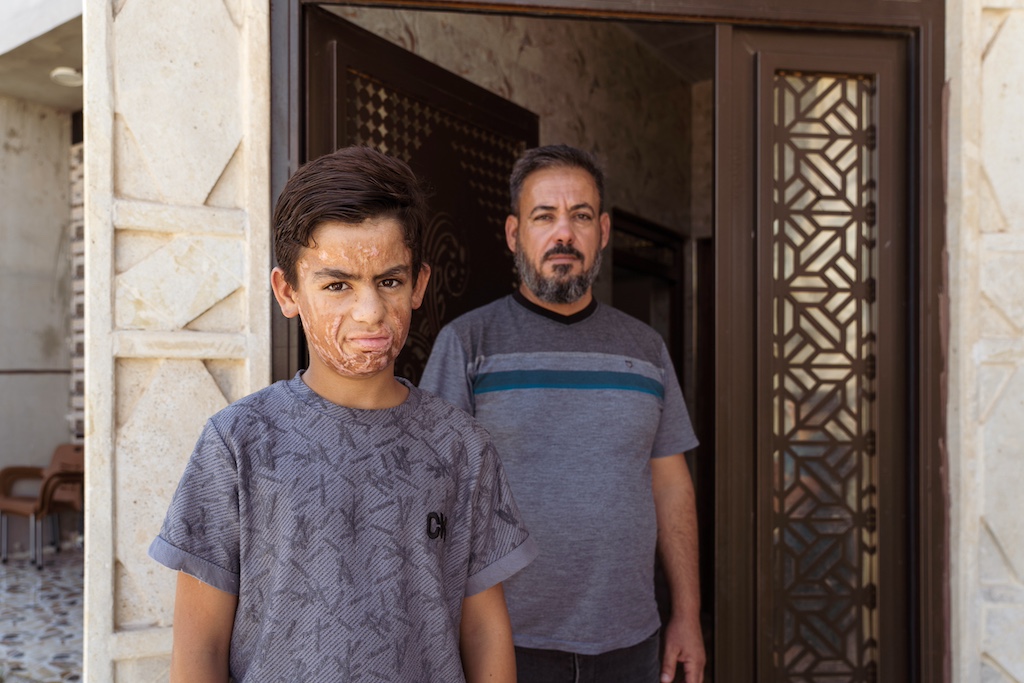
Omar Ahmad Abdallah al-Jamili stands outside his home in Hawija with his father, who recalls finding his four-year-old son after the June 2, 2015, strike “with his face on fire, his clothes melted off him.” (Jaclynn Ashly / Jacobin)
Omar Ahmad Abdallah al-Jamili cannot fully open his mouth. His ear is deformed and his face is a topography of surgical scars — skin grafted and stretched across bone in operations performed in Amsterdam, the capital of the country whose air force set him on fire.
Omar was four years old on the night of June 2, 2015, when Dutch F-16s — acting on US-supplied intelligence under the US-led coalition against the Islamic State of Iraq and Syria (ISIS) — bombed an ISIS weapons factory in Hawija, a town in northern Iraq. A secondary explosion, triggered by tens of thousands of kilograms of homemade explosives in the factory’s sheds, sent a wall of fire across surrounding neighborhoods.
The strike killed at least eighty-five civilians and injured hundreds more, destroying or damaging six thousand buildings across a five-kilometer radius, flattening 1,200 businesses overnight.
“It felt like we were struck by a nuclear bomb,” recounts forty-six-year-old Ahmad Abdallah al-Jamili, Omar’s father. “It was night and then suddenly light appeared, as if it was day. Then we heard the explosion and everything turned to fire.”
The family had a routine shaped by years of war: if they heard planes, they ran to the garden so their bodies could be retrieved rather than crushed beneath rubble. But when they rushed out, they heard screams. Omar and his brothers had climbed into the family car when the blast hit, setting it alight.
“I found Omar with his face on fire, his clothes melted off him,” his father recalls. They rushed him to Hawija’s main hospital — then under ISIS control — and pushed through crowds of wounded. After three days, they fled, fearing the militants’ presence would draw another strike.
More than a decade later, much of the destruction remains — rubble, no environmental cleanup, rising cancer rates and birth anomalies among children born after the blast.
Omar’s maternal grandfather, injured by shrapnel that night, died of leukemia months later — the family attributes it to toxins from the explosion. His paternal grandfather, overwhelmed by what happened to Omar and the loss of the family’s electrical shop — their sole livelihood — attempted suicide twice. The family says he is alive but mentally dead.

Omar has become the face of a historic and ongoing legal case, one of roughly twenty-five Iraqi plaintiffs representing more than three hundred victims suing the Dutch state for taking an unreasonable risk when it bombed Hawija. No individual compensation has been paid.
The Dutch are the only ones facing legal scrutiny. The United States — which identified the target, supplied the intelligence, approved the mission, ran the civilian casualty investigation, and redacted its findings before sharing them with the Netherlands — has never faced a single legal question over Hawija.
Hawija reflects a broader pattern. Modern coalition warfare is built to be remote and marketed as precise. But analysts say it produces more destruction, not less — while shared command structures distribute power but dilute accountability.
The bombs were Dutch. The intelligence was American. The dead were Iraqi — and no one has been held responsible.
The Night of June 2
Since September 11, 2001, the United States has launched or led military operations across at least eighty-five countries. Up to 4.7 million people have died as a direct or indirect result of these post-9/11 wars, according to Brown University’s Costs of War Project. Thirty-eight million have been displaced, at a financial cost exceeding $8 trillion.
The 2003 US invasion of Iraq — launched on the false premise of weapons of mass destruction — dismantled the Iraqi state, dissolved its military, and ignited a sectarian civil war carrying decades-long consequences, among them the rise of the Islamic State. By mid-2014, ISIS had seized large swaths of Iraq and Syria, declaring a caliphate across a territory roughly the size of Jordan.
The United States assembled a coalition of at least eighty nations — Operation Inherent Resolve — to destroy the so-called caliphate from the air, directing operations from thousands of miles away through allied jets, classified intelligence, and computer-generated damage estimates.
Hawija, a traditionally Sunni town, fell to ISIS in June 2014 and remained under its control until October 2017. The coalition’s target — an ISIS facility assembling vehicle-borne improvised explosive devices — had been monitored from Virginia since December 2014. It sat in what planners called an “industrial zone.” In Iraq, this is not a depopulated business park but mixed-use: people live above workshops, homes share walls with shops, government buildings sit beside small factories.
“There was a baseline lack of understanding of local context,” says Emily Tripp, director of Airwars, an investigative organization tracking civilian harm from air and drone strikes. “They just assumed civilians weren’t there.”

A Dutch commission of inquiry last year found the coalition should have known civilians were present — the International Organization for Migration (IOM) had publicly documented the influx of displaced people into Hawija’s industrial zone as early as February 2015.
Targeting was US-led and intelligence was US-controlled, running through the coalition’s operations center in Qatar. US agencies vetted the target, identified as sitting in an urban industrial zone surrounded by residential areas. The Central Intelligence Agency (CIA) specifically flagged the proximity of one. The strike was initially rated CDE-5 High, the “Collateral Damage Estimation” indicating expected civilian casualties, so planners revised the loadout to lighter Small Diameter Bombs, lowering it to CDE-5 Low.
But the model excluded secondary explosions, as the stored quantity was unknown. All US agencies — including the CIA — approved the strike, and the CIA’s flag about the residential neighborhood was never passed to the Dutch pilots or authorizing officers.
The Netherlands drew the strike as the only coalition member other than the United States with Small Diameter Bombs. Dutch Red Card Holders — national officials with veto power — saw that the target sat in a populated area with residential blocks nearby, as well as a mosque. Unable to independently verify US intelligence, they pushed the strike from 9 p.m. to midnight, betting fewer civilians would be outside.

Just after midnight, two Dutch F-16s released their bombs. A massive secondary explosion followed — unlike anything seen in a coalition strike. Civilian casualties were immediately assumed, yet the Dutch Ministry of Defence told Parliament there were no indications of civilian harm — a position it maintained for years despite internal intelligence to the contrary. Dutch military intelligence later estimated fifty thousand to one hundred thousand kilograms of explosives at the site — up to five times the United States’s initial post-strike estimate.
Driving through Hawija today, the scars remain — pockmarked walls, empty lots, rubble strewn across the ground. Seated on the floor of his still window-shattered home, his small children around him, Khaled Ahmad, forty-seven, recounts what happened.

He had been sleeping on the roof with his family. Windows shattered, doors blew inward, part of the house collapsed. His wife’s legs were cut by flying glass. His youngest son suffered a head injury. Shrapnel tore through his twenty-year-old brother, killing him within minutes. His sixty-year-old mother was also wounded; weeks later she developed stomach cancer and died a month after.


Ahmad’s car-electrical shop — his only income, a kilometer from the blast — was destroyed. It remains that way. “My mother was the beating heart of our family and I think about my brother every single day,” he says. “Families in Hawija are still broken by this.”
What followed was not rescue but chaos under ISIS control. The group ran the hospitals and controlled movement.
“Using explosive weapons in urban areas under insurgent control creates an extremely difficult situation for civilians,” says Lauren Gould, associate professor in conflict studies at Utrecht University. “There are no troops on the ground to secure access to care. ISIS made medical access political — people with severe injuries were turned away.”
Others pledged allegiance for treatment. Some were stitched by pharmacists without anesthesia. Those who could afford smugglers navigated checkpoints and mined roads to hospitals in Mosul, Kirkuk, or Baghdad. Treatable injuries became permanent.
In a sunlit sitting room across town, Hussein Ibrahim Hussein, fifty-six, edges forward. He lived five hundred meters from the blast. “Our home was completely destroyed,” he recalls. Many neighbors were displaced families hoping to reach Kurdish-controlled Kirkuk city. “Their bodies were scattered across the streets.”

His brother was found dead on the road, thrown from the house. His son’s face was covered in blood — a fifteen-centimeter shard of glass lodged in his right eye. Overwhelmed doctors could offer only first aid, so Hussein smuggled his son out. “I sold all my wife’s gold — everything,” he says.
After fleeing to Turkey and Iran and five years seeking treatment, every diagnosis was the same: irreversible retinal detachment and permanent blindness. His son, Hussein Ibrahim, now twenty-two, suffers balance problems and headaches that leave him unable to work. “I feel like they stole my future from me,” he says, eyes fixed on the floor.
Like many victims of coalition airstrikes, Hawija’s residents did not know whose planes struck them. Only when Dutch media reported on the strike in 2019 did the community learn the bombs had been Dutch.
Architecture of Not-Knowing
Hawija exposes a structural feature of coalition warfare: responsibility is spread across command chains, making accountability nearly impossible.
“Coalition structures can allow states to hide behind the framework and avoid responsibility,” says Annie Shiel, US advocacy director at the Center for Civilians in Conflict (CIVIC). Civilians are left unable to identify who caused the harm or where to seek redress.
“When bombs are dropped, it’s not like each one is wrapped in a Dutch flag,” says Tripp of Airwars. Even the coalition’s own statements do not specify which country carried out a strike.
The Dutch commission concluded senior officials sought to downplay the Hawija strike, failing to report known casualties and misleading Parliament. When journalists exposed the incident, the government claimed uncertainty — though the US military had already recorded around seventy civilian deaths in its own database.
For Gould, this is not a breakdown but part of how the system functions. “It’s a systematic and strategic refusal to know about the harm done to civilians,” she says. “And that undermines democratic oversight. The debate shifts to who knew what and when, instead of the impact — civilian deaths, injuries, destruction of homes and livelihoods. None of that was meaningfully debated in parliament.”
The Dutch inquiry also found the Netherlands “entirely relied on US intelligence during the war in Iraq” and “failed to build up its own intelligence position” — a dependence the state has since leaned on to deflect accountability. That reliance extended beyond the strike itself — the Netherlands also depended on the United States to investigate whether civilians had been harmed afterward. But the US military’s own record of accounting for civilian casualties has been widely criticized.
“The US relies heavily on its own information and underuses external reporting,” explains Shiel. “In air wars, ground-level information is essential — and the military often doesn’t have it.” Gould traces this to the remote character of the war: “They rely on the same aerial imagery used to estimate civilian harm in the first place. There’s no feedback loop.”

Coalition forces carried out roughly 35,000 airstrikes across Iraq and Syria and dropped 120,000 bombs yet acknowledged only about 10 percent of civilian casualties documented by civil society. France acknowledged none. The UK acknowledged one — a case that did not exist. Mosul and Raqqa, meanwhile, were 70 to 80 percent destroyed. In Raqqa, the coalition acknowledged twenty-three civilian deaths; Amnesty International later identified around 1,600.
This, Gould argues, is not incidental. For remote air campaigns to continue, harm must be obscured. “If you destroy an entire city and wipe out civilian infrastructure, that isn’t a mistake. That is strategy,” she says. “In the short-term it can weaken the opponent, disrupt daily life, and make survival harder.”

“The denial and secrecy around civilian harm are also not accidental — they’re part of the strategy,” she continues. “If the public saw the destroyed neighborhoods and broken lives in places like Hawija, the political cost of these ‘precision’ wars could become too high.”
Therefore, the system of not-knowing is maintained: “Data is kept classified, you point fingers at coalition partners, and the violence remains invisible to the people in whose name it is carried out.”
The Reckoning That Wasn’t
Under parliamentary pressure, the Dutch government allocated €4.5 million (about $5.3 million) in 2020 as “voluntary compensation” to Hawija. Individual payments were refused. Last year, former Defence Minister Ruben Brekelmans apologized for “unintentional civilian casualties” but maintained the strike was lawful.
The funds were channeled through the United Nations Development Program and the IOM to rebuild infrastructure, including electricity networks and municipality-owned shops. But the projects functioned as general development aid, not targeted compensation: victims of the 2015 strike were neither identified nor prioritized. PAX, a Dutch peace organization, found that only 5 to 15 percent of beneficiaries were likely victims. Many affected families had already left Hawija by the time the projects began, and the link between the aid and the Dutch bombing was never communicated, leaving most residents unaware the Netherlands was attempting to make amends.
In January, Brekelmans traveled to Hawija to again apologize and announce additional funding. He reiterated there would be no individual compensation, arguing it was impossible to determine exactly who was affected. This is despite substantial evidence available on victims, including a detailed database compiled by a local Iraqi organization in partnership with Utrecht University and PAX, documenting the repercussions of the bombing on more than three hundred individuals — information repeatedly offered to the Dutch government but never used.

Back in Hawija, Hazem Muhammad, forty-eight, holds his seven-year-old daughter Rania, born with a severe arm deformity doctors attribute to environmental contamination from the blast. They are one of many families who say the effects have been intergenerational.
“My arm isn’t normal,” Rania says shyly, clutching her father. “So the other kids don’t like to play with me.”
The secondary explosion registered 4.3 on the Richter scale and left an eleven-meter crater. As of 2026, no official soil or groundwater testing has been conducted to assess long-term toxicological impact.
But even as the Netherlands grapples with the harm it caused, the power that set the strike in motion has faced no reckoning at all.
The Invisible Defendant
The United States designed and controlled the system behind the strike — identifying the target, supplying intelligence, running the damage estimate, and approving the mission.
Afterward, it led the civilian casualty investigation on the Netherlands’s behalf and carried out its own internal review. The review was completed in August 2015, but shared with the Netherlands only in January 2016 in redacted form, with the CIA’s warning about the nearby residential neighborhood omitted. Journalists later obtained a more complete version through Freedom of Information Act requests than the Dutch Ministry of Defence had received from its own ally.
The state at the center of the operation has placed itself behind a legal fortress. The United States has not ratified the Rome Statute, has sanctioned the International Criminal Court (ICC), and authorized extraordinary measures to free any US official detained by it. The Alien Tort Statute — once a pathway for foreign victims to bring human rights claims in US courts — has been significantly narrowed by Supreme Court decisions.
Even its limited civilian compensation mechanism — a $3 million annual condolence fund — is out of reach for Hawija’s survivors. Because Dutch aircraft carried out the bombing, the United States does not accept claims, even though the intelligence, targeting, and approval were all American.
Kevin Jon Heller, professor of international law and security at the University of Copenhagen’s Centre for Military Studies, explains the legal standard: a state that knowingly aids another in committing a wrongful act is itself responsible. “If you’re providing the targeting information . . . if your permission is required, that would clearly be substantial assistance.”

But in practice, “you can’t take the US to the ICC,” Heller tells me. “And there are essentially no US domestic mechanisms to hold the government accountable, and most states lack the power to impose consequences — even if they wanted to.”
John Chappell, an advocacy and legal adviser at CIVIC, notes the irony: “The Netherlands hosts the ICC, while the United States has sanctioned it and implicitly threatened to use military force against the court in the American Servicemembers’ Protection Act. You couldn’t find two NATO countries with more different relationships to international justice.”
That disparity rarely — if ever — factors into operational planning. “Military planners focus on interoperability and effectiveness,” he says. “Accountability, if something goes wrong, is unlikely to be at the front of mind.”
The Distance Machine
Operation Inherent Resolve was presented as the most precise war in history. But remote warfare did not make war less destructive — it made destruction invisible for Western publics.
“In the first ten years of the wars in Iraq and Afghanistan, over 2,500 US and NATO personnel were killed in each theater of war,” Gould tells me. “In the next decade, as warfare went remote, roughly twenty died in each context. But that doesn’t mean the violence decreased for the local civilians. It means the Western public no longer feels it.”
Hawija represents a rare break — a case where destruction could not be contained, and one coalition member’s legal system allowed survivors to push for answers. “For residents of Hawija, being able to go to court — to be recognized — mattered,” Gould says. “It disrupted that distance, forcing a human connection in a system designed to remain clinical and detached.”

But the gap between capability and accountability is widening. Remote warfare is giving way to what Gould calls algorithmic warfare — AI systems generating targets faster than humans can review, adding another layer of remoteness to the kill chain. In recent operations in Gaza, Israeli soldiers reported having only seconds to approve algorithmically generated targets.
“The operators describe themselves as merely a rubber stamp,” Gould explains. “It further dehumanizes those being targeted. They become data points — they don’t have a face. Even with drones there was some proximity. Now there’s none, and that fundamentally alters the relationship between those carrying out violence and those undergoing it.”
Responsibility is further diffused in these systems, Gould notes. “Who is then accountable — the engineer who built the system, the analyst who fed it data, or the officer given seconds to approve a target they cannot verify?” Unlike a soldier or commander, a machine cannot be sued or brought before a court.
Claims of accuracy also become a shield. “If militaries claim these AI systems are right 90 percent of the time — regardless of anyone verifying that — then even when operators see mistakes, they believe they have statistics on their side,” Gould says. “And they don’t have to feel responsible for the destruction.”
On February 28, 2026, the United States and Israel launched strikes across Iran, hitting over 1,700 sites in seventy-two hours using AI-driven targeting. Monitoring units had been reduced and databases scrapped under the promise of algorithmic precision.
One strike on the Shajareh Tayyebeh girls’ school in Minab killed at least 165 people, most of them children. Investigations later indicated the target had been flagged using outdated intelligence.
“We are entrenching socio-technical systems that enable both the obscuring of responsibility and the rapid expansion of violence,” Gould says, “in ways many people would be horrified by if they understood how they actually operate.”
Like a Butterfly
Kurdi Fadhal, fifty-five, sits in his home in Hawija where late afternoon light filters through curtains drawn against the dust and heat.
His grandchildren — his son’s daughters — are gathered around him, brought on weekends to fill the silence. At his request, they slip into another room and return carrying a large poster, which they unfold. It is a memorial for Shaima, Fadhal’s nine-year-old daughter, killed in the 2015 explosion.

“My son brings his children here to keep me company,” Fadhal says quietly. “The house feels too empty without Shaima.”
“She was my everything,” he says. “A clever student — so active, so full of joy. Every day when I came home from work, she would be outside waiting for me . . . like a beautiful butterfly, always fluttering around me.”

Shaima had been sleeping by the window. The explosion shattered the iron and glass frame, striking her head. The hospital in Hawija could not treat her. For months, Fadhal tried to get her care, but ISIS would not allow residents to leave. He watched her deteriorate — arms and legs becoming paralyzed.
Eventually he found a smuggler. For $2,300, they crossed ISIS territory to Baghdad. Doctors said it was too late. She slipped into a coma. Nearly two years later, on March 17, 2017, she died.
“My wife and I try to hide from the children when we cry,” he says. “But every corner of this house reminds me of her.”
“When ISIS took Hawija, I thought the coalition would save us,” he continues. “But instead, they killed our precious daughter. Even ISIS didn’t do that to us.”
“With all this sophisticated technology and intelligence these Western countries have, how could they not know this area was full of civilians?”