Christian Nationalism Has Arrived in Britain

Far-right activists in Britain are increasingly adopting the rhetoric of Christian nationalism. Yet while they look to American churches for an example, their evangelical style seems unlikely to map onto Brits’ quite different attitudes toward religion.
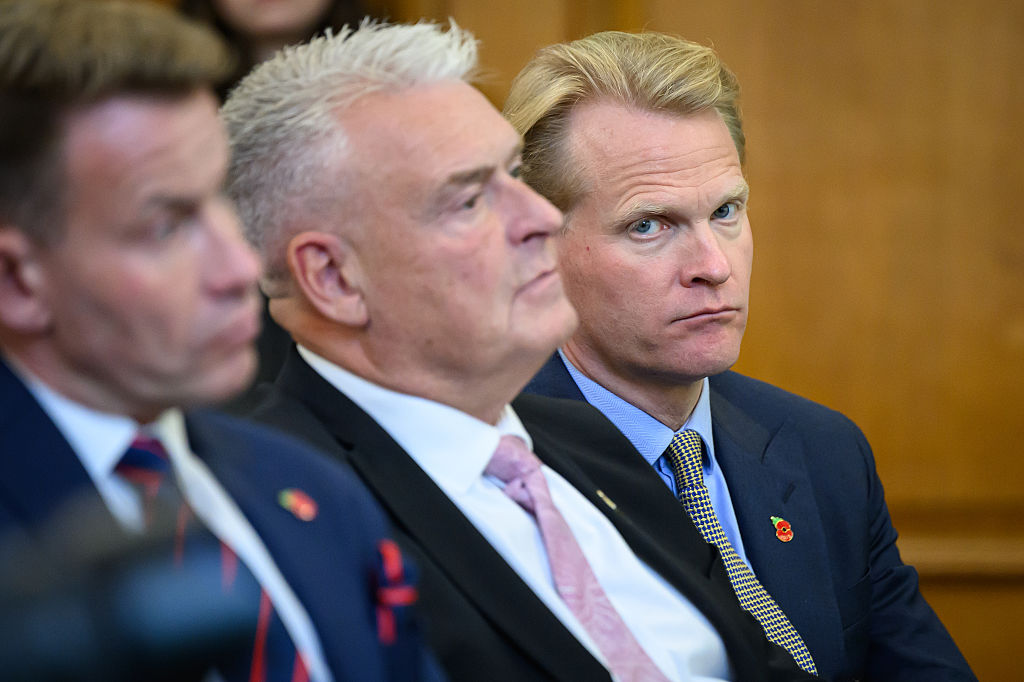
Reform UK Chairman David Bull (left) and Reform UK MP for Ashfield Lee Anderson (center) and Reform UK advisor James Orr (right) listen as former Conservative MP Danny Kruger addresses the media during a Reform UK press conference on October 28, 2025, in London, England.

Reform UK Chairman David Bull (left) and Reform UK MP for Ashfield Lee Anderson (center) and Reform UK advisor James Orr (right) listen as former Conservative MP Danny Kruger addresses the media during a Reform UK press conference on October 28, 2025, in London, England. (Leon Neal / Getty Images)


“Can we still have an ethos if we don’t have an ethnos?” This question is unlikely to preoccupy many Jacobin readers, but it’s at the top of James Orr’s mind. Orr, a Cambridge don who’s become the policy chief of Nigel Farage’s Reform UK party, recently asked this on a podcast with Danny Kruger, an MP who defected from the Conservatives to join the party in September 2025. Both new additions to the far right have been vocal about their concern with the fragmentation of British society. But they have a solution: Christianity, and a lot of it. And not just as a matter of private belief. Amid the turncoats now decked out in Reform UK turquoise, an argument’s been gaining currency that Christianity ought to serve as the foundation of a new national order.

The parallels with the United States are plain enough, and many have noticed them. Christian nationalism, once an item discussed on fringe websites and muttered in lengthy podcasts, has moved to the core of the Trumpist right. And as Orr and Kruger are keen to show, their British fellow travelers have not been idle listeners. Ties across the Atlantic are as personal as they are ideological. Orr’s oft-reported relationship with J. D. Vance — who describes the British philosopher-cum–policy strategist as his “British Sherpa” — is an outward sign of an inner truth: there’s a conscious effort to transpose what’s going on in the US to Britain.

“By their fruits shall ye know them.” But in Britain, the harvest will be limited. Christian nationalism relies, in the United States, on the near-absolute separation of church and state, where denominational competition allows for confessional triumphalism to be tethered to claims of national greatness. The British marketplace of faith doesn’t behave the same way. The mingling of crown and creed has pressed religion into the service of the state, not the nation. Whatever story can be told about it will be closer to a monograph of applied social science than to a collective, providentialist bildungsroman.

Yet this shouldn’t quiet all worries. While the US’s openly prescriptive Christian nationalism may not travel far across the pond, religion is not entirely absent in British public life. Here Christianity has often been presented as a matter of inheritance, part of the background furniture that allows things to work. This is an appeal to civilization and what makes it function, not to doctrine and to forceful proselytization. While vaguer and less prone to confessional partisanship than what’s happening in the United States, its talk of heritage and order, decline and restoration is equally as punishing to those outside the imagined core.

Crusaders 

To many of its advocates, Christian nationalism is as American as apple pie. They’re likely right, if only not in the way they mean. For Pete Hegseth, the Fox News pundit turned self-styled “secretary of war,” Christianity itself isn’t always immediately about Christ. “We Christians,” he declared in his 2020 book American Crusade, “need to pick up the sword of unapologetic Americanism and defend ourselves.” Here one’s faith comes with an imperative to affirm the nation.

This reversal of priorities has a history. As the sociologist Philip Gorski has shown, successive attempts by Puritans, Civil War–era doomsayers, and twentieth-century Christian Reconstructionists gave life to a peculiar theology: an account of the nation as a covenant with God, populated by a chosen people carrying a providential task, whose national power stands as evidence of divine favor. What emerged as Evangelicalism jettisoned traditional notions of predestination — which makes holy wars, at best, useless — yet held on to election. Conversion becomes not just key to confessional growth but indicative of the nation’s health, as well as of salvific primacy.

This theology is exacerbated by the composition of American religion. As more Europeans crossed the Atlantic, the separation of church and state generated a marketplace for belief. Churches, often tied to ethnic identities, would compete, split, expand, and advertise themselves, much as businesses do. And this persists today, even within Donald Trump’s united religious front — an anonymous X screed, amplified by evangelical Ted Cruz, accused America First Catholics of dividing their loyalties between Rome and Washington, DC. This is best described as a “denominational society,” as the priest and scholar Andrew M. Greeley put it, where confessions vying for control are always the order of the day. In this context, claiming to not only speak for the nation but to be its sole means of survival and best chance of success isn’t a bad strategy.

Nowhere is this clearest — and loudest — than in megachurches. Often in exurbia, these churches exist where social life is thin and civic institutions weak. Half sanctuary, half miniature commonwealth, the megachurch monopolizes the hinterlands of the United States’ religious marketplace. By offering food and music, childcare and dating, even a ready-made social calendar, these institutions don’t merely gather believers but bind them together in whole ways of life. The gospel isn’t just heard in pews; it sets the norms of thousands of microsocieties dotted across the US.

Transnational Ideology

It’s obvious, then, that for the Christian nationalist, the land of milk and honey lies west of the Atlantic. Yet some in Britain look on studiously, as they begin to emulate a version of it over here. Efforts have concentrated around Reform UK, whose need for a national story that isn’t the overworn embrace of the leafy Home Counties and not some reissued Brexit battle-cry has made it a congenial vehicle.

And Orr’s in the driver’s seat. His rise in the party has made once marginal ideas central to its strategy. On his account, Britain is being dissolved by “transnational, rootless, cosmopolitan ideologies.” With the risk of reading too much into his words — as someone with an interest in theology, Orr would appreciate the wariness — Reform UK’s own philosopher-king knows where to lead us instead: toward a single “national spirit,” alone capable of holding “a nation of many ethnicities together.” Otherwise, he warns, Britain will likely become a “mere economic zone.”

The defensive spirit here is more literal than figurative. To his credit, Kruger’s forthrightness dispels any doubts: “Our country is rooted in Christianity,” whose liberties derive from the “Christian idea of absolute moral dignity.” In this setting, Christ’s cross is more than ornament in public life; it supplies the substance of a national idea that accounts for past, present, and future.

Like its American counterpart, this rendition of Christianity is a deliberately national, not merely civic, project. And this is clearest in how rarely Britain is referred to in the abstract, or for how those qualities generally associated with Britishness are often simply English. Former political scientist, now Reform UK politician Matt Goodwin — to broaden our cast of characters — has this in mind when he speaks of England’s “very distinct identity,” one recounted for over a millennium, often by Christianity’s greatest and wisest. The nation’s Christian heritage, which allows the crispness of Englishness to be discerned through the murkiness of Britain, isn’t just in the interest of antiquarians; it is something for which the onetime academic has vowed to fight — alongside, presumably, Orr and Kruger.

Base and Superstructure

For them to have platoons worth leading, Christian nationalists need an infrastructure that feeds them devoted conscripts. Some think Britain has something like this, and they look to West London for proof. There a well-heeled church, Holy Trinity Brompton (HTB), has transformed itself from a wedding venue for the privately educated into an inclusive meeting point for those who like to pray in tongues — even Old Wykehamists like Orr, Old Etonians such as Kruger, and Old Merchant Taylors of the order of Paul Marshall, the owner of hard-right media outlets GB News and the Spectator. HTB’s charismatic carousing has generated an Evangelical network across Britain: softly, through its trademarked training package, the “Alpha course,” which can be used in any church; and with a harder touch, by means of its Church Revitalisation Trust that takes over flailing parishes and imports its own brand of leadership and discipleship.

But the theology HTB peddles doesn’t neatly match Orr’s vision of the nation. Nicky Gumbel, the barrister-turned-pastor who shepherded the West London church through its period of national growth, preaches a form of comfortable Christianity that, for all its conservative values, is skeptical of the United States’ militant religiosity. For starters, Gumbel’s own treatment of denominational difference has led to an ecumenism that is more sincere than that of the American Christian nationalists. Under his leadership, the Alpha course found many receptive congregants — and priests — in Catholic churches, without there being any competition or pushes for conversion.

The divergences are as political as they are theological. While figures like Hegseth and Wilson, indebted to the vision of the “Moral Majority,” want to fuse temporal politics with supernatural belief, Gumble inherits an Evangelical tradition — largely forged under Margaret Thatcher — that was almost wholly otherworldly. Much as with the state and the market, the argument ran, the city of God was best left untouched by the rules of men.

Yet the Church of England is melded to the state — and to the monarch as its supreme governor. Advocates as well as critics of politicized Christianity are quick to point this out, with antidisestablishmentarianism having become a beleaguered position. Yet for those worried about religion’s hand in government, this may not be entirely bad news. The established church’s affiliation to the state has led to it often being tasked with bureaucratic duties. In the wake of the Industrial Revolution, Westminster often looked to Lambeth Palace to take care, almost always inadequately, of the poor and hungry, the worrisome and the rowdy, as well as those unable to pay their way through private education. Welfare failures aside, this led to a partial identification between the church and the mundanities of administration, not the grandeur of nationhood.

In the interest of its own preservation, as it oversees charismatic Evangelicals, not-so-closeted papal sympathizers, and middling country vicars, the Church of England also encourages a posture of inclusion. The case of the previous archbishop of Canterbury, Justin Welby, is instructive. An alumnus of HTB, Welby once rubbed shoulders with many of Britain’s Evangelicals. But many at the West London parish, including Orr, remember his time as chief Anglican cleric with disappointment. In conversation with Damian Thompson, a traditionalist Catholic commentator, Orr bemoaned Welby’s time in office as a missed opportunity. As the onetime oil executive rose up the ecclesial hierarchy, he gradually favored conciliation over conflict — in Thompson’s view, he became “woke.”

This is symptomatic of an institution bound by the logic of equilibrium that comes with public managerialism. Rowan Williams, who preceded Welby as head of the church, is another case in point. To his mind, the somewhat deflated presence of the Church of England ought to recall the role of the wounded shepherd found in Christ. For Williams, the Anglican hierarchy’s ability to maintain public roles with constrained political authority — establishment as a bind, not a platform — reinforces “God’s displacement of divine power from Heaven and Earth.” With too neat a distinction between creed and commonwealth, a vacuum could yawn into existence that risks being filled by the moralized politics of the mobilized faithful.

Identity Politics

Were this to happen, a broad-based march on Westminster is unlikely to be to the rhythm of a procession. While many, especially on the Left, look at the diffusion of Christian nationalist language in Britain with anxiety, those to the far right are more anxious about its success. Even among figures who rub shoulders with Orr, his Christian story of the “English spirit” — whether uttered in tongues or paraded in a chasuble — is thought ineffective as a means to mobilize the masses. Secularism, they concede, has won out, at least in some form.

Yet this should not reassure Reform UK’s critics, much as it’s not a source of despair for its sympathizers. Rather, the British far right does look to Christianity to define the nation’s identity — but it also looks elsewhere. Words from Kruger’s maiden speech to parliament, when he still sat as a Conservative MP, provide odd clarity. Surveying Britain, he observed that the Christian ideas had lost their purchase. In their place, he lamented, “we are trying to find a new set of values to guide us.” Along this search, many have settled on a divisive “cult of modernism” that opts for feeling over reason. While Kruger today may wonder about what this means for the nation’s many souls, back in 2020 he was more concerned with what it implied about belonging to Britain. Christianity not so much as a repository of ideas but as a marker of identity.

Although Kruger has now shifted his tone, his older Tory self was more in step with those in his new party. Most of the talk about Christianity that has gained traction — and which is shared even by some within government and the opposition — speaks about membership, not discipleship. “The ethnic and cultural core of a nation,” Goodwin writes in his self-published book Suicide of a Nation, “is what holds it in place.” Though many may “feel British,” Goodwin warns, and may even “passionately support the country,” not everyone will have the “same instinctive, emotional connection to our identity, history and landscape.” The role of “our Christian religion,” it seems, is to provide a generational awareness of belonging — something that’s troubled by real church demographics, with pews in fact increasingly filled by non-white, migrant parishioners, especially in evangelical churches.

Religion, then, stands in for imprinting — a process that forms immediate attachment and ensures protection, and one that is inherently impulsive. This shares little with the deliberate theologizing of Hegseth and his coterie; it’s backward-facing, preoccupied with how a historical identity can be remembered, not remade, for the present. What is intentional about the far right’s use of Christianity is its retrospective gaze. Within their reading lists, a title that’s nearly omnipresent is Tom Holland’s Dominion, a book that stresses Christianity’s role in fashioning the mores of modern civilization. To recognize Jesus’s influence on the Beatles, Holland stresses, is to be a good historian. Yet for some of his readers, it’s tantamount to decoding the nation’s DNA.

Among some groups, this would be understood literally. What Britain’s form of public Christianity shares with the American versions is a fixation on race and ethnicity. Yet there’s a difference. While in the United States, talk of ethnic identities often camouflages concerns about racial purity, for the British far right, one’s race may say something about one’s ethnic loyalties, but it’s not alone a sufficient indicator. In part, this is a difference of emphasis, not of kind. But its implications are significant. As Goodwin — as well as Orr and Kruger and Farage — has made abundantly clear, this tends to disqualify British Muslims from proper Britishness. But what about someone born in Belfast? Or someone else whose parents came from Germany? An ethnic understanding of civilizational identity may be vaguer than one that’s manifestly racial, but it’s equally as insidious. Within this rejigged jingoism, Christianity tells the story of a proud, little, and courageous island nation that stands against all — even, hypothetically, a France ruled by Marine Le Pen. But ultimately, this isn’t the British story; if it were true, it would be true only of England.

A potential hundred-year war today would reveal, maybe more apparently than Christian nationalism in the US, the indecent arbitrariness of this account of membership. A story that flounders between race and ethnicity, creed and crown, past and present, is one that obviates the rules of narration — and leaves everything up to the author. To the far right in Britain, all Christianity provides is the veneer of coherence where there is none. At least, it seems, Orr’s question to Kruger is more instructive than it first appeared.