Palestinian Solidarity Faces Growing Repression in Australia
Pro-Israel advocates in Australia want to escalate repression against critics. Their efforts are a sign of their growing weakness.
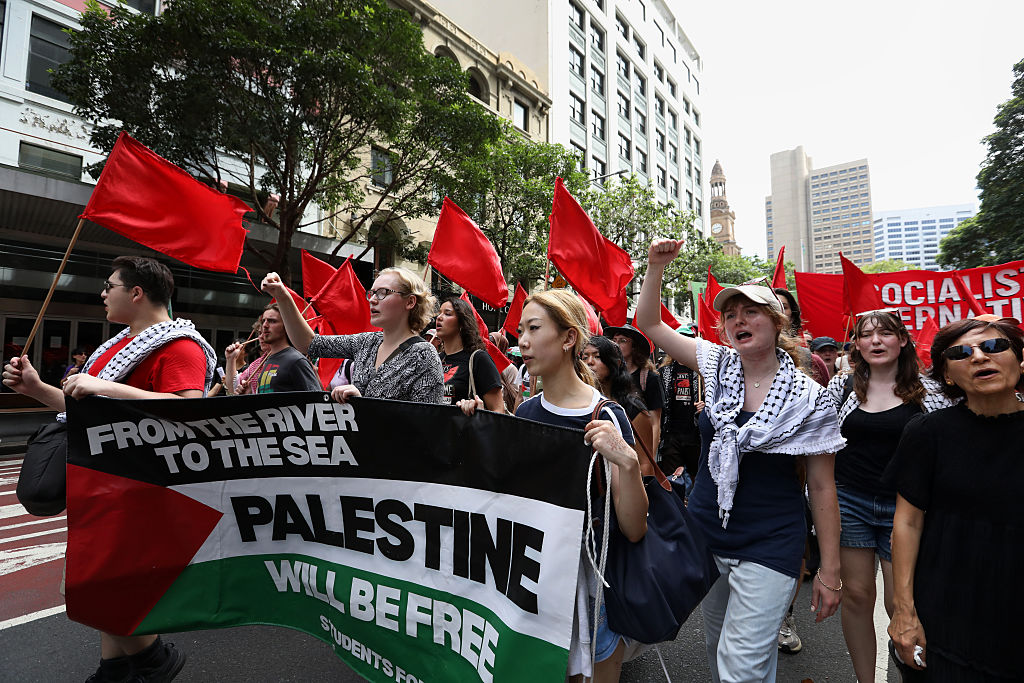
Palestinian solidarity continues to face repression in Australia. (Lisa Maree Williams / Getty Images)
- Interview by
- Chris Dite
The Palestinian solidarity movement in Australia has endured a wave of repression throughout the first few months of 2026. Every attempt to silence Palestinian voices, however, has been met with resistance.
In January, the banning of Palestinian Australian writer Randa Abdel-Fattah from Adelaide Writers’ Week resulted in a mass boycott and the collapse of the entire festival.
In February, Prime Minister Anthony Albanese invited Israel’s president, Isaac Herzog, to visit Australia. Herzog was met with huge anti-genocide protests across the country. In Sydney, police violently dispersed protesters, and thuggish raids against the protest participants continue.
Later in February, a far-right lobby group organized a summit of mayors and local councilors in the state of Victoria. At the summit, Jillian Segal, the special envoy to combat antisemitism, described Palestine solidarity protests as antisemitic and “antithetical to what we want in our country, and to building social cohesion.”
In March, the state of Queensland criminalized the slogans “From the River to the Sea” and “Globalize the Intifada.” Two activists, including Queensland socialist Liam Parry, were immediately arrested. The states of Victoria and New South Wales also introduced increased police powers aimed squarely at the Palestine solidarity movement.
Despite all this, opposition to Israel’s genocide and Zionism more broadly has broken into the mainstream debate. The Jewish Council of Australia — formed in late 2023 in response to Israel’s bombardment of Gaza — has played a key role in this. It has become a prominent voice of opposition to Israel’s actions and a growing pole of attraction for Jewish Australians. With Palestinian peak bodies excluded from speaking at the ongoing Royal Commission Into Antisemitism and Social Cohesion, the Jewish Council will be one of the few voices making the case that criticism of Israel is not antisemitism.
Jacobin spoke with the Jewish Council’s new executive member, Bart Shteinman, about the frenzied start to the year.
Chris Dite
How is this wave of repression worsening antisemitism?
Bart Shteinman
Jewish Australians are stereotyped as being universally pro-Israel. The assumption that all Jews support horrible violence is a huge contributor to antisemitism.
When Israel’s president, Isaac Herzog, visited Australia in February, there were large protests, marred by heavy-handed police brutality. Australian Prime Minister Anthony Albanese called Herzog the head of state of the Australian Jewish community.
What better example could there be of the old antisemitic trope that Jews possess dual loyalties to states other than their own? In his comment about Herzog as the Jewish head of state, Albanese implied that a section of the Australian public is actually under the rule of a foreign leader. Imagine the reaction if he had said that the ayatollah of Iran was the head of the Shia Muslim community; that Vladimir Putin was the head of the Russian community; or that Xi Jinping was the head of the Chinese community in Australia? All of that would be unacceptable. And yet it still seems totally permissible for leaders to treat Australian Jews as guests or strangers who actually belong — as befits the Zionist narrative — overseas in Israel-Palestine.
No one should be continually forced to answer for an overseas government that they have nothing to do with, on account of their religion or ethnic identity.
But there’s a big difference between ordinary people in society and political organizations like the Executive Council of Australian Jewry, whose policies advocate for the State of Israel. They do have things to answer for. It’s obviously irresponsible to use Jewish people to justify repression. Restricting pro-Palestinian advocacy might be in the interests of the Israeli government, but it’s directly counterposed to reducing antisemitism and increasing solidarity with other communities.
Chris Dite
What’s the best approach to challenging all of this repressive legislation?
Bart Shteinman
The pro-Israel lobby is not insignificant, but it’s also not omnipotent. For example, Zionists didn’t get their preferred commissioner for the current Royal Commission Into Antisemitism. Proposed anti-protest restrictions in Victoria were watered down. Even previously unconditional backers of Israel like One Nation or the Nationals opposed the government’s recent anti-hate-speech laws.
Despite Australia’s weak constitutional free speech protections, we’ve also seen some courts refuse to prevent protests. The mobilization of people has been instrumental in this. The most obvious case was the 300,000-strong Sydney Harbour Bridge rally, where the court considered the scale of people dedicated to marching in defiance of a ban. This shows that there is always a back and forth between grassroots mobilization and the courts’ decisions.
The Adelaide and Bendigo literary festival boycotts and resignations also demonstrate the limits to repression. The solidarity from the Australian cultural workers for Palestinian author Randa Abdel-Fattah meant that similar proposals to censor the Sydney Writers’ Festival were deemed unworkable by state Premier Chris Minns.
Trade unions have a role to play here, in updating their strategies to fight for free speech as an industrial issue. Codes of conduct are being selectively used to go after particular political attitudes in professional industries. We saw that really clearly at the Australian Broadcasting Commission, where journalist Antoinette Lattouf was fired for sharing a Human Rights Watch story on her personal social media.
All this shows that civil society can and will teach governments a lesson about their ability to police open criticism and debate.
Chris Dite
Australian conservative politicians used to campaign against hate speech laws but now demand they be strengthened. What’s happening here?
Bart Shteinman
In the early 2010s, there was a huge move on the conservative side of politics to water down hate speech and racial discrimination laws.
People like former federal treasurer Josh Frydenberg previously argued that “you don’t need a hurt feelings test to run successful cases against anti-Semitic views.” Now he calls for incitement to hatred to face actual criminal penalties.
It speaks to the huge growth of the pro-Palestinian movement that these conservatives now need to turn their previous view on its head. These conservatives understand that even though those pieces of legislation might restrict right-wing speech and racism, they are useful in cracking down on pro-Palestinian speech. It’s ruthlessly pragmatic opportunism, with no connection to a consistent concern for Jewish Australians.
There should be penalties for incitement of racial hatred. But it’s critical that there are clear protections for political speech, and that the laws are defined so that people can understand what the line is and avoid it.
The pro-Israel lobby is demanding the thresholds in these pieces of legislation be lowered and widened so that any strident criticism of Israel could be held liable. It would be left up to the state — and who could pressure it most effectively — to decide what hate is. That is going to lead to all sorts of really inconsistent and punitive repression.
Chris Dite
“Social cohesion” is being used to justify repressive proposals. Is this just Orwellian doublespeak?
Bart Shteinman
Social cohesion does not have an obvious meaning. When you read the terms of reference for the Royal Commission Into Antisemitism and Social Cohesion, they define social cohesion as “strengthening the national consensus in support of democracy, freedom, and the rule of law.” They argue that this provides the strongest defense against antisemitism and other forms of extremism.
Most people would actually support that definition of social cohesion. The Jewish Council is striving for social cohesion in that regard: democracy, freedom, the rule of law.
But these are the very things that are being undermined by this wave of McCarthyite repression. It’s a restriction on freedom. It’s undermining the right to due process for people who are being put through the courtroom of public opinion and scorn. And ultimately, it’s about restricting our democracy from implementing what most Australians want: a humanitarian foreign policy that applies international law and does not arm governments committing genocide.
Chris Dite
Why are slogans with declared peaceful intent being criminalized but genocidal incitement from Israeli politicians ignored?
Bart Shteinman
There is an increasing contradiction within Zionist organizations. As Israel’s government becomes more and more right-wing, these organizations have to follow.
Israel’s former — and possibly future — Prime Minister Naftali Bennett gave a speech recently in which he said “the aspiration that the world is going to love Israel is not going to happen. What we need is that our enemies fear us.” Many Israeli politicians now openly say genocidal things. It’s bragging or vice signaling. But it’s a reflection of increasing weakness, not of strength or omnipotence.
This vice signaling is not very helpful for Israel’s supporters in the West, and yet this change in strategy is reflected in the pro-Israel lobby in Australia.
In the past, Australian Zionist organizations primarily ran PR campaigns for Israel, took politicians on junkets, promoted Israel’s economic and technological and cultural accomplishments, and so on. But now, it’s not really about making Australia love Israel. That is very much a lost battle. It’s about making people fear criticizing Israel.
They are allying with an ever smaller, right-wing section of Australian politics. And they’re simultaneously becoming more detached from elements of civil society the Jewish community used to be associated with: trade unions, multicultural organizations, the arts, literature, and mainstream journalism.
This does not bode well for their future influence in Australian society.
Chris Dite
Will Zionist organizations benefit from their alignment with the Australian far right?
Bart Shteinman
The pro-Israel lobby and the current wave of repression have to be understood as operating within and in concert with a larger, right-wing authoritarian agenda. It includes a range of people who don’t operate on behalf of the Jewish people.
Rupert Murdoch and Gina Rinehart aren’t Jewish, nor are they primarily motivated by the safety of Jews. They’re interested in maintaining a conservative stranglehold on major institutions and on our democracy and resisting any mild social democratic reforms.
There may be Jewish people with a lot of social capital in society who choose to collaborate with this right-wing agenda, but that doesn’t make this agenda Jewish. This agenda is about shrinking democracy, preventing Australians of all different faiths taking the country in a social democratic direction, reducing dissent, and stifling questions about our international alliances.
There are some contradictions here. One Nation is the most glaring example. More than any other party it has poured scorn on Muslims and Palestinians in Australia. Pauline Hanson has gone into parliament wearing an Israel flag scarf and offered some of the most public backing to the war against Iran. A portion of the Jewish community supports her. She and her newest team member, former Deputy Prime Minister Barnaby Joyce, stood together with the far-right Australian Jewish Association at the Bondi memorial.
But One Nation has a history of aligning with antisemites. Most recently, a candidate who was within single-digit points of winning a seat in the South Australian parliament ranted online about “pesky Judeans” and questioned the truth of the Holocaust. Similarly, the Rinehart-funded right-wing lobby group Advance Australia hosted a MAGA operative recently who claimed that Germany’s welcoming of Muslim refugees did more damage than Adolf Hitler did.
It remains to be seen when this contradiction will become unsustainable.
Chris Dite
How has the existence of the Jewish Council of Australia shifted the debate?
Bart Shteinman
There have been coordinated attacks on the Jewish Council to try to keep us out of the public debate. The pro-Israel lobby fear anything that disrupts the narrative that the Jewish community is monolithic and unconditional in its support for Israel.
But it is clearly feeling pressure. None of the main pro-Israel organizations in Australia has offered serious criticism of any Israeli policy toward the Palestinians since 2023. But in early April this year, they expressed misgivings about Israel’s new apartheid death penalty law.
This is partly because the Jewish Council of Australia is increasingly having our voice heard in the public debate. In just a couple of years, we have become the largest progressive Jewish organization in the country. We now have thousands of Jewish supporters in Australia. This includes many young Jewish Australians who have graduated from Zionist schools then gone through a 180-degree political evolution. It’s a sign of progress ahead that so many young people have been able to deradicalize themselves.
It’s also a positive indication that, in the long run, debate and conversation can shift the political alignment of a large proportion of the Jewish community in Australia. We’re now beginning to build the kind of community organizing structure that can achieve that kind of transformation of consciousness.
Ultimately, at the end of the day, the interests of the Jewish community are the interests of any minority in Australia. These interests include a universal application of human rights, a struggle against racism and bigotry, and a world in which people can get along with their neighbors and not be cynically divided by right-wing forces.