Julie Su Wants Economic Development for NYC’s Working Class

Mayor Zohran Mamdani’s deputy mayor for economic justice, Julie Su, speaks to Jacobin about her plans: “For too long, city hall policies have benefited the few but not the many in New York City.”
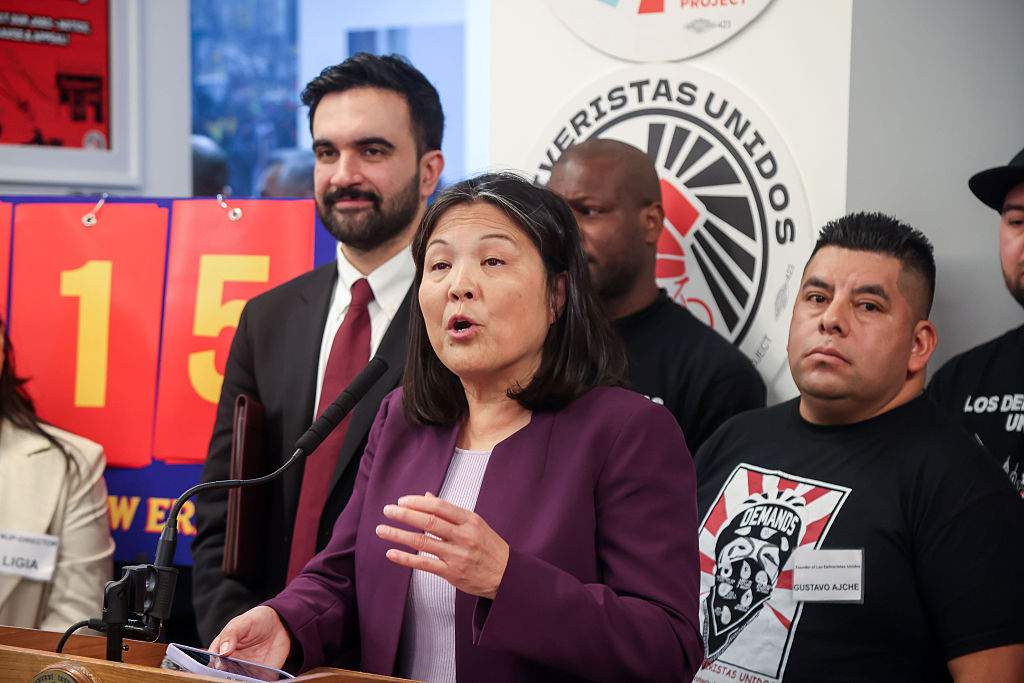
Julie Su, first deputy mayor for economic justice of New York, center, and Zohran Mamdani, mayor of New York, center left, during a news conference in the Brooklyn borough of New York, on Thursday, January 15, 2026.

“This idea that it’s so radical to propose that the city could be a place where everybody experiences justice is only the case because we’ve accepted injustice for so long,” Zohran Mamdani’s deputy mayor for economic justice, Julie Su, tells Jacobin. (Michael Nagle / Bloomberg


As I wait to speak with Julie Su, a lifelong labor advocate who has, under socialist Mayor Zohran Mamdani, become the first deputy mayor for economic justice, I watch people come through the doors of city hall and interact with artist Tom Stanford’s life-size wooden cutout paintings of the New York Knicks, on loan to the city in honor of the city’s beloved and often beleaguered basketball team, which has made the NBA playoffs this year. The figures seem to invite people to identify with the greatness of some of the city’s most intense strivers, as well as to feel at home in city hall, proud to be New Yorkers, and optimistic that better times are just ahead. Many visitors take selfies with the paintings.

I’m summoned and move to the room just next door to the Knicks cutouts for my meeting with Julie Su, a policymaker whose role in the new Mamdani administration is key to turning that welcoming, forward-looking vibe into something more tangible, in the form of a better collective life for New Yorkers. Su, fifty-seven, was acting Secretary of Labor under President Joe Biden for two years, but the Republican-controlled Congress never agreed to confirm her due to her pro-worker track record.

Some of the accomplishments they hated: the Department of Labor she led enacted new protections for construction workers, farmworkers, and miners and recovered more than a billion dollars for workers who had experienced wage theft. When union leaders call the Biden administration “the most pro-labor“ White House in decades, they’re praising Su’s leadership.

Explaining her new role as the deputy mayor for economic justice, it’s clear Su is already fluent in Mamdani. “For too long,” she says, “people have felt that city hall policies have benefited the few but not the many in New York City. “

Su comes to this position with experience as well as a decidedly more pro-worker bent than most who have served in the White House. Economic development in New York City is usually the purview of the business class, not of labor and economic justice advocates. The administration has not yet chosen the head of the Economic Development Corporation (EDC), an agency usually heavily influenced by the Partnership for New York City and other business groups. The EDC is, however, always controlled directly by the mayor and, due to its peculiar nonprofit status, allows the city executive unusual leeway over city-owned land and corporate tax breaks.

That makes it a gleaming prize in the power struggle between government and business. Business elites are plainly worried that under Mamdani, they won’t be able to manipulate it to serve their interests.

While the EDC has carried out some good projects under past mayors — the Brooklyn Navy Yard project under Michael Bloomberg and Bill de Blasio, for example, which created some unionized, light manufacturing jobs alongside small businesses — it has also presided over billions in wasteful giveaways for office space and luxury housing. Hudson Yards is a particularly shameful (and ugly) example of this kind of plundering and profiteering by the real estate industry.

But in this administration, the EDC will report to Su, an explicit statement by the administration that it intends to put economic justice first even in matters of economic development, and that business elites won’t have the first and last word.

“Mayor Mamdani and I are laser-focused on measuring what we do, and whether we succeed, by how much economic justice there is in New York City,” Su says. “You can’t have justice if you’re not talking about everybody. Especially those who’ve been left behind in the past. New Yorkers are hungry to see that economic development means development for them,” she continues. “And economic growth means growth for them.”

In the past, she says, “measures of economic development were about whether corporate profits were going up, but there was too little attention to everybody else.” To Su, “a shining example” of economic development for the many is the city-owned grocery stores. A signature plank in Mamdani’s campaign platform, these are intended to provide a public option for groceries, which many New Yorkers have cited as a burdensome cost. The week before our conversation, Su and Mamdani announced the first site for a city-owned grocery store: La Marqueta in East Harlem, on the site of a city-owned market opened by Mayor Fiorello La Guardia in 1936. Mamdani’s incarnation of this market will be open for business by 2029.

Su said that day:

Sixty-two percent of New Yorkers cannot afford the real cost of living in this city. Not extras, not luxuries — the basics. A home, childcare, medicine, food. Sixty-two percent is not an individual choice. It’s not one community’s problem. And it is not inevitable. It is a policy failure. . . .  At some point, government has to stop tinkering at the margins and act to make sure that public goods serve the public good. And that is what this is. The city owns this land, and we are going to use it to make food cheaper.

Su explained in our interview that the grocery stores will offer “a core basket of staples available at a dramatically reduced price.” Some items may be closer to market price, but the stores will affordably provide food meeting New Yorkers’ basic needs. Workers will be unionized.

Asked about the impact on small businesses, which has been the primary line of criticism from the Right (other than “communism, something something, bread lines”), Su says the city is working closely with small businesses in the target neighborhoods to get feedback on the plans, and that the city hopes the city grocery stores might even help local bodegas and other businesses by increasing foot traffic in the area. But, she says, “the other part of the answer is that New Yorkers named groceries as one of the things that is most unaffordable. So, we cannot rest on what is already there.”

Not all the criticism of this initiative has come from the Right. Some who support the city stores, like grocery expert Errol Schweizer, have pointed out that one reason grocery prices in New York City are expensive is that our stores aren’t large enough to command real negotiating power with suppliers, as Walmart and Costco do. So the city’s current plan could be too unambitious to succeed; having only one grocery store in each borough might be less effective than having many more. According to this view, Mamdani should consider scaling up this project.

Indeed, as the city and state budgets get closer to final form, it also seems clear that both governments need to think bigger on food security. What the city’s hungriest people need more than cheaper groceries is free food. Especially with some 180,000 New Yorkers poised to lose food stamps due to Donald Trump’s cuts, the hunger crisis is too large and too current for these small-scale, future-oriented solutions.

Emily Eisner of the Fiscal Policy Institute told Jacobin that the city and state should expand food voucher programs and (less expensively) the city’s school meals program. On the latter point, Eisner said, offering school lunch during the summer, as well as delivering school meals in a more flexible way during the school year (allowing kids to eat breakfast during their first period class, for instance) would go a long way. The failure so far to do any of this lies largely with the governor, who, despite fashioning herself as an anti-Trump leader, has largely left Trump’s tax cuts in place at the expense of New York’s poorest.

Still, the city-owned grocery stores are creative and popular policymaking. If they work well and people like and appreciate them, the stores will offer both a concrete improvement in New Yorkers’ lives and an ideological victory for the Left, showing that the government can deliver where the private market is not.

The city is announcing a second grocery store location this morning, a spokesperson told me, a 20,000-square-foot store in Hunts Point in the Bronx, scheduled to open next year. It will be on a public property called the Peninsula, the former site of an infamously awful juvenile detention facility, which the EDC has been developing into a mixed-use potpourri of affordable housing, childcare, open public space, and commercial space, which is where the city-owned grocery story will live. Only one other supermarket currently exists within a quarter of a mile of Hunts Point, and it is a neighborhood where, according to the city, 77 percent of residents cannot afford basic needs.

Thinking Big

I ask Su about other big economic development projects in the works. She says there are projects underway, like the one at the Brooklyn Marine Terminal, that her administration is going to try to ensure provide as many good jobs as possible for ordinary New Yorkers as possible. But much work has already been done on those projects, so the opportunity for Su and Mamdani to put their own imprimatur of economic justice on them might be limited. She says, diplomatically, “I’m really excited about those projects that will truly, wholly be ours.”

Su has been on the job officially since March, though she was working for the city informally before then. In addition to the grocery stores, another of her priorities has been getting tough on the crimes of the boss class. “Everyone should play by the same set of rules,” she says, “and working people should know that when the laws are violated, the city is going to have their backs.”

Su has been cracking down on predatory delivery apps for stealing deliverista workers’ paychecks, with new laws governing the sector and aggressive prosecution of violators. Her office has already helped win millions for those workers in settlements for violating minimum wage rules and is setting up deliverista hubs where workers can rest, charge their phones and e-bicycle batteries, access bicycle repair, and other services. The first of these hubs opened last month at city hall. Su has also been cracking down on junk fees, the numerous hidden or unnecessary fees imposed on consumers in all sorts of transactions.

Last week, the mayor and city council announced the city’s budget for the coming fiscal year, and the state budget was coming together in final form, as well. A city hall spokesperson told Jacobin that the priorities Su and I discussed — grocery stores and workers’ rights enforcement — were “positively impacted” by this budget, which contains $70 million in capital funds for the grocery stores. Indeed, despite the gaps, there is much to celebrate in this budget, especially on childcare and housing, but also more funding than promised for libraries and parks.

More Than Affordability

Su also wants to ensure that working people can have greater access to the arts and culture of New York City. “We certainly want life to be affordable,” she says, “but that’s not just about your groceries and rent. It’s also about real access to the things that make New York City New York City.”

Like so much about the Mamdani administration, this intention reminds me of the Fiorello La Guardia era, when, as historian Joshua Freeman documents in his classic history of this period Working-Class New York, due to a myriad of city policies and the strength of labor unions, workers could afford to go to the ballet, theater, and opera. Su’s EDC has announced free salsa parties, film screenings and other events at the Brooklyn Army Terminal, and free fan street parties during the World Cup.

“This idea that it’s so radical to propose that the city could be a place where everybody experiences justice is only the case because we’ve accepted injustice for so long.” She elaborates, “This city at one point did invest in public goods. We really want to get back to that.” This administration, she says, wants to invest in childcare, housing, transit, food — and all the things you need “to build, to enjoy a good life.”