Rejecting the Health Care Trap of the Democrats’ Donor Class
An oligarch-funded think tank is trying to undermine Medicare for All even before Democrats regain power. Candidates like Graham Platner and Abdul El-Sayed are rejecting the ploy.
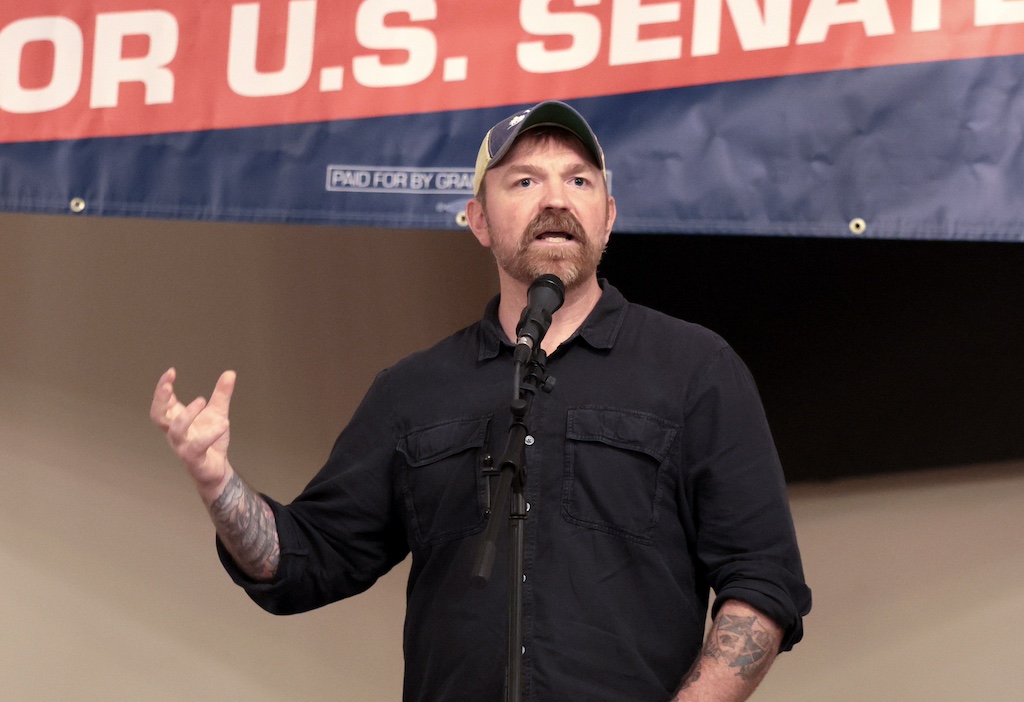
Maine Senate Democratic candidate Graham Platner is pushing back against Democrats’ tepid health care reform. (Joe Raedle / Getty Images)
The Democratic Party’s donor class is freaked out by the prospect of a massive populist wave election that doesn’t just switch control of Congress but puts into office the particular kinds of Democrats they loathe — the kind who may actually fight to get big stuff done, like, say, Medicare for All. And so they’re rolling out a set of proposals designed to prompt Democrats to begin negotiating against themselves and prevent that fight from even happening.
Last week, the oligarch-funded Searchlight Institute, led by Sen. John Fetterman’s former top aide, got itself a headline proposing that Democrats coalesce around free primary care and around creating the public health insurance option that the party promised to create eighteen years ago and then dropped.
In a vacuum, the initiatives are fine. Free primary care and a public insurer competing with private insurers would be better than the current health care dystopia (which is why I was an advocate for the latter eighteen years ago when it was on the legislative table!). And yes, the proposals are like many laudable Democratic bills in Congress that would incrementally improve the health care system.
But this isn’t a vacuum — it’s a political arena. In context, the proposals can be properly read as an attempt to preemptively narrow the terms of the discourse and the parameters of what’s considered “politically possible” before Democrats even regain power.
As he surges ahead in primary polls, Michigan Democratic Senate candidate Dr Abdul El-Sayed rightly called the proposal out for what it is — a cynical ploy.
Responding to the example of someone getting a free primary care consultation but then no additional coverage, he said such a person “then has to be admitted and STILL faces an insane deductible and financial ruin . . . because they got sick.”
He then added: “Folks will do anything not to admit that Medicare for All would be the single most transformational policy to ease financial anxiety and improve health in America.”
This prompted New York Times opinion writer Rachael Bedard, a physician, to pooh-pooh El-Sayed, declaring: “I’m a single payer girlie myself but if there was reasonable chance of passing free primary care 4 all (and a public option, and restored Medicaid + Medicaid expansion) I’d be thrilled to take that deal on behalf of my precariously insured patients, and at this point in the game I’m definitely not about to let perfect be the enemy of good on improving the American healthcare system.”
Bedard is invoking a now-familiar argument among American liberals — namely that their party should always be pitching compromises rather than making maximalist demands. And perhaps at the end of drawn-out legislative fights, that logic occasionally might make a bit of sense. But what’s new here is that this argument — which had resulted in so many surrenders, including Barack Obama’s surrender of his single payer promise and then his public option promise — is now being made by liberals even before Democrats are in any kind of policy fight at all.
That, of course, is the intended effect of the Searchlight Institute’s proposals — to get liberals to help stop a Medicare for All fight before one even unfolds.
Personally, I do not think Democrats should be negotiating against themselves before their party even has majorities in Congress. I think they should be doing the opposite right now. Out of power and wildly unpopular, Democrats should be using this moment to transform their party, think big and actually stand for something other than the insipid incrementalism that made them so loathed in the first place.
I do not believe Democrats must instead use this current moment in exile to preemptively prioritize not “let(ting) perfect be the enemy of good.” I think that whole notion is a fiction — one that aids the moneyed interests that have been playing a cynical Overton Window game for forty years.
Notably, Searchlight’s own executive director, Adam Jentleson, once criticized that game in 2019 when Pete Buttigieg suddenly dialed back his support for Medicare for All. Back then, Jentleson impugned Buttigieg, saying he “supported Medicare for All for 15 years, then flipped and started attacking other Dems over it after raising a ton of money from the health care industry.” Jentleson added: “A reasonable person might conclude that the health care industry bought Pete’s opposition - and did so pretty easily.”
Fast forward seven years, and the health care crisis is worse, but Jentleson is now playing that game. And my question is: Why would anyone fall for such an obvious parlor trick? This impulse by liberals to constantly back down and make apologies for capitulating Democrats is just weird — and it’s ultimately why so many Americans think Democrats stand for nothing.
Even for those like Bedard who say they’d be thrilled with just free primary care or a public option — which, again, are decidedly better than the status quo — the preemptive retreat strategy at this particular moment makes little sense.
After all, we know from basically every legislative fight in history, if one side starts out demanding a full loaf of bread, they have a better chance of at least getting half a loaf. If instead they start out demanding merely a thin slice of bread, they are probably going to only end up getting a crumb, if anything at all. You can see that in the original fight over the Affordable Care Act: Obama dropping the full loaf (single payer) from the outset resulted in a legislative fight that ultimately didn’t even get half a loaf (the public option).
El-Sayed seems to understand this dynamic — and he’s not the only one. There’s also Maine Senate Democratic candidate Graham Platner.
“There’s been a frustrating relationship with a lot of the pundit class over the course of this campaign, which is always like, ‘We haven’t been able to get Medicare for All, so why do you think we can get it now?’” Platner told the New York Times this weekend. “Well, we’re definitely never going to get it if we elect people who don’t want to get it! That seems fairly obvious to me. I think we need to look at the United States Senate as a place where we have to engage in a power-building process, which is going to be electing more people who want to advocate, vote for and elevate the conversation around these things.”
That reference to “the conversation” is key: the conversation — read: the political discourse — is what creates the perception of possibility, which ultimately creates policy.
Oligarchs want to control the discourse to narrow policy possibilities down to only those initiatives that preserve their wealth and power. They don’t want to have to pay more in taxes to fund something like Medicare for All, and so their minions throw out half measures as a way to try to limit the policy horizon.
As Admiral Ackbar warned: it’s a trap.