US Military Aid to Israel Is a National Security Risk

We have another report that Israel used the military power the US underwrites to pressure Donald Trump into a disastrous war in Iran. US military aid to Israel makes Americans — to say nothing of the rest of the world — less safe.
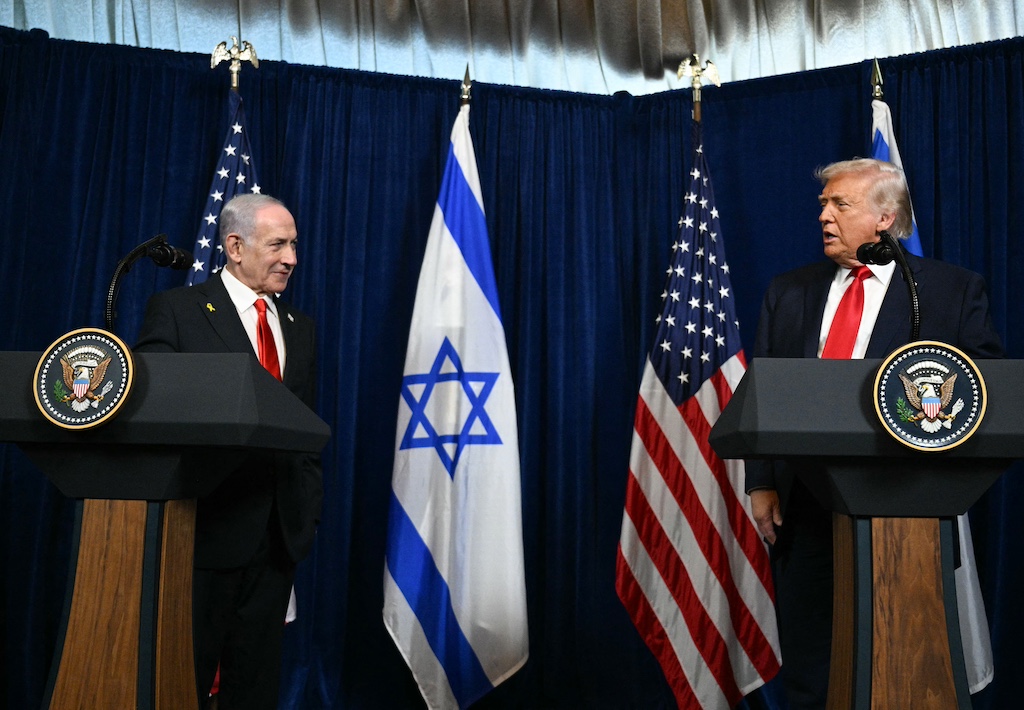
Israel does not have the capacity to do what it’s doing in Iran without the United States. (Jim Watson / AFP via Getty Images)

Over the weekend, the Washington Post was the latest to publish a claim that Israeli prime minister Benjamin Netanyahu used the threat of launching a war with Iran solo as a way to pressure Donald Trump into the disastrous war he has now embroiled the United States in. It’s at least the fifth piece of evidence now suggesting that the United States was pushed into this war by Israel, and that the very military support that Washington provides Israel has served as the mechanism to do it.

It’s tempting to see this as a deliberate way to dump responsibility for this horror show onto Israel and divert it away from the US president, who ordered it, and the US foreign policy establishment as a whole, which has salivated over a war with Iran for decades. But we have mounting evidence that Israel bears a huge amount of responsibility. Which raises the question: If Israel was indeed able to successfully trigger a US-Iran war, is any ceasefire or lasting peace possible here without Israel’s approval? This is particularly relevant to an American public that foots the bill for Israel’s war-making.

According to the Post, Netanyahu, “increasingly alarmed” that Trump might actually solve the Iran issue peacefully, repeatedly rushed to Washington over the past few months to make sure he went to war instead. A “key component of his drive to war,” reports the Post, was telling Trump that Israel would go ahead and attack Iran with or without his help, which “led Trump to believe an Israeli attack was inevitable” and that his best option was to go along with it.

“Trump felt like he didn’t have a choice,” someone who understood the president’s thought process told the paper.

This account closely mirrors an earlier report by the New York Times, published a day after the war’s start, that likewise has Netanyahu deathly afraid that peace is going to break out and doing a full-court press on Trump to push him into war instead, including by threatening to go it alone against Iran. That report had Trump similarly telling Tucker Carlson that he felt like he didn’t have any choice but to join a coming Israeli attack.

This is on top of separate public statements made by Secretary of State Marco Rubio, Republican House speaker Mike Johnson, and Trump warmonger-in-arms Sen. Tom Cotton, all of whom sketched out the same, broad scenario: Israel was going to attack Iran no matter what, which would have triggered reprisals against US troops and assets in the region, leading Trump to decide that preempting such attacks by joining the war from the start was his best option.

It’s true that there is a big war lobby in the United States that has wanted war with Iran for a long time, and that some US officials have explicitly seen regime change in Iran as the first shot in a future war with China. But there is little sign that launching this war is part of a coherent grand strategy. The war undercuts Trump’s own, two-month-old National Security Strategy, which envisioned the United States pulling out of the Middle East to exert dominance over Latin America. Instead, Trump is now diverting military resources away from the Americas to the Persian Gulf. Far from strengthening the US hand against China, it has ended up drastically depleting the US of munitions stocks meant for any future confrontation with the country, while simultaneously alienating US allies in the Gulf and the “Indo-Pacific.”

Meanwhile, Trump officials’ confused public messaging and slapdash approach paint a picture of an administration that seems taken by surprise by its own war: the shifting public justifications, their inability to articulate a clear endgame or consistent goals, the failure to warn and evacuate Americans from the region, and the rushed and ad hoc response to Iran’s retaliation, to name just a few. That’s not to mention the clear way this war works against Trump’s own political interest, which is why his chief of staff is scrambling to mitigate its affordability impact and advisors already want him to get out.

In no way does this absolve Trump for making the idiotic decision to go to war. The US president has the power to say no to Israel, as many have over the years, Trump included. In fact, former secretary of state Antony Blinken just told Bloomberg News that Israel tried this exact move previously, with both Barack Obama and Joe Biden, and both presidents managed to avoid getting drawn into the Israelis’ plans.

Pressure can be resisted. But pressure can also work, particularly on weak and war-happy politicians — and unfortunately there is no shortage of those in Washington.

This is not a minor detail. If true — and the fact that we now have five separate claims for this suggests that there is at minimum a sizable kernel of truth to it — it means that far from a benefit to the US and a boon to its national security, the US security partnership with Israel is, instead, a liability and a national security risk to the United States and its people.

As we’ve seen repeatedly, both in this war and Israel’s various wars over the past three years, Israel simply does not have the capacity to do what it’s doing without the United States. The weapons and military equipment, the bombs, the logistical support it needs to drop them, the defensive capabilities it needs to shield itself from retaliation for dropping them — all of it comes courtesy of the US taxpayer, and of the US troops and military infrastructure stationed in the region.

This is what gives tiny Israel the ability to wage six separate wars simultaneously as it did throughout 2024, to illegally occupy and even annex the territory of three different neighbors as it’s doing now, and to launch, as it just did in Lebanon, a separate war in a different country at the same time that it started its most dangerous confrontation with its most hated enemy, Iran.

Israel’s ability to launch war after reckless war is almost entirely underwritten by the United States. That ability, it turns out, is also the gambit unscrupulous Israeli leaders can use to potentially trap the United States in a war most of its people do not want — a war that has already killed Americans, that is making terrorist attacks against them more likely, and which is set to make them poorer and quite possibly jobless pretty soon. By footing the bill for US military support for Israel, American taxpayers are effectively paying to undermine their own security and place themselves in danger.

In a rational political system, this would prompt the immediate pause of US military aid and an urgent and public conversation about ending it entirely. US security partnerships, after all, are meant to enhance the security of Americans, not weaken it. Instead, because Israel carries such sacrosanct status among the political and media establishment, this bizarre arrangement is allowed to continue with barely any comment.

This isn’t even the only new information we have about Israel’s role in pressuring the United States into this war. Last Friday, the Wall Street Journal reported how Sen. Lindsey Graham — who Trump once called “one of the dumbest human beings” and said would start World War III before turning him into one of his closest advisors — repeatedly went to Israel in the weeks leading up to war, where he conferred with its intelligence agents and spent time “coaching [Netanyahu] on how to lobby the president for action.” No wonder a prominent and politically connected Emirati billionaire issued a scathing statement accusing Trump and Graham of being “prepared to risk their country and the lives of Americans for Israel’s interests.”

Just the other day, Trump told the Times of Israel that with the war on Iran, “we’ve destroyed a country that wanted to destroy Israel,” and that ending the war would be a “mutual” decision with Netanyahu, not even so much as gesturing to the war’s necessity to US interests. These are extraordinary statements for a US president to make, and which the Israeli paper, in the understatement of the year so far, said “pointed to the significant degree of influence Netanyahu would appear to have over Trump’s decision-making in the war.”

Meanwhile, there are clear signs of the way that Israeli and US war aims are diverging. Four days in, a former Israeli military intelligence official told the Financial Times that while the United States was interested in some kind of stable postwar Iran whose government they found acceptable, Israel “couldn’t care less about the future . . . [or] the stability of Iran,” while one currently serving Israeli military official said, “We want to ensure Iran stays in disarray.”

This has played out on the ground in Iran: Israel’s decapitation strike on Iran’s leaders killed several officials that Trump had hoped to make a deal with, and US officials — including, revealingly, the bloodthirsty Graham — were reportedly unhappy with Israel’s bombing of Iranian fuel depots over the weekend, which they view as critical to a future stable Iranian state (and want to profit off of) and claimed Israel had misled them about. Simply put, Israel has very different goals and interests than the United States, and it has already repeatedly undermined the Trump administration’s own half-assed plans in the course of this war.

This is critical to what happens next, especially as Trump signals he might be ready to wrap the war up. He of course should: not just because it’s best for the country and the world, but because it’s best for his own political self-interest, given the risk of economic crisis heading into this year’s midterms.

But we are learning that it may not be completely up to him. The real question for anyone who wants prolonged peace and economic stability — a group that includes a majority of the US public — may instead be whether the Israeli government will be satisfied with leaving things as they are now: with an even more hard-line supreme leader in place, the Iranian regime’s moderates discredited, and nearly half a metric ton of highly enriched uranium still in its possession. If not, continuing US military aid to Israel may end up the arsenic in the cup of any lasting peace that Trump tries to serve moving forward.