Henry Kissinger: To Die at the Right Time
From Rockefeller to Nixon, then on to Reagan, George W. Bush, and Donald Trump, Kissinger’s service tracked the metaphysical evolution of American power. We all live now in the Kissingerian void. What horrors await?
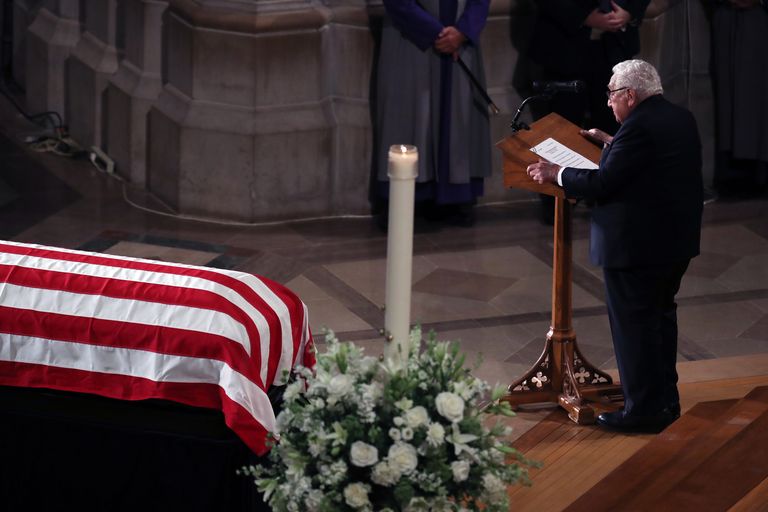
Henry Kissinger delivers a eulogy for John McCain, 2018.
In 2015, I published a book, Kissinger’s Shadow, which argued that Henry Kissinger is good to think with. By this, I meant that his long career (as an early Cold War defense intellectual, top foreign policymaker, consigliere to the world’s elite and hawkish pundit) and very self-aware philosophy of history help illuminate the contours of postwar militarism, tracing a bright line from the disastrous war in Southeast Asia to the catastrophic one in the Gulf.
The book came out a year before the unanticipated election of Donald Trump to the White House, when I thought an autumnal Kissinger’s last act would be to bask in the warmth of neoliberal accolades offered by Democrats such as Hillary Clinton and Samantha Power. Its conclusion focused on the ways in which Barack Obama’s pragmatic, managerial militarism echoed Kissinger’s earlier justifications for interventionism and war, and the way Kissinger used Obama’s disregard of national sovereignty, in his reliance on drones and bombing campaigns, as an ex post facto absolution of his own past actions. Asked about his involvement in the overthrow of Salvador Allende in Chile and his illegal bombing of Cambodia, Kissinger answered that Obama has behaved similarly, pointing to drone assassinations and the ouster of Gaddafi in Libya.
It seemed a perfect expression of American militarism’s merry-go-round logic: Kissinger invokes today’s endless, open-ended war to justify what he did in Cambodia, Chile and elsewhere nearly half a century ago, even as what he did half a century ago helped create the conditions for today’s endless wars.