Sven Beckert’s Chronicle of Capitalism’s Long Rise
Capitalism is a global economic system, so a proper chronicle of its rise to dominance has to examine the entire world, as historian Sven Beckert does in his massive new book, Capitalism: A Global History.
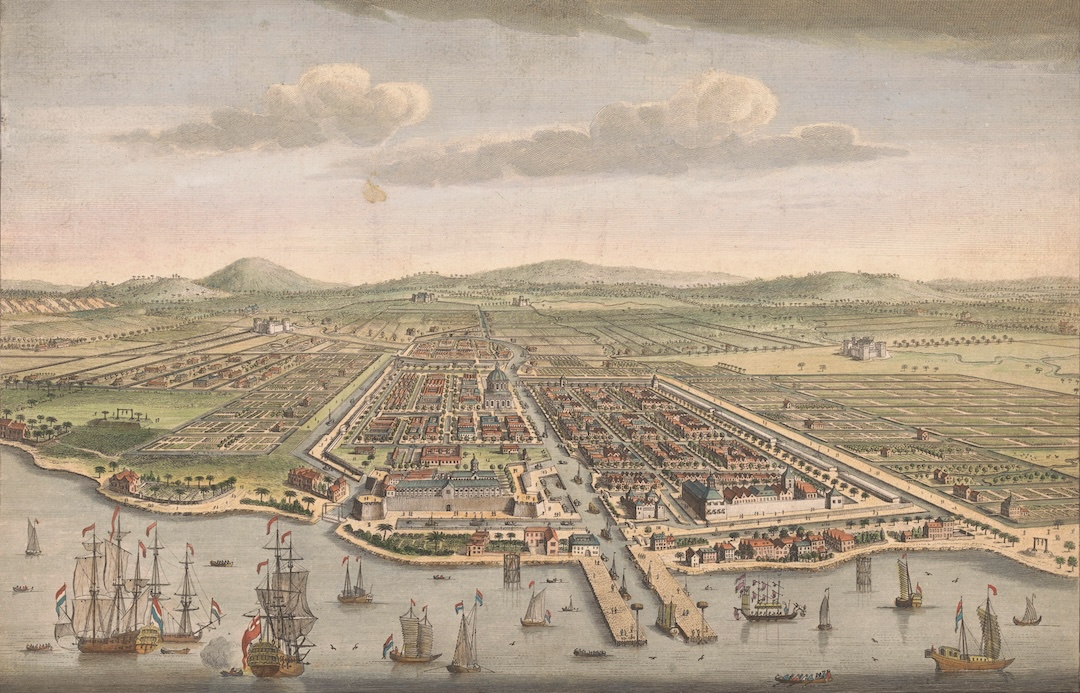
Throughout the sixteenth and seventeenth centuries, the archipelago of capital metastasized as island after island — both in the literal and metaphorical sense — was added to the mercantile universe: Santo Domingo in 1516; Macau in 1557, Batavia in 1619, Manhattan in 1624, Barbados in 1627. (Heritage Images via Getty Images)
Sven Beckert’s doorstop of a book is supremely ambitious, an insightful and well-illustrated history by the Harvard historian who has been a pioneer in the creation of new narratives exploring how an ever-changing capitalism has been a socially and culturally rooted phenomenon. At well over a thousand pages, Beckert’s volume offers a synthesis and occasional recasting of almost everything we have learned about the history of capitalism, and not just in the closely studied societies bordering the North Atlantic. It is a global history, holds Beckert, because capitalism “was always a world economy.” Writing within the world-systems schema associated with Fernand Braudel and Immanuel Wallerstein, he probes for the connections, parallelisms, and transformations taking place within an economic and social history stretching back almost a thousand years.
Historian Marc Bloch once wrote that carefully observing the world was just as important in understanding history as time spent in the archives. Beckert agrees. His book is a result not just of an immense amount of bookish research but of visits to factories, plantations, warehouses, railroads, docks, mansions, mosques, churches, and merchant homes stretching from Phnom Penh to Senegal, from Samarkand to Amsterdam, and from Turin to Barbados. I can attest to the importance of such travel: twenty years ago when I visited China’s Pearl River Delta, then becoming the workshop of the world, I not only gained crucial insights into how Walmart sourced its supply chain but also came to a more intuitive understanding of what a booming and fissiparous Detroit must have seemed like nearly a century before.
“There is no French capitalism or American capitalism,” writes Beckert, “but only capitalism in France or America.” And there is also capitalism in Arabia, India, China, Africa, and even among the Aztecs. In his narrative of merchants and traders in the first half of the second millennium, Beckert puts Europe on the margins, offering instead a rich and, except for specialists, unknown account of how the institutions vital to commerce and markets, including credit, accounting, limited partnerships, insurance, and banking flourished, in Aden, Cambay, Mombasa, Guangzhou, Cairo, and Samarkand. These are all “islands of capital,” a recurrent metaphor in Beckert’s book. For example, in the twelfth and thirteenth centuries, Aden was host to a dense network of merchants who played a pivotal role in the trade between the Arabian world and India. It was a fortified, cosmopolitan city of Jews, Hindu, Muslims, and even a few Christians.