Capitalism Had a Beginning and Will Someday End

Sven Beckert

Historian Sven Beckert on where the capitalist system came from, what keeps it alive, and what it would take to bring it down.
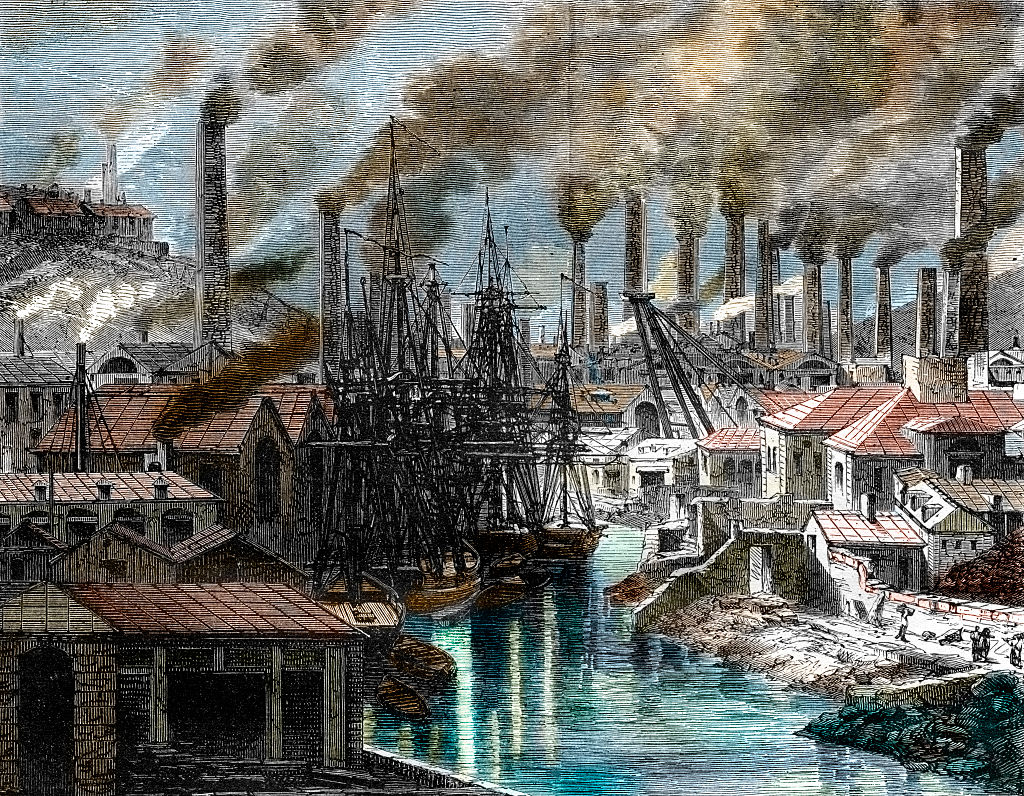
“Everything that has a beginning also has an end.” Harvard historian Sven Beckert on a thousand years of capitalism and what comes next. (Leemage / Corbis via Getty Images)

Interview by
Loren Balhorn

The past several decades have been turbulent ones for the world system: the financial crisis, the rise of new middle powers in the Global South, and the wars in Ukraine and Gaza, to name a few, have placed greater strain on the postwar order than at any other time in its history. Yet despite growing apprehension that said order may be on the verge of collapse, its economic foundation — namely, capitalism — remains remarkably sound. For the first time in human history, a single mode of production dominates the world almost without exception. No political force, not even the remaining party-states that embrace the “communist” label, offers a plausible alternative to market-based economics.

But how did capitalism come into being, and what makes it such a uniquely dynamic — and thus tenacious — form of social and economic organization? This question has occupied scholars for two centuries, beginning with thinkers like Adam Smith and Karl Marx. Some, such as the American Marxist historian Robert Brenner, point to the transformation of property relations in England in the middle of the last millennium, while others like Jairus Banaji see the beginning of capitalism much earlier in human history — namely, with the emergence of commercial trade networks hundreds of years prior.

Historian and Harvard University professor Sven Beckert recently published his own contribution to the debate, Capitalism: A Global History, in which he weaves together various strands of historical scholarship across more than 1,200 pages to craft a comprehensive and sweeping yet detailed narrative of capitalism’s rise to global dominance over the past thousand years. He spoke with Jacobin about his intellectual formation, how his own work fits into debates on the history of capitalism, and how — if at all — this notorious mode of production might one day disappear from the stage of history.


Loren Balhorn

As a historian, you’ve studied the emergence of capitalism a long time. Your last book, Empire of Cotton: A Global History, was also a history of capitalism in some ways, or at least specific aspects of it. What did you seek to accomplish with this new history of capitalism?

Sven Beckert

The motivation to write the book came partly from the academic response to my book on cotton production. One of the criticisms was that capitalism is more than a history of cotton, which is obviously true. Empire of Cotton puts forward quite a few arguments about capitalism, but the book naturally only covers a small part of its history — temporally, spatially, but also in terms of what the industrialization of cotton represents in the history of capitalism. There was, naturally, a lot more I wanted to say about capitalism.

Beyond that, however, I noticed two things about how we talk about capitalism today. First, capitalism plays a very, very important role in political debates. There are many very strong arguments about capitalism, but the understanding of capitalism itself is often not particularly well developed — both on the Right and on the Left. My aim, therefore, was to write a history of capitalism from a historical perspective in order to enrich contemporary debates by gaining a better understanding of capitalism itself.

Second, the project developed out of a critique of existing attempts to understand capitalism. A very prominent school of thought about capitalism is an ahistorical one that views capitalism as the quasinatural state of the world. Changes happen, of course — we produce more than we used to; we produce differently — but in principle, the capitalist logic is universal and has existed in all societies throughout history. The book fundamentally challenges this argument.

Moreover, the history of capitalism is also still very much shaped by Eurocentric perspectives. My study of the history of cotton already made it clear to me that capitalism cannot be explained from a purely European perspective. This is especially true in the twenty-first century, when even the most superficial observation would lead one to conclude that it is impossible to understand the modern global economy without also taking into account other parts of the world beyond the European continent. Thus, it seemed important to me to analyze this in greater depth. A central argument of the book is that capitalism was born global, so to speak, and can only be understood from a global perspective at every moment in its history — even in its most Eurocentric moments.

Loren Balhorn

As a scholar, which intellectual traditions or schools of thought do you draw on? You mention Fernand Braudel in the book’s introduction. Would you consider yourself a student of the Annales School?

Sven Beckert

I find it difficult to define myself as a student of one particular school. Fernand Braudel’s work on the history of capitalism has perhaps influenced me more than the works of other historians or thinkers. My emphasis on the importance of merchant capital, trade — including with the non-European world — and the radical transformation of economic life by the capitalist revolution, yes, these are all ideas that can also be found in Braudel, even though my book is completely different from Braudel’s. The emphasis on the importance of the state in the history of capitalism is definitely also something I share with Braudel.

But that’s only one of many works that have influenced me. Reflections on the history of capitalism are at least 200 or even 250 years old. There are important traditions in a wide variety of disciplines, from Adam Smith to Karl Marx to Rosa Luxemburg, which are also important for the book. In that sense, I’m influenced by a wide variety of sources. Last but not least, there are libraries full of very specialized works that often attract very little attention — but without them I could not have written Capitalism.

The book is not about showing that Smith or Marx was right or wrong but rather about telling and analyzing the history of capitalism over the last five hundred years in order to better understand it — and, of course, to give us an opportunity to think about the world we live in today in a new and perhaps more creative way.

Loren Balhorn

You just mentioned the last five hundred years of capitalism, but the book itself refers to a “thousand years” of history. While reading, I was a little surprised that you start centuries before what most historians would consider the birth of capitalism.

Sven Beckert

That may be a misunderstanding. The second chapter of the book is called “Capitalists Without Capitalism.” The first chapters are not about arguing that capitalism originated in the eleventh or twelfth century but about two other things. First, they are about showing that there were other forms of economic life and that these followed a fundamentally different logic than that of capitalism. That allows us to see the radicalism of the capitalist revolution.

The second thing is that I see the emergence of capitalism as a fundamentally historical process that cannot be precisely dated or localized on the world map. Many scholars are searching, in a sense, for the seed from which capitalism sprang: some find it in Florence, others in southern English agriculture. I believe that this is doomed to failure. Capitalism emerges as a globally networked process that unfolds slowly. In a sense, it is also an ongoing process that we can still observe today in certain regions of the world or in certain spheres of our lives. The capitalist logic is still in the process of emerging.

Nevertheless, the emergence of capitalism is a historical question that to some extent should and can be located in time and space. To this end, I felt it was important to identify the actors who introduce this new, so differently structured logic into economic life. Here I agree with Braudel or Jairus Banaji that they can initially be found among owners of capital. Until well into the nineteenth century, these were largely people who organized long-distance trade or banking.

When I look at the world in the first half of the second millennium, I find that even at that time there were a number of places where merchant communities organized their economic life according to a different logic than tributary rulers or subsistence farmers. These groups can be found in many different parts of the world, but they are concentrated in urban “islands of capital.” They often enter into relationships with noncapitalist agriculture and tributary rulers, which give them opportunities to further spread the logic of capital.

This logic has existed for a long time, even before the first half of the second millennium, but it was marginal to the economic life of the world. The answer to the question of the emergence of capitalism is therefore when this logic spread and had a stronger influence on economic life. For me, this ultimately happened — and perhaps that is very traditional — at the end of the fifteenth and beginning of the sixteenth centuries, with the European expansion.

Loren Balhorn

That’s the point at which capitalist logic moved from the periphery to the center?

Sven Beckert

Exactly. This happens first and foremost in agriculture. Robert Brenner is right: capitalism first emerges in the countryside. This process can be found in different forms in different regions. It is problematic to say that the place where this transformation really matters is exclusively southern England. It’s problematic for two reasons: For one, even in these rural transformations we can see the importance of merchant capital. And second, this merchant capital is, of course, also directly involved in the expansion of production in the Caribbean and the Americas more broadly. The development of capitalism can therefore only be understood as a networked global process that cannot be grasped from a local perspective.

It’s crucial to look at the Atlantic world here: because European capital owners were able to radically and rapidly change the logic of production in the Caribbean or on the West African islands, they had considerable capital at their disposal, which in turn enabled them to transform the much more conservative social structure of European agriculture, often against significant resistance from both elites and the peasants themselves. Therefore, my argument is that Europe changed not only from within but also from the outside in.

Loren Balhorn

Capitalism can only be understood as a global process, but nevertheless one in which violent conquest by the West played a central role?

Sven Beckert

Absolutely. One of my central arguments is that capitalism is not only based on contractual regulation of social and economic relations, or merely a realization of human freedom, but also relies heavily on extraeconomic coercion. This observation was not very popular in the neoliberal era, but when we look at the world today, it unfortunately confirms some of the arguments I make about the history of capitalism.

The history of capitalism, at least in one of its important phases, is a history of violent conquest. Europe was central to this history. The book argues against a Eurocentric reading of the history of capitalism, or one that virtually ignores the rest of the world. But on the other hand, I am similarly skeptical of arguments that Europe should be marginalized. On the contrary, as you say, Europe played a very central role, especially from the end of the eighteenth century to the middle of the twentieth century, and that must also be reflected in our thinking about capitalism.

But even in capitalism’s most Eurocentric moments — say, the mid-nineteenth century, when a great deal of attention must be paid to Europe — European developments can only be understood by embedding them in a more global history. Here again, cotton is a good example: we cannot understand the Industrial Revolution in England without understanding the transformation of agriculture in the Southern United States. The two belong together and must be explained together.

Loren Balhorn

In the chapters on the mid-nineteenth century, you provide vivid descriptions of how the upper class emerged in the metropolises and publicly displayed its newfound wealth and power. In your view, when did a coherent, conscious capitalist class as such come into being?

Sven Beckert

I’m glad you noticed the chapters on the nineteenth century. Often people notice the chapters on early history and then those on neoliberalism, but not everything in between. But I think some of the more original arguments in the book can be found precisely in the chapters on the history of the nineteenth century.

One of the results of the capitalist revolution is the emergence of a class society, and indeed a specific type of class society. I call it “capitalist civilization.” Of course, this also means a self-aware bourgeoisie that understands itself as a class emerges. These social classes are a complicated issue at every point in the history of capitalism, because they are never completely uniform, neither culturally nor politically, and of course they have competing economic interests. This cannot be overemphasized. The same is true among workers: we can observe the emergence of a working class in the nineteenth century, but there are still many differences and conflicts within this working class. It is never a homogeneous social formation.

In the first half of the nineteenth century, a society emerges in some parts of the world that is very much subject to this capitalist logic, but in a sense it is still surrounded by precapitalist forms of political power, social life, and labor organization. Tensions arose between the very dynamic capitalist-organized economy and these older traditions of political and labor organization, tensions that exploded in the mid-nineteenth century. This is the moment when the older forms of political rule or the older forms of labor mobilization, such as slavery, are marginalized. I refer to this in the book as the age of rebellions.

Loren Balhorn

Similarly central to both the upper class of the nineteenth century and earlier capital owners in your book is the patriarchal family, both for the transfer of property and for the social structure of the class itself. At the same time, we can observe contradictory tendencies toward the dissolution of family structures in capitalism. Given these tensions, could there be capitalism without the family?

Sven Beckert

Whether it would be possible in the future for capitalist civilization to do without the bourgeois family is a good question, but one that is difficult to answer. I would say there are reasons to assume that the family will continue to play a very important role. First, because the bourgeois family is central to the production of bourgeois culture and the creation of social connections and networks, which in turn are central to the constitution of the bourgeoisie but also to the organization of the capitalist economy itself. Of course, the family is also central because it allows for the transfer of accumulated capital, which is difficult to imagine conceptually without the family.

But beyond that, as we know, the family is not only central to the bourgeoisie but also to the reproduction of the workforce and thus to production. Therefore, there are no examples of capitalism that are not based on an ideologically and socially important idea of the family, and I don’t think that this is fundamentally different today. At the beginning of the interview, you asked which authors have influenced me. One author who has definitely influenced me is Nancy Fraser, who explains why the nonmarket is so important for the constitution of the market and for the constitution of capitalism. I would agree with that 100 percent.

Loren Balhorn

There is a long-running debate among Marxists on precisely this question of the external or outside that capitalism must constantly incorporate. In your book, you describe the era of European colonialism, for example, as a kind of “war capitalism.” Given the rapidly escalating geopolitical tensions today, are we heading back toward such a period?

Sven Beckert

The nonmarket and coercion have played an important role at every point in the history of capitalism. I am somewhat skeptical of an interpretation that says: yes, there is a violent early history of capitalism, but it ultimately gives way in the nineteenth or twentieth century to a peaceful history of contract and human freedom. I would question this narrative.

Of course, the way in which this violence is exercised and the forms it takes change. There is sometimes a tendency to lump everything together and say: okay, slavery is not really that different from what textile workers in Cambodia have to endure today. I disagree with that. It is important to see how these forms of coercion have changed throughout the history of capitalism.

Today many observers are shocked and disoriented because they adhered to a narrative that assumed that this early history of capitalism had been permanently overcome and we had entered a completely different moment of capitalism. In the age of neoliberalism, the idea that contracts and markets could and should best structure all human relationships became, so to speak, a law of nature. Now we see that what some observers regarded as natural over the past fifty years was in fact only a particular moment in the history of capitalism. And to the surprise of almost all of them, we are returning to a moment in which the rhetoric, the issues, and even the politics of the late nineteenth century are suddenly reappearing in the present.

From the perspective of the ideology of the last fifty years, this is surprising, but from the perspective of the long history of capitalism, it’s not surprising at all. In a way, one of the core arguments of the book is that capitalism has taken very different political forms in the past — but also very different forms of labor regimes, very different forms of territorial organization — and that these differences have always combined and recombined in new ways. They were sometimes relatively stable for long historical periods but never permanently.

Now we are witnessing another moment in which these things are being recombined. In a way, it reminds us of the late nineteenth century or the beginning of the twentieth century. But history does not repeat itself. Europe is no longer at the center of the global economy — today the most dynamic capitalist economies are found in Asia. Thus, it is not a return to the nineteenth century, but rather certain themes and strategies are being revived, albeit in a different global configuration.

Loren Balhorn

In the epilogue, you refer to Erik Olin Wright’s concept of “real utopias,” islands of noncapitalist relations, and link them to your image of the early “islands of capital” that gradually spread as a possible way in which capitalism could one day end. But if we accept your argument that the state was a central factor in establishing capitalism, wouldn’t any noncapitalist logic also need such a relationship with the state?

Sven Beckert

That’s not in the book, but it’s an excellent point, and exactly right. Social democracy embodied that as well; it pursued precisely this strategy. No one can predict the future. I have only tried to make two arguments: first, that capitalism is historical. Some years ago, Immanuel Wallerstein attempted to date the end of capitalism. I was even there when he did so. I don’t have that kind of confidence. That said, everything that has a beginning also has an end.

When I reread Erik Olin Wright, I was amazed to see — I had completely forgotten — that there is a certain parallel between his arguments and my argument about the emergence of capitalism. This is purely speculation, but perhaps there is something in this history of “islands” that is useful for our thinking about the future.

Loren Balhorn

Perhaps one key difference between today’s capitalist civilization and historical capitalism is the absence of a powerful adversary in the form of the workers’ movement. The rise and fall of the movement that once contested capitalism in the heart of Europe also plays a major role in your book. Do you now view it as an inevitable historical phenomenon that emerged from a specific moment in history?

Sven Beckert

The workers’ movement that shaped the twentieth century in Western Europe and North America is, I believe — and perhaps this is a depressing lesson of history — also historical. It is very strongly tied to the moment of its emergence — a moment that not only rested on heavy industry and male industrial workers but also a moment in the history of capitalism when the nation-state played an extremely important role, and the trade unions and social democratic and socialist parties focused on that very nation-state.

In a sense, capital freed itself from that nation-state in the late twentieth century, while trade unions and social democratic and socialist parties remained rooted in it. Of course, this was not only due to strategic miscalculation but also because it represented a source of real power. It is therefore not particularly surprising that these institutions continued to cling to the source of their power.

A central theme of the book is to show that capitalism has changed significantly throughout its history. It has not only changed as a result of the logic of capital itself, or because entrepreneurs suddenly saw other preferences, interests, or profit opportunities, but also due to the collective and individual resistance of social movements that altered central aspects of capitalism. I discuss in detail the slave rebellions in the Caribbean, which brought an end to an essential component of eighteenth- and nineteenth-century capitalism, namely plantation slavery. The other example is the labor movement of the late nineteenth and twentieth centuries that we just discussed.

Therefore, if I extrapolate this historical lesson into the future, I would assume that social movements of varied kinds will continue to play a crucial role. However, it is difficult to predict exactly what form they will take. Nevertheless, it is certainly a productive question worth thinking about.