What Was History’s Deadliest Era?
A recent history of guns and empire argues that early modern Europe marked the origins of a uniquely murderous era. But the world it describes is not so different from our own and making sense of its horrors requires judgment, not just arithmetic.
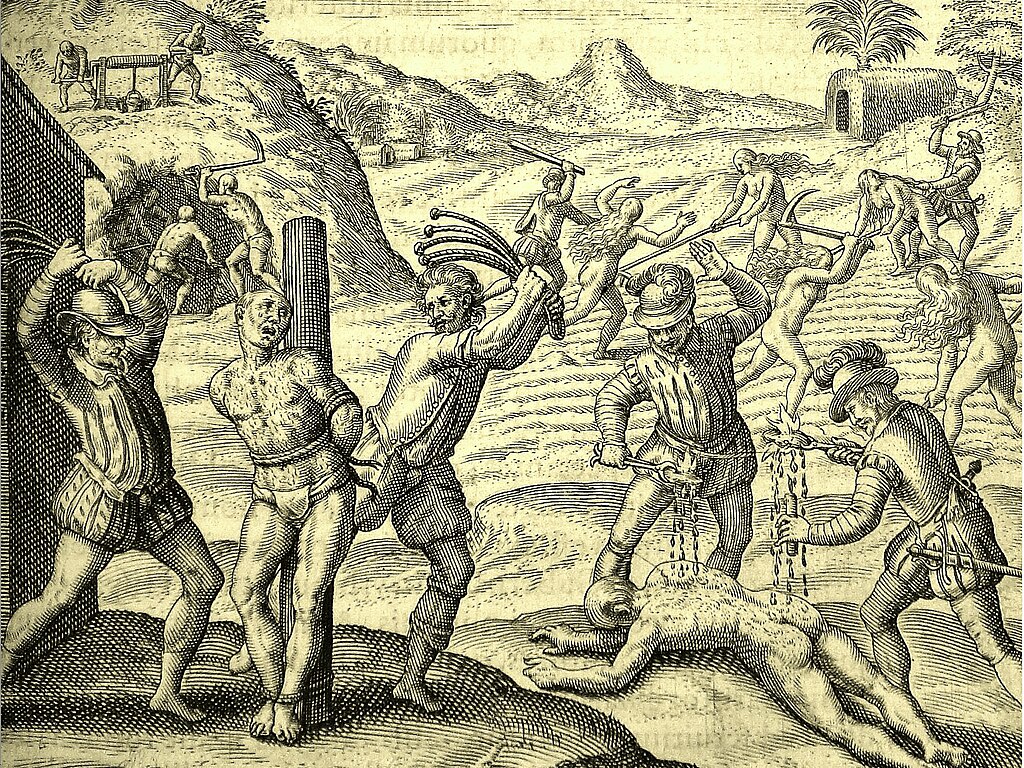
A new global history of guns and murder claims the early modern world was uniquely violent. But while modern history was clearly violent, it is less clear that its enormity marked more than an intensification of enduring forms of human domination.
One of the first Europeans to try out slave trading failed dismally at it. In 1510, the Portuguese freebooter Dom Francisco de Almeida landed at the Cape of Good Hope and tried to capture some of the Khoekhoe people. He was wrong to put faith in his firepower. The arquebuses lugged around by his men were so cumbersome that they required a prop to aim, and cooperative victims who posed to be shot at. Heavy rain extinguished the smoldering wicks required to fire them. When Khoekhoe fighters bombarded De Almeida’s forces with poisoned arrows, they beat a swift retreat.
The historian Clifton Crais tells this story early on in The Killing Age, his vast, saturnine epic of how modernity was made, precisely because it was atypical of the centuries that followed. De Almeida’s folly was a curtain raiser to the “Mortecene”: a very long nineteenth century (1750–1900) in which the West’s industrial manufacture of arms revolutionized the ease with which humans could kill one another and so restructured the globe in its interests. Power and riches flowed not from ingenuity or values but from the barrel of a gun.
We are currently spoiled for leftish but pessimistic histories of modernity. These flip the teleology once sketched by H. G. Wells and his successors among pop historians. If world history has an endpoint in these accounts, it is not peace, prosperity, and international federation but heating oceans and the spasmodic lunges of narcissistic hegemons. Academic historians have once again come to understand capitalism as a subset of imperialism: not so much an economic doctrine as a “military-commercial revolution” violently imposed on others at home and abroad. Armies and slaving ships now feature as prominently in its story as factories or laboratories, forced work as much as laborsaving gadgets. The adoption by historians of the concept of the Anthropocene has strengthened their disposition to present the ascendancy of Western civilization as a road to ruin, one that required the ever-accelerating burning of fossil fuels and is now destabilizing the climate on which human life depends.