We Need to Understand What Makes Capitalism Special

Capitalism is a distinctive mode of economic organization, one that emerged relatively recently in human history. What distinguishes it, a new history argues, is not a reliance on coercion or colonialism but the way it subjects everyone to market dictates.
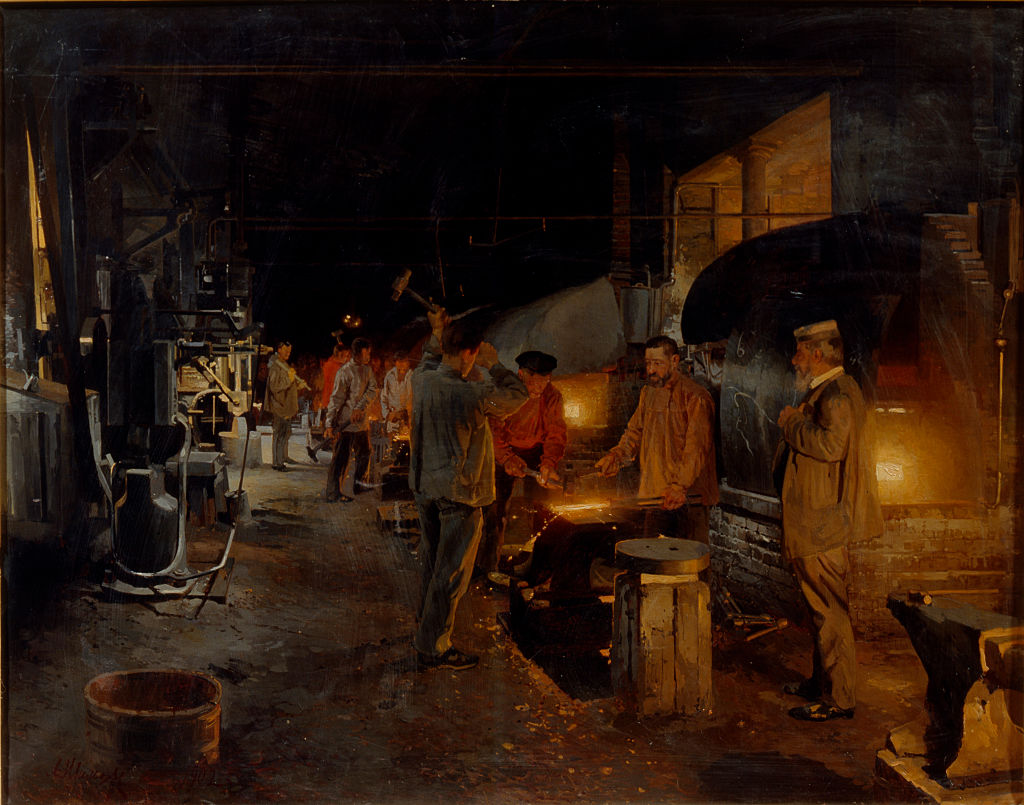
"Ironworks," a 1902 painting by Andrei Nikolayevich Shilder

A new book chronicles the development of capitalism from its origins to the end of the long 19th century. It makes for a refreshing contrast with recent histories of the subject that refuse to clearly define capitalism. (Fine Art Images / Heritage Images via Getty Images)


Those seeking to understand the history of capitalism are immediately presented with a formidable challenge. The complexity and historical sweep of the subject seem to invite treatment in weighty tomes, whether of classic or recent vintage, that demand considerable endurance from the reader. Those slogging through these colossal works might wish for a more concise treatment of the most important economic phenomenon shaping our present world.

Refreshingly, Trevor Jackson’s new book detailing the history of capitalism, The Insatiable Machine: How Capitalism Conquered the World, is surprisingly slim, comprising less than 250 pages of text. Jackson, an economic historian at the University of California, Berkeley, has attempted to provide a synthetic work that translates the recent findings of academic economists into a readable historical narrative for nonexperts. His judicious treatment of controversies in economic history is a highlight.

Jackson seeks to explain how capitalism became the globally dominant economic force by the end of the long nineteenth century. He argues that capitalism’s domination was not intentionally worked out by anyone in advance but rather was the unforeseen result of a series of decisions over the course of centuries by economic actors pursuing their own particular interests. Its proliferation has brought not only rising living standards but also great suffering and environmental catastrophe in train. Even if these are not particularly original observations, they are fundamental components of any competent history of capitalism.

Unlike many who cast a critical eye on capitalism, Jackson does not write as a Marxist or, really, an adherent of any other readily identifiable ideological lineage. He does recognize that his narrative is broadly compatible with both Marxist and more mainstream traditions in economic history. The only perspective Jackson clearly distances himself from — and rightly so — is the Adam Smith–inspired position that capitalism is a logical expression of human nature.

Capitalism From Luther to Lenin

Jackson bookends and bisects his work with three short chapters on historical personalities: Martin Luther, Issac Newton, and Vladimir Lenin. These chapters are less biographies of these figures than they are milestones to contemplate the evolving form of capitalism that existed (or did not exist) in the epoch that each man inhabited. Capitalism has developed so rapidly, over such a short span of history, that the form Lenin encountered in the early twentieth century, Jackson avers, would have been “unrecognizable” to Newton two hundred years before, let alone to Luther’s early sixteenth-century world.

The meat of the book is elaborated in thematic chapters devoted to sequenced and overlapping historical eras: Money 1415–1650s, Finance 1650–1720, Land and Labor 1640s–1800s, Industry 1710–1830, and Empire 1840s–1914.

Perhaps the most jarring chapter for those who view the origins of capitalism as emerging out of class struggle would be the first one, on money. Jackson considers the flood of bullion that saturated the world after the conquests of the New World as not merely an inflationary episode but rather a necessary precondition of capitalism’s birth. The so-called Price Revolution united the world on a single monetary system based on Spanish silver by 1650. In doing so, it monetarized exchange, thereby vastly expanding the reach of markets and providing incentives for producers to produce for exchange instead of their own consumption. “New World silver and the Price Revolution did not create capitalism alone,” Jackson writes, “but capitalism could not have emerged without the conditions they produced.”

The subsequent chapter chronicles the creation of financial institutions, largely by examining the English and Dutch experiences. Many of these financial inventions, such as public banks and professional tax bureaucracies, emerged primarily for military-political purposes rather than strictly economic ones. Indeed, although the so-called financial revolution created a number of varied institutions, their impact on the immediate development of capitalism is somewhat ambiguous. “One of the big puzzles of financial history,” Jackson notes after a deep dive into these financial mechanisms, “is why banks contributed so little to the Industrial Revolution.”

After a brief encounter with Newton, Jackson tells the story of how land and labor were commodified in the seventeenth and eighteenth centuries. Varying by region, these transformations could take different forms: “enclosure, conquest, colonialism, slavery, and indenture.” The most momentous labor development in this period, however, was the creation of a capitalist labor force — that is, a mass of workers dependent on wages for subsistence.

The fourth chapter chronicles the Industrial Revolution, which inaugurated capitalism as the “dominant form of economic life on the planet.” Malcontents such as the Luddites and Swing Rioters were unable to arrest the spread of industry, with all of its fateful consequences. Jackson is particularly keen to note the environmental effects of industrialization, which included deforestation, skies blackened by coal dust, and hunting whales almost to the point of extinction. The final historical chapter details how imperial powers spread capitalism at gunpoint to the remainder of the world.

Plunder and Profit

In broad outlines, the story of the rise and spread of capitalism will be familiar to many. Where Jackson’s account distinguishes itself is in its adroit handling of a number of controversies in economic history whose nature and import remain sources of dispute even today.

One issue concerns the role of plunder in capitalism’s ascent. Some historians of capitalism have suggested, in one way or another, that the historical pillaging of the Global South was necessary and sufficient for the prosperity of the Global North. Jackson dispenses with this idea, noting that, although the history of plunder traces back to antiquity, capitalism’s existence requires a set of institutions (Jackson emphasizes financial institutions such as banks, joint-stock companies, dividends, and government bonds) that no amount of plunder is capable of bringing into being. The history of profit-seeking is littered with gains as well as losses, and the ability of capital to renew and reproduce itself is only possible under capitalist conditions. In other words, “plunder is nothing compared to profit.”

Jackson also tackles the “most hotly debated subject in the field of economic history,” namely the controversy initiated by Eric Williams regarding the relationship between slavery and the Industrial Revolution. Though few would agree with the strong version of Williams’s argument that the slave trade caused British industrialization, nearly everyone accepts that slavery made some contribution to enriching Britain. Beyond this common ground, there is plenty of disagreement about the particulars, and Jackson’s discussion is a useful overview of this contested area of economic history. Jackson, for his part, is skeptical of more ambitious claims, since “the aggregate size of the sugar economy and its profits were just not that big.”

Jackson is also clarifying when it comes to the nature of nineteenth-century imperialism. Contrary to discussions of this subject that proceed as if states themselves had agency in subordinating weaker ones, Jackson identifies particular capitalists in core countries as key drivers of the imperial dynamic:

We speak of “British” or “European” imperialism, but imperial violence was very often a matter of private, local initiative, almost entrepreneurial in its character, and state involvement came as a kind of bailout when private actors got into trouble, socializing the costs and privatizing the gains.

Contemporary socialist critics of fin de siècle capitalism, such as Lenin, often supposed that the profits gained from imperialist exploitation of noncapitalist areas of the world were crucially propping up the Global North economies. Jackson notes that then as now the overwhelming weight of investment took place between Global North economies, and that nineteenth-century imperial investment was not especially large or profitable. But Lenin and his comrades were nevertheless correct about the corrosive effect that imperialism had on working-class internationalism and the devastating outcomes of imperial violence. “Although the socialists of the time were wrong about the profits and investment patterns,” Jackson writes, “they seem to have been exactly right about the politics.”

Against the “New History of Capitalism”

Unlike some writing about capitalism today, Jackson is not an adherent of the “new history of capitalism” (NHOC) approach associated with scholars such as Sven Beckert, Walter Johnson, and Edward Baptist. He peppers his book with various criticisms of NHOC, arguing that its infamous resistance to defining what capitalism is has hindered the ability of scholars to accumulate knowledge about an agreed-upon subject. Moreover, the expansion of capitalism to encompass potentially all things at all times has made it harder to demarcate a precapitalist history or imagine a postcapitalist future.

Jackson devotes several pages to pinning down a definition of capitalism. Although he begins rather in the manner of a standard economist by stating that capitalism is an economic system constituted by markets in the factors of production — namely, land, labor, and capital — he ultimately locates capitalism’s specificity in market dependence: “The basic feature of capitalism is that . . . today nearly everyone is dependent on markets in order to live.”

NHOC scholars often attempt to show that “slavery not only was capitalism but in various ways represented the essence of capitalism.” Jackson resists this framing for a number of reasons. The NHOC view elides the fundamental difference that free labor as opposed to slave labor imparts to an economy. A slave plantation society such as seventeenth-century Barbados should therefore, Jackson opines, not be considered a capitalist society.

Additionally, capitalism was able to expand and prosper after slavery’s abolition. In the US case, the “poor, undercapitalized, extractive colonial system” of the antebellum South was supplanted by a system that was able to vastly increase production of its leading export, cotton. Southern cotton production, in any case, was of less importance to the American economy than agricultural commodities like hay or wheat.

Against the NHOC, Jackson considers it “more accurate” to enshrine the capital-intensive corporation rather than the slave plantation as the definitive form of American capitalism. He also mentions continuous large-scale immigration from Europe and westward expansion into the continental interior as factors that should be a “bigger story” than plantation slavery in explaining the trajectory of the economic development of the United States. “We can debate the counterfactual of whether the Industrial Revolution and modern capitalism could have emerged without Southern slavery,” Jackson says. “But it seems incontrovertible that it could not have happened if Native Americans had retained their own system of property rights over the entire territory of North and South America.”

The Machine Becomes So Odious

Jackson’s tone is usually evenhanded and technical, but he loses this staid demeanor when explaining the stakes of grappling with capitalism. “The world I live in will be destroyed within my lifetime,” he writes. “The question of what kind of world will follow it is entirely a question of whether we all manage to kill capitalism or it kills us first.” The insatiable machine’s rapid degradation of Earth’s ecosystems seems to be Jackson’s main motivation in urging us to drastically change course and try to construct a new kind of economic system.

The situation, while dire, is not hopeless, Jackson thinks. He urges engagement with history in order for people to collectively realize that their common interests point to a confrontation with capital. “The struggle of people against capital is . . . immortal,” he writes, and “community, solidarity, and meaning begin with the recognition of a shared condition and shared struggle.” Perhaps it is appropriate that Lenin is the figure who closes the book; in the final pages, it feels like Jackson is attempting to conjure some of the urgency of Lenin’s writings.

Jackson’s call to divert the calamitous trajectory that capitalism is pushing humanity toward reprises the upshot of Marxist critiques of capitalism, even if his account places more emphasis on monetary and financial matters. Regardless, Jackson has produced a serviceable narrative of capitalism’s development that avoids the analytical pitfalls that have crippled many competing accounts.