Why Capitalism’s Origins Matter
A new book defends a Marxist theory of the origins of capitalism. Along the way it shows why understanding the transition from feudalism can help us make sense of the present.
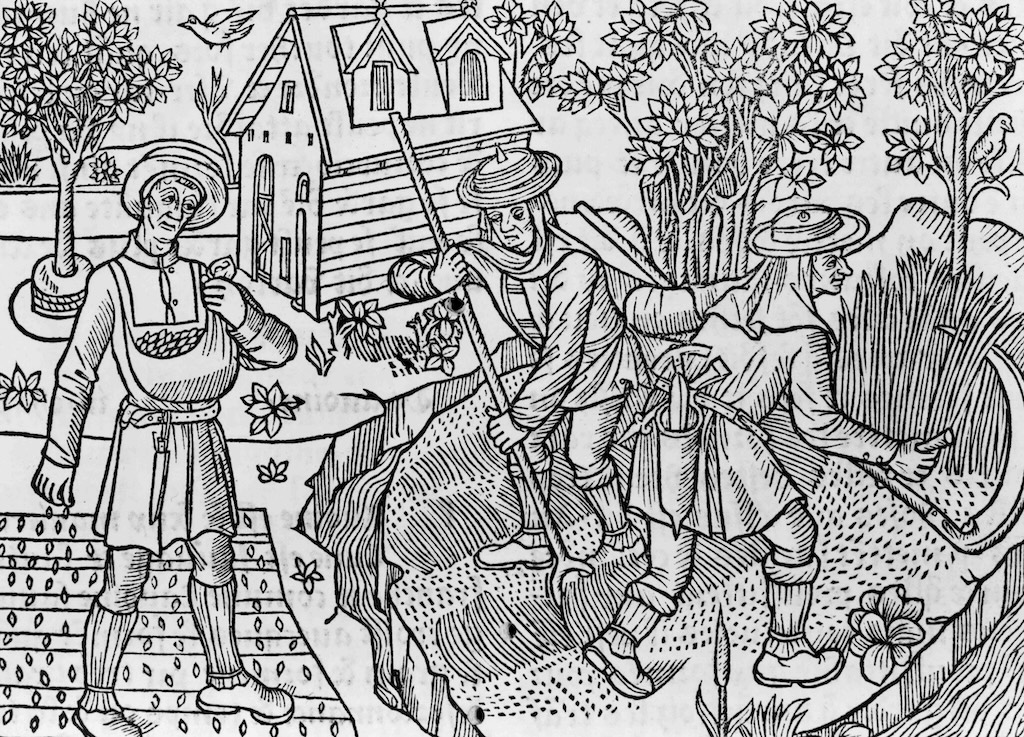
In Mother of Capital, Marxist historian Matthew Costa offers a brilliant history of feudalism’s decline. The book is essential reading for anyone looking to understand how capitalism came about, and how it might be overcome. (Photo12 / Universal Images Group via Getty Images)
How did the medieval world give birth to our modern system of capitalist accumulation and competition? A new book by Matthew Costa, a Marxist historian and mandarin at New South Wales’s treasury, offers a compelling answer and synthesizes a vast body of writing on this topic. Mother of Capital: How Rent Gave Birth to Modernity provides an engaging account of the transition from feudalism to capitalism, a subject that has been debated among historians and economists for centuries.
The Transition Debate
Costa pitches his tent firmly in the camp of the economic historian Robert Brenner, who fifty years ago initiated what came to be known as the Brenner Debate with “Agrarian Class Structure and Economic Development in Pre-Industrial Europe,” an essay he published in the journal Past & Present. With that paper, the young Brenner became a gadfly to several academics, at whose rival theories he took calculated aim by arguing, controversially, that capitalism originated in the English countryside. Out of a feudal system of coercive extraction of peasants’ economic surplus by nobles and the crown, a new class of tenant farmers emerged. This new class of capitalists competed with one another to pay rents to landlords by investing to increase the productivity of agriculture. Mother of Capital advances and popularizes this long-running debate, defending the position of its namesake.
In his “Agrarian Class Structure” paper, Brenner dismissed what he termed the “secular Malthusianism” of thinkers who explained capitalism’s emergence by appealing to what he called the demographic model. According to these historians, large populations created cheap labor, which could be easily yoked during the feudal period. But the Black Death in the mid-fourteenth century reversed this condition, strengthening the hand of peasants and allowing them to bargain for greater compensation from their lords. This reversal resulted in a decline in agricultural profits for the lords and higher incomes for their peasants.
Peasants in turn began to exercise their new leverage over their lords by leaving one manor for better wages at another, thereby breaking down the system of manorial local courts that increasingly failed to enforce customary laws designed to keep them on the land. This in turn empowered a new class of mobilized wage laborers, the rise of whom caused feudal lords to impose enclosures and lay the ground for a series of doomed revolts by the peasant class.

Brenner also dismissed the “commercialization model” first espoused by Adam Smith. According to the author of the Wealth of Nations, the steady growth of trade and commerce passed a decisive tipping point in the early modern period, giving rise to capitalism by unleashing forces already latent in society.
Against these two views, Brenner argued that capitalism instead emerged as a consequence of class struggle between the peasants and their lords. Profits produced from exchange, demographic transformations, and the Black Death existed within a set of social relations defined by the relative power of one class over another. “In my view,” wrote Brenner, “it was the emergence of the classical landlord-capitalist tenant-wage labor structure which made possible the transformation of agricultural production in England, and this, in turn, was the key to England’s uniquely successful overall economic development.”
Costa holds that what drives the epochal shift from feudalism to capitalism is the internal dynamics of English “social-property relations.” “Nothing less explains more,” Costa states boldly. Commercialization, commodification, wage labor, and even the Reformation and English revolutionary history all emerge from a shift in the internal balance of social-property relations. It is not that these relations determine capitalism, but their interaction with the constellation of power in medieval England just so happened to produce capitalism.
An English Story?
Capitalism’s radical contingency is therefore a major theme of Costa’s book, although neither he nor Brenner are the only writers to insist on its English origins. For example, in Origins of English Individualism, Alan Macfarlane claimed that the culture of medieval England was deeply hostile to feudalism — a term which only came into widespread use in the nineteenth century — even before it was capitalist. Social relations and legal arrangements typically associated with feudalism such as arranged marriages, the keeping of the household farm in the hands of a single family, and a tendency to work where they were born were, Macfarlane claimed, conspicuously absent from much of England during the height of the medieval period. The English are, he argued, a highly mobile, atomized, and individualistic nation of tinkerers whose culture provided the unique prerequisites to bring about capitalism and the industrial revolution.
There is something suspiciously teleological about these arguments, which bear a close resemblance to the commercialization thesis first put forward by Smith, who insisted that “truck, barter and exchange” were ineradicable features of human social relations. Costa instead argues that while capitalism was indeed incubated in the laboratory of the social relations of medieval England (and would become global through commerce and colonialism), this was not determined by cultural mores but instead was a contingent effect of power relations.
The Making of the English Peasant Class
In feudal England rent was extracted through a tributary system, whereby lords received money from tenants at harvest time in cash or “in-kind,” such as in crops or livestock, but also when peasants married, died, became priests, or even had children out of wedlock. This system of extraction through rent was maintained by a mixture of custom and law, adjudicated through manorial courts and, when necessary, through force.
The lords funneled money and knightly service to the crown but increasingly checked the latter’s power through Parliament to protect their own local interests. Collectively, the barons and gentry (rich peasants) used Parliament to introduce general taxation to substitute for a large proportion of rents they paid to the crown. Exceptions were carved out for their own property, and this placed the fiscal burden on the peasant population.
The emergence of this “federalized” equilibrium between the crown and the lords is central to Costa’s book. In England, the crown was strong enough to settle territorial disputes between lords but not strong enough to make them mere instruments of its power. “The centrifugal power of local lords kept the centripetal power of the Crown in check,” writes Costa. “Forming a ‘homeostatic mechanism’ where neither local nor central power attained supremacy.”
In the wake of the Black Death, the peasantry transformed into a mobile labor force that threatened the extractive model that defined English lordship. At first the lords, with the support of an ambivalent crown who feared civil war, attempted simply to coerce peasants by crushing several revolts in the late fourteenth century. They also passed new punitive customary legislation through the manorial courts that had for generations reproduced the feudal system. None of this worked because the Black Death, which had decimated populations, created great disparities between how much a peasant could earn from one manor to the next.
The feudal system had relied on lordly solidarity and widespread immiseration of their peasants, but the Black Death was an economic shock to both labor supply and income. In response to this new reality, the lords innovated their way out of this problem to survive. The new game was competition over resources and slowly but surely cutting out the crown and becoming the would-be British state themselves.
English lords began to lease out their lands to a new class of yeomanry who were mobile, competitive and literate in accounting. This allowed the lords to accumulate capital by growing cash crops for the market. The marketization of land ran counter to the interests of the crown, which feared that enclosure would provoke a backlash that would spark a civil war.
Only in medieval England in the wake of the Black Death, Costa argues, did the particular balance between lordly and monarchical power exist to prevent feudalism from slipping into absolutism, as it did on the European continent (though this latter process goes conspicuously unexamined in Mother of Capital). “English lords lost control of peasants’ bodies,” Costa writes. “But unlike continental lords, with a strong Crown’s backing, England’s lords retained control of the land to a unique degree.”
The peasants, once the source of the lords’ wealth, became an albatross around their collective necks. With the ascendance of the new proto-capitalist class of cash croppers, lords elected to remove peasants from the land through enclosure.
The core of Costa’s argument is that the tributary rent relation transformed into one of competitive leasing. Rent remained central but its transformation from money extracted from peasant labor to money extracted from the land managed by industrious yeoman gave birth to capitalism. This was not a painless process. The collapsing rental income caused by the Black Death threatened the tributary system and therefore the nobility itself.
While the peasant revolts in the fourteenth century were put down by the crown and the lords, the latter would slowly turn on the former leading to the English Civil War and the Glorious Revolution in the seventeenth century, which were effectively a final showdown. It was only then that the crown would be domesticated, and a modernizing English capitalist class would emerge.
Lords, meanwhile, morphed into the aristocracy riding on the wealth of this new capitalist class. While France responded to the Black Death with an absolute monarchy that saw agricultural yields rise by 20 percent from 1600 to 1800, England gave birth to capitalism, which doubled its productivity over the same period.
What About Agency?
Perhaps surprisingly, Costa’s history assigns little agency to people or even classes. “Changing the world is not just a matter of willpower,” he writes. He discusses attempts to reverse the tide of history such as Kett’s Rebellion against enclosures in 1549 and the Levellers and the Diggers of the civil war a century later, but he views these events as failed efforts to resist the spread of capitalist social relations.
This runs against the ideas of historians like Rodney Hilton who emphasized the role of peasant resistance in the fourteenth century to overcome feudalism. But Costa also criticizes, as Hilton did, the notion that history was simply mechanical and shaped entirely by structure. Instead, Costa makes the case for the dialectical view that neither agency nor structures shape the world, but they shape one another to shape the world — although his critics might, not unjustifiably, see this as trying to have it both ways.
Religious ideology, which Costa argues provided feudalism with its moral justification, gets a small but interesting treatment in Mother of Capital. The feudal hierarchy was one blessed by God, and it mirrored the heavenly hierarchy of the Host of Hosts down from angels, saints, and priests to the laity. Rent was taboo without the sense that it was paying for something of real value. In theology, obedience to your spiritual superiors sustained existence itself, but this sacred system was transposed in the medieval period onto profane social relations. The theology of feudalism saw rent as a covenant between the lord and his peasants and, while not always consciously understood in these terms, the ideology was strong enough to preserve the system for centuries.
Discussing the thirteenth-century romance poem King Horn, Costa observes that moral ideas about the importance of rent also shaped secular notions like chivalry. In these tales, rent is not understood as a burden but perversely as an honor granted by a lord:
The King offers his daughter in marriage to Horn, a promising knight. Horn refuses the King’s offer on the basis that he is undeserving. Instead, he proposes that by the completion of seven years’ service to the King, he could earn the princess’ hand as a rent. The story shows how ruling-class mores rejected the idea of rent as an unearned or unilateral benefit.
Technofeudalism
Costa’s book also engages with contemporary debates about what has come to be known as “technofeudalism.” Technofeudal theorists argue that we are witnessing the emergence of a new technofeudal mode of production that is replacing capitalism. Thinkers such as Jodi Dean, Yanis Varoufakis, Joel Kotkin, and Cédric Durand claim that platform capitalists such as Uber and Spotify are globalized feudal lords, and drivers and artists their peasants. Their new coinage offers a striking metaphor to describe current economic conditions characterized as they are by a surfeit of rent-seeking, unproductive capital accumulation, and the rise of informal work.
But these theories, according to Costa, have little explanatory value. They miss the point that rent never really went away under capitalism; it simply changed its form from rent on labor to rent on land. Rent extraction is not only part of capitalism, it is its origin story. “This new ‘techno-feudal reason,’ like mainstream economic thinking, sees rent everywhere in capitalism, but paradoxically insists rent is not capitalist,” Costa writes. “It regards capitalism as exploitative but lacks a ‘broader account of capitalist accumulation’ that incorporates both ‘redistribution and exploitation,’ both rent and profit.”
While the grounds on which Costa’s challenges to “technofeudalism” are a little arid, it joins the chorus of earlier attacks on the rather muddled category. Obviously, one doesn’t need Costa’s book to observe that rent and landlordism were rampant under capitalism, but his focus on the medieval period will help disabuse readers of the notion that we are living through a sequel. As many other commentators have already observed, an Uber driver is not a peasant legally tied to a lord but simply an insecure worker forced into an unbalanced commercial contract with an exploitative boss by capitalist market forces.
While Costa succeeds in providing a historical explanation for the transition in the feudal to the capitalist mode of production, which is often deployed in a casual and confused way by writers on the left, his own arguments rely on some uninterrogated assumptions. For instance, his claim that social relations, rather than the Black Death, were the ultimate cause of the rise of capitalism takes for granted a hard social constructivism — that is, the view that reality, including biological systems, are primarily shaped by social interactions. But the question of how Marxists ought to incorporate nature into their view of capitalism is far from straightforward. It might be too much to expect a philosophical defense of why nature can be subordinated to the social from a historian, but it is not unfair to say that his core argument relies on a set of presuppositions that one is left wondering about when reading this book.
That said, the book is an excellent engagement with a period of history often dismissed as arcane or irrelevant. Mother of Capital, though abstract, is engaging particularly because it allows readers to see that there was nothing inevitable about the rise of capitalism, and perhaps also that there is nothing necessary about its continued existence.