Colonial Plunder Didn’t Create Capitalism
Despite what you may have heard, colonial plunder didn’t give rise to capitalism. In an interview with Jacobin, Vivek Chibber discusses why the “colonialism-created-capitalism” argument fails, and why Marxism provides a better account of its emergence.
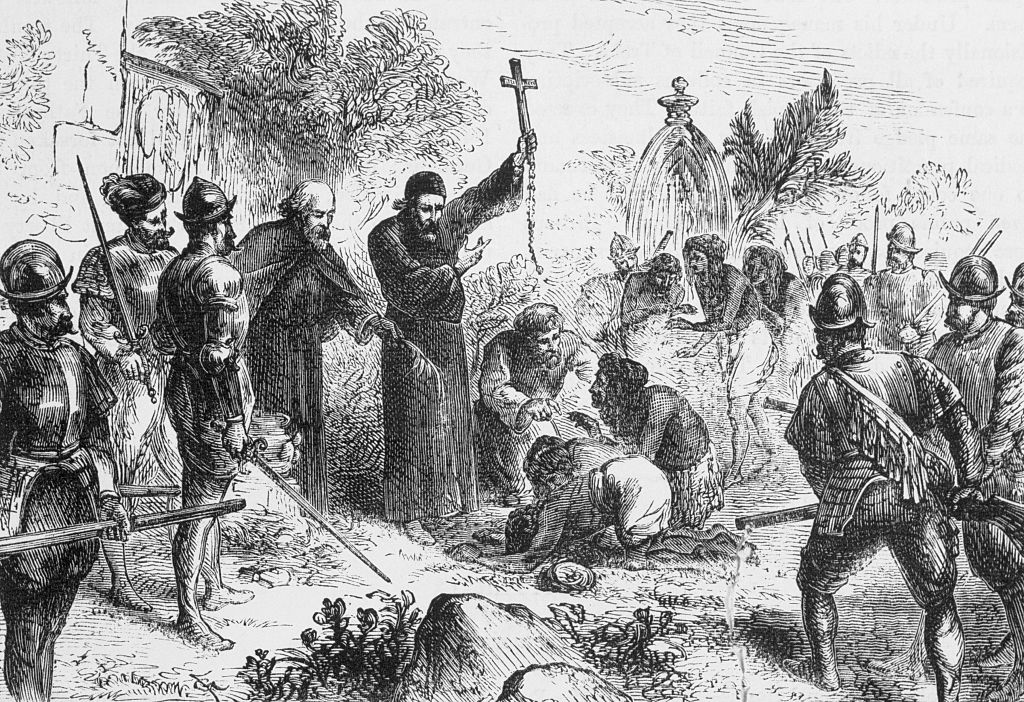
Resources brutally extracted from the New World did not bring capitalism to Spain or Portugal, while England had a rapidly growing capitalist economy well before it had an empire. Why, then, does the “colonialism-created-capitalism” argument persist? (Bettman Archive via Getty Images)
- Interview by
- Melissa Naschek
It’s well understood that capitalist economies are a recent development in human history. But there is persistent disagreement on the Left over exactly how and where the transition to capitalism occurred, as well as what role colonial plunder played in enriching the West.
On this episode of the Jacobin Radio podcast Confronting Capitalism, Vivek Chibber explains the origins of capitalism, what primitive accumulation means, and how colonialism actually affected European development.
Confronting Capitalism with Vivek Chibber is produced by Catalyst: A Journal of Theory and Strategy and published by Jacobin. You can listen to the full episode here. This transcript has been edited for clarity.
Today, we’re going to talk about the development of capitalism. And specifically, we’re going to look at a very trendy argument right now in left-wing and academic circles about the connection between colonial plunder and the establishment of capitalism. And the big argument going around is that, basically, the West became rich and economically developed directly as a result of colonial plunder — that colonial plunder was essentially responsible for bringing about capitalism. So what do you think of these arguments?
They’re utter nonsense. They don’t have a shred of truth to them.
The idea that capitalism was brought about by plunder can’t even get off the ground. And it’s interesting — and maybe not surprising — that this argument is in such vogue today especially within the activist left. But it’s also coming back in academia, after it had been pretty thoroughly discredited in the 1980s and ’90s. So I think it is worth going into it a bit to explain why it’s empirically unsustainable, but also why even theoretically, it just makes no sense.
And what’s interesting is that a lot of leftists point to Marx himself in Capital, Volume I and how he talks about the relationship between colonial plunder and capitalism, using that as evidence that there is a deep relationship between the two.
The last few chapters of Capital are on something that Marx calls the “secret of so-called primitive accumulation.” And in those chapters, he’s trying to explain where capitalism in fact comes from. So he calls it “primitive accumulation” because that expression comes from Adam Smith — sometimes it’s called the “original accumulation.” And he takes up Smith’s position as a kind of a springboard from which he then derives his own position.
Smith’s argument said that in order to have capitalism, you need to have investment. And that investment has to come from some pool of money somewhere. You need to have a pool of money so that you can invest it. And that money must have some point of origin if you’re going to get the system. So Smith says, “Well, there must have been some original accumulation of capital that launched this new system.” So where did it come from? And he says it came from people being really frugal, from saving their money. And then they were able to derive from that enough investible funds that they then put it to use as capital.
Now, Marx starts off his chapters on so-called primitive accumulation by poking fun at this. First of all, he says it’s empirically not the case that it was this kind of frugality and good customs and habits that gave you that pool of money. In fact, he says, if anything, what got you the pool of money was things like robbery, the nobility thieving people of their money, and, he says, the fruits of colonial plunder. That’s the context.
So basically what he’s trying to do there is to say, look, insofar as an initial pool of money was needed, it did not come from savings. It came from the worst kinds of practices you can imagine. So he’s indicting capitalism in those terms.
Right. And so rejecting Smith’s savings-oriented argument, he’s putting out a potential counter that maybe it was this other source of forcible, often violent wealth extraction.
Yeah. Essentially, he’s saying it’s not from decent people using their Protestant ways to save lots of money. It came from the worst kinds of things.
But that’s just a rhetorical ploy he’s using. In fact, what he says immediately after that is it doesn’t matter how much money you have. It doesn’t matter how much capital you have, because money only becomes capital in certain situations, in certain circumstances.
What are those circumstances? He says that whatever money these people had, it could only be put to use for capital accumulation once you had the social context and the institutional situation that induces people to use money productively toward profit maximization.
Now, what does that even mean? Why wouldn’t they use it toward profit maximization prior to capitalism? This is Marx’s main point. What Marx is saying is that money does not become capital until you get a change in the social structure of feudalism, so that you move from a feudal class structure to a capitalist class structure. And the money itself can’t make that happen.
Feudalism was the economic system that existed prior to capitalism. Within feudalism, whatever money people got, whether it was from savings or from plunder, was put to use “feudalistically”, you might say — i.e., in a non-capitalistic way.
Can you explain that a little bit more?
To begin with, I think Marx made a rhetorical error when he indulged Smith even to the point of saying that it wasn’t frugality that gave you the original accumulation, but plunder. Because that’s just a kind of a side note in the chapter. But people have fixed their sights on this rhetorical device and used it to justify exactly the argument he was trying to falsify, and spent the next five chapters doing so.
The core of what Marx is saying is that, first of all, there was no shortage of savings within feudalism. In other words, there was no shortage of lots of investable funds in feudalism. How do we know that? Well, because the feudal nobility, the aristocracy, the people who had all the money and the power, were filthy rich. If they had wanted to deploy that money in a profit-maximizing way, which is what capitalists do, they would have done it long ago.
Furthermore, plunder and colonial expansion were endemic to Europe for a thousand years before capitalism came around. So, if what it took to get to capitalism was some kind of original accumulation of money — even through plunder — you would have had capitalism a thousand years prior.
The key is to remember that there was never any shortage of investable funds within feudalism. So, even if it is the case that lots of new silver and gold is coming through colonialism, it doesn’t alter the fact that whatever money you have, you’re going use it in a way that’s sensible by whatever economic rules there are in your system.
And because feudalism was a system in which the most sensible thing to do with your money was to use it toward nonproductive, non-profit-maximizing ends, regardless of whether you were the peasantry or the nobility, whatever money you had would be deployed in that particular feudalistic way.
Now, the fact of the matter is that in the fourteenth, fifteenth, and sixteenth centuries, the two European countries that had the largest empires were Spain and Portugal. And those empires were explicitly created to bring lots and lots of treasure from the New World to the Old World.
This treasure is exactly what Smith is talking about. It’s enormous hoardings of wealth. And if Smith was right that you needed to first have this original accumulation of wealth, Spain and Portugal ought to have had the first transitions to capitalism. They should have gone from being feudal monarchies to being capitalist economies and the fastest growing economies in Europe. What happened in fact was that this treasure, as it came into these countries, did nothing to bring about a change in the economic system. In fact, what it did was it pushed these two countries into about 150 years of economic stagnation.
Where you did have a change to a new economic structure was in the country where there was virtually no empire, which was England. And let’s get our dates right. England moves toward a new economic structure that had not been seen in the world before, which we call capitalism, starting in the mid- to late 1400s. So that by about 1550 or 1560, you’ve essentially got a truly capitalist economy. This is about a hundred years before England has any kind of real empire at all.
So, the countries with the largest empires and the largest inflows of treasure — colonial extraction, you can call it — experienced no change to a new economic system. The country that did experience a change to a new economic system is the one that didn’t have an empire.
So if the question is “What role do treasure and plunder play in the rise of capitalism?” then the argument that treasure and plunder are what trigger it can’t even get off the ground, because the countries where it should have happened — if the argument were correct — are the countries where it didn’t happen. And where it does happen is in a country where you don’t have this kind of plunder. And that’s England.
Now, this is just the empirical record. The theoretical problem is this: You have to explain what would make a feudal landlord or a monarch who’s suddenly endowed with this huge pool of money to change the entire class structure, whether it’s of his feudal holdings if he’s a landlord or, if he’s the monarch, the entire national economic structure itself? What would make them do it in, say, 1550? I’ve never seen a single argument that would explain why they would do that. What they did, in fact, was use it in a way that makes sense for a feudal landlord.
Right. And a Smithian-type argument assumes that capitalism has just always been this little kernel developing in society. They don’t need to point to any sort of turning point. They don’t need to explain why suddenly the wealthy class decided to reinvest their money and pursue a profit-maximizing strategy. And this is a very key point, that the main strategy among the exploiting class of pursuing profit maximization through improving and expanding production is specific to capitalism. That was not the basic imperative of the feudal system.
That’s right. Now, without getting too deep into the weeds, let me just make this argument here. In feudalism, you had plenty of money going around. In feudalism, you had plenty of markets as well. But the markets were very limited, and the money was deployed in a mostly nonproductive way. Why?
Well, who were the bulk of the producing class in feudalism? Who controlled production? It was peasants. Peasants with small plots of land. And those peasants with small plots of land overwhelmingly were geared toward what you might call a “safety-first” strategy. Instead of throwing themselves onto the market, trying their best to be as efficient as possible, or trying their best to outcompete other peasants, they tried to steer away from market competition and relied on their own crops, their own land, and even produced as many of their own manufactured goods as they could.
Now, because they’re making their own food and their own manufactures, it means that they don’t actually go to the market very often. They don’t have to buy things very often. Now, if every peasant is doing this — if every peasant is basically producing for himself — it means that they only take those things to the market that are left over after they’ve taken care of their consumption needs.
But if this is the case, it also means that markets are pretty thin. They don’t have a lot of goods coming to them because people only bring the tiniest fraction of all the goods they’re growing or making at home to the market. But this means, in turn, that the markets themselves are not very reliable. Peasants can’t count on finding everything they need there. And that reinforces peasants’ tendency to not rely on the markets.
So you have a situation where there are some markets, but they are not continually growing. This is the opposite of Adam Smith’s assumption. The same can be said regarding the nobility. They don’t control production the way capitalists control production. The way they get their income is by extracting rents from peasants.
But rent extraction posed a problem. The nobility, like today’s landlords, could say, “Hey, I’m jacking up your rent a hundred bucks. Pay it or I’m going to evict you.” But whereas the landlord nowadays can rely on the fact that whoever’s renting from them is going to try to raise money to pay these higher and higher rents, the feudal landlords were not legally allowed to kick peasants off the land as long as the peasants were willing to pay what’s called a customary rent. So they couldn’t jack up the rents.
Now, how do feudal landlords increase their income if it’s coming out of rents? The main way they can do it when they can’t threaten peasants with eviction is through coercion. Often times, this involved physical threats and intimidation. But most of all, it involved raiding other lords’ lands and annexing them. Warfare is the best way to dramatically increasing your revenue when markets don’t allow for it.
Warfare and coercion were built into the feudal system. This had a very important implication: The rational thing to do with your surplus, if you were a lord, was not to invest it in means of production, but in means of warfare and coercion. If lords come across a windfall, a lot of money, what they’re going to use the money for is a larger retinue, a larger army — that is to say, the means of coercion.
So, for both the main classes — peasants on the one hand, lords on the other — the feudal structure imposed specific economic strategies. Peasants avoided the market to the extent that they could, which kept the market small, and they committed to a safety-first strategy rather than a profit-first strategy. And the lords did not put what money they had into new machines, new tractors, new trailers, new plows, but instead put their money into larger and larger armies.
In this situation, if these lords suddenly got lots of physical treasure, what they did with it was accelerate the intensification not of production, but of warfare, which is what Spain and Portugal did. In turn, that system generated its own rationality for what you do with your money. And no matter if it’s a small pool of money or a large pool of money, you’re going to use it in a way that makes sense within that class structure.
So what it required, therefore, for money to become capital, and this is what Marx is saying in his chapters on primitive accumulation — and it’s impossible to miss unless you’re going quotation-hunting — is if money is to be used in a way that’s recognizably capitalist, the money itself won’t trigger that change in class structure. It’s a prior change in class structure that creates a new function for money. That money now becomes capital, whereas previously it was just money.
That is what the chapters on primitive accumulation are supposed to show. They show that Smith’s mistake was not that he was wrong on where the money came from — plunder versus frugality. He was wrong in assuming that the money would be used capitalistically at all.
And this is what you just said, Melissa. The key here is Smith assumes what needs to be proved. He’s assuming that capitalism already exists. Yeah, if it already exists, then a windfall like treasure could accelerate your pace of development. But if it doesn’t already exist, that money is going to be put to other uses, which brings us back to the question of where capitalism came from if it couldn’t have come from the windfall?
I want to return to one of the claims that you just made, that you can really locate in time and geographic space where capitalism originated, which is fifteenth-century England. That is another claim that is very trendy to challenge. And typically, the response today is that it’s a “Eurocentric” claim that capitalism originated in England. So what do you think of that argument?
It’s preposterous. It has no basis. Again, this is just part of the general decline in intellectual discourse, not just on the Left, but generally. For it to be a Eurocentric claim, it would have to show that the claim is empirically wrong.
Eurocentrism is a kind of parochialism, which means that you’re ignoring obvious facts about the world because you’re biased toward Europe. In other words, if you’re biased toward Europe, it has to be the case that something that is recognizably capitalist could be found elsewhere, but you’re ignoring the fact that it was found elsewhere and you’re just focusing on Europe.
All right. So empirically, can one show that something that’s recognizably capitalist could be found everywhere? That’s going to come down to how you define capitalism. Now, if you define capitalism as just the presence of a market, then yeah — it was everywhere. It would therefore be Eurocentric or racist to say that capitalism was just in Europe.
But it is not the case that capitalism is just markets. Capitalism is not the presence of a market, but when the market rules society. It’s when everybody becomes dependent on markets. So, is it the case that something different was happening in those parts of Europe that I’m talking about — Northwestern Europe, which was England, but also included parts of Holland and what’s called “the Low Countries” — was something different happening there?
Now, as it happens, in the last thirty-odd years, there’s been an extraordinary outpouring of economic history. And the leading economic historians from all parts of the world have converged around some very, very interesting findings. And those findings are that, if you just look at growth rates in Eurasia — which is the European continent, but also Asia, China, and India — the core of the global economy at this time was the Mediterranean and Asia. If you look in those countries and you examine the growth rates, whether it’s per capita income or whether it’s national income — whichever way you’re measuring it — from say 1300 or 1400 to the 1900s, what you find is that, from about 1400 to 1600, Spain, Italy, and the Low Countries quickly take off. And the Low Countries are growing faster than Spain and Italy by say 1500.
But very quickly after that, the British rates of growth go onto an entirely new slope, so that by 1600 or 1650, England was visibly growing faster than any of the other European countries. And China and India, which were in fact leading from 1500 to 1700 in Asia, are, along with the rest of Europe, falling behind England and the Low Countries.
There is a very strong consensus around this. If it is the case, empirically, that England is on a different growth path than these Asian countries, then two questions arise: What explains the explosive growth that England is witnessing? And when I say explosive, these growth rates were never seen before in the world. Something happens between 1500 and 1550, right? You have to note this fact. The second is to say, well, where does it come from? Why does it happen?
This has been the central theoretical question for all of social science for about three hundred years now: What explains the divergence of this part of Europe from the rest of the world?
The best explanation for this is that, suddenly, the people in this country had to follow different sorts of economic activities and economic strategies just to survive than had been available to them in the first fifteen hundred years after the death of Christ, which was the rise of capitalism. Because up until then, as I said earlier, it had been the avoidance of market activity — safety first and the accumulation of armies, retinues, and means of coercion (e.g., big old guns) — that had been the way to get rich.
Now, if it is the case that, empirically, these parts of Europe are taking off, leaving the rest of Europe and Asia behind — and let me emphasize, it’s not that Europe is developing rapidly while Asia and Africa are not, it’s that this part of Europe is leaving the rest of Europe behind as well. If that is the case, then it is simply absurd to say that locating capitalism in Europe is parochial or biased or ignores the facts. It is, in fact, trying to explain the facts. And by now, there’s not much of a debate about this. It is pretty clear that by 1600, England and Holland are on a different growth path than China, India, Africa, and Latin America.
So the claim that it is arbitrary, random, or parochial to locate the origins of this new economic system in those parts of Europe doesn’t have a leg to stand on. It’s fashionable, but it goes nowhere.
What happened in England and Holland at that time that basically shifted their societies into capitalist societies?
What happened was that the economic structure was transformed through willful action in such a way that peasants in the villages had no choice but to throw themselves onto the market to survive, either as wage laborers or as farmers paying competitive rents.
Basically, starting in the 1400s and 1500s in these countries, everybody had to compete in order to survive. Market competition became the norm. And as we know, the essence of capitalism is market competition. What happened in all these precapitalist systems was that people did not have to compete with anybody else on the market, whether it was in the labor market or the product market, because they mostly produced for themselves on their own plots of land to which they had rights that could not be taken away from them.
As long as you had an economic system in which everybody has rights to their land and they’re guaranteed a subsistence, they actually resist being market dependent. This is because market dependence, as any worker will tell you, is fraught with insecurity and with all kinds of vulnerabilities. And land was an insurance policy. You’re not going to give up that land because, come hell or high water, you’ve got your land.
For most people, they had insulation from market competition for thousands of years. But in these countries, for the first time, you get masses of people being thrown onto the market. This is what Marx says is the secret to primitive accumulation. It is not the original hoarding of wealth at some point in time. It is the changing of your economic structure through willful acts that, for the first time, forced people onto the market to compete with each other.
And it’s that competition that gives you these explosive rates of growth in productivity. Because everyone is having to compete on the market, they have no alternative but to seek to be more efficient, to seek to drive down the prices of the goods that they’re selling. And that is what gives you this constant upgrading of productivity and of techniques and things like that. That happens in Northwestern Europe. In the rest of Europe and in Asia and Latin America, they continue to lag behind for decades and for centuries because it takes them that long to inaugurate and engineer this kind of transformation themselves.
This was Marx’s insight — that you needed to have a change in the class structure in order to bring about modern growth. And among the more contemporary historians and social theorists, it was Robert Brenner who made this point more forcefully, I think, than anybody had in postwar Marxism. And a lot of this credit goes to him for making this point in a very cogent way.
Yeah. I’d add Ellen Meiksins Wood as another person who really popularized this argument.
Absolutely. But, you know, as she would have told you, she was building on Brenner’s arguments. And these two, I think, have played an absolutely crucial role.
But let me just make an important point clear: It isn’t just them. This account is the consensus that most of the leading economic historians have come to, Marxist and non-Marxist. There is a mountain of economic literature and data supporting it.
The argument is driving home the point that I think was fundamental to Marx’s epoch-making insight, which is that economic activity is always constrained and dictated by economic structure. So the economic structure of the medieval world dictated a different kind of macroeconomics and microeconomics than the macro- and microeconomics of the contemporary world. And the reason the two are different is that the underlying economic structures — what we would call class structures — are different.
Now, this was pretty well understood into the 1970s and ’80s. And the argument for colonial plunder had been pretty thoroughly discredited. It has just come back now for a variety of reasons. But it really doesn’t have much of a leg to stand on.
Something struck me in your comments about the labor market. We’re talking about the traditional Smithian arguments about the development of capitalism and what capitalism is, and one of the data points Smithians cite is the history of merchant capital and the fact that, during feudalism, there were many trade routes and markets. There was a lot of wealth creation. But I think one of the things that you’re pointing to is that markets themselves are not sufficient for a capitalist society. What happens when you get a capitalist society is a complete transformation of markets.
The way I would put it, Melissa is markets are not a sign of capitalism because we know that markets have been in existence for thousands of years. So, you can call anything you want capitalism — that’s up to you. But if you want to attach the word “capitalism” to that which explains the historically unprecedented rates of growth that we see emerging in the 1500s and the 1600s in Northwestern Europe and then later across the world — if you want to say that is what capitalism is, whatever explains that — then it can’t just be the presence of markets. It is when markets take over all of production. Between 3000 BC to 1500 AD, markets existed, but they were on the fringes of society — not geographically, but economically.
And also, this is not to say that they weren’t generating vast amounts of wealth.
No, they were generating plenty of wealth for some people. But the point is, if you measured economic activity in feudal Europe, what you would find is that merchant activity, markets, and trade only accounted for a tiny proportion of national wealth. Overwhelmingly, national wealth came in the form of production for the household, on people’s own lands, and production directly for the lordly class by their serfs. So, the fact that there’s mercantile activity is not a sign of capitalism.
Second — and this is the really important point — feudalism put limits on how far markets could expand in the first place. So, the thing about markets was that it’s not like they were born, say, three thousand years ago, then they just kept expanding to the point where you got capitalism. It’s that within precapitalist societies, there was a place for markets, but there were always also severe limits on how far markets could go. So there were markets in the village, as I said, but peasants tended to try to avoid them as much as they could.
Also, there’s an idea that the cities are where all the merchants were, and where the markets were, and this is where capitalism grows out of. Also not true. Urban centers were directly controlled by the feudal nobility. There was no urban competition in manufacturers. People weren’t trying to minimize costs and drive costs down. Prices were completely administratively controlled by the guilds of the time, which were associations of artisans and merchants, but also by the feudal aristocrats. Cities were completely controlled and dominated by landlords, and the merchants were completely dependent on the landlords to give them access to markets.
There was no question of merchants fighting against feudal lords or markets eroding feudal priorities and feudal power. The markets were internal to feudalism. They were limited by feudalism, and merchants wouldn’t even dream of taking up the cudgels against feudal lords.
So, that alternative account of where capitalism might’ve come from — meaning, maybe not from plunder, but just from the expansion of the market — is also untrue. As I said, this was the epoch-making insight of Marx, that it’s not that the market gives you capitalism, it’s that capitalism gave you the market. That’s putting it in a very compressed way.
I don’t mean quite literally that markets didn’t exist before capitalism. It’s the consolidation of capitalism that finally allows markets to expand to the point that they have today. So why did it happen? It happened because, as Marx says, what happened in England was the expropriation of the peasant classes, which threw them out onto the labor market and also then the product market.
Right. And this is another jargony but very common line that one hears about Marxist analysis, which is that, under capitalism, workers do not own their own means of production. And the distinction here is, in feudal societies, peasants did directly own their means of production. There was no alienation of the worker from their labor. They had a lot of control over the labor process in a way that is unthinkable today. But, with the transformation of the feudal economy into the capitalist economy, all of that is taken away from them. And they’re thrown onto this new thing, which is the capitalist labor market.
Yeah. You get capitalism when the economic structure is changed. And that doesn’t happen on its own. It requires action.
So if we’re rejecting the arguments about colonial plunder and the expansion of merchant capital, what about the arguments made by someone like Max Weber about a certain mentality or mindset that led to this shift into capitalist society?
You mean like Protestantism, for example?
Yeah, the Protestant work ethic.
Weber’s real heyday was the 1950s and ’60s. In economic history, he didn’t really have much influence, oddly enough.
The real influence was in the sociology of development and in certain parts of cultural history, where they took seriously the idea that it was the presence of Protestantism that gave you the rise of capitalism in the first place. But more importantly, and just as relevant, that it was some kind of Protestant-like mentality that would be needed in the Global South in order to get them to develop. Because remember, in the 1950s and ’60s, much of the Global South was still overwhelmingly agricultural. And their primary challenge was how to accelerate and foster development.
Now, Weber’s Protestant ethic argument was that what gave you capitalism was a prior shift in people’s orientation to the world and in their mentalities. And so, in the South, you would also need an orientation of this kind to give you capitalism.
This was a plausible argument in the 1940s and ’50s, because, as I said, in much of the Global South, you still didn’t really have a visible capitalist economy because they were all still primarily agrarian. That argument died a very rapid death by the 1970s and ’80s, when you saw countries like Japan and Korea and Brazil developing really, really fast, where there wasn’t a whisper of Protestantism, obviously.
Why was that? What does that tell us? It tells us two things.
I think the experience of the Global South told us that you don’t have to have a prior shift in mentalities to give you market dominance. What happens, in fact, is that market dominance gives rise to the functionally needed mentalities.
So, in all these countries where there wasn’t even a hint of Protestantism, why did you get a full-fledged roaring capitalism by the 1980s? Well, it’s because you took the peasantry and you took their land away from them. And here’s the essence of it: Once you take the land away from people and you throw them out on the market, they don’t need to read Calvin or Martin Luther to understand what to do. They’re going to go out looking for jobs. And once they go out looking for jobs, and the people who they’re working for find that they need to sell their products to survive on the market, they’re going to do what they need to survive on the market, which involves cost-cutting and efficiency-enhancing activities.
So what you find is that capitalism was emerging everywhere, regardless of the culture and the religion. And the dynamics of that capitalism are the same everywhere, at least in the very narrow sense that profit-maximizing activity and job-hunting took root everywhere around the world. So by the 1970s and ’80s, it was pretty clear that if this is what’s happening in the Global South, it probably was also the case in the original capitalist countries that you didn’t need Protestantism. And where was the Protestantism in 1480 England all the way into the 1500s in England, right?
That sounds like bad news for the Weberian argument.
Right. I think that the notion that you needed a prior shift in mentality to give you capitalism doesn’t hold much water. And here’s the interesting thing. Weber is very cagey about this. He says it and then he draws back, because I think he understood that the empirical basis for it is just too thin. It became kind of the bubblegum, popular version of his book, where it’s been argued that there’s a causal sequence going from shifts in mentality to shifts in the economy. If that is the way in which you interpret Weber, I don’t think it has much credibility.
And interestingly, if you just read the debates among economic historians of the past sixty years, that question doesn’t even arise. And that’s a pretty good sign that they just never take it seriously. The questions that arise are the ones that Marx raised, which are: Why did the enclosures happen? Why did productivity take off? In what way was it linked to market competition? Et cetera. Weber, fortunately or unfortunately, has not played much of a role in the contemporary debates among the people who actually study this business, economic historians.
So, if there’s all this evidence that pretty definitively proves your argument, where does this other argument about colonial plunder come from? Why does it keep cropping up?
It really came out of third world nationalism, anti-colonial nationalism, in the late nineteenth century and then expanding through the early parts of the twentieth century. The motivation for it, I think, was a respectable one, because they were trying to counter the justification for colonial rule that came out of the metropoles from the European countries. And that justification was, “We’re doing this out of some sense of moral mission, a moral commitment to civilize, to educate, to uplift. And so therefore, actually, we’re bearing the costs of this responsibility that we have, and we’ll go when we think you’re ready.”
So nationalists had to deal with this rationalization, or a justification, that says colonial rule is actually a sign of Western morality and their sense of responsibility. So what they wanted to say was, “You’re not doing this out of the goodness of your heart, you’re doing it because you’re getting something out of it. You’re not here to educate us, you’re here for yourself.”
So the weak version of the argument was to say there’s a material basis for colonialism. And that was 100 percent right.
The British did not go into Africa and Asia, and the French did not go into the Middle East and into Africa, in order to do right by the natives. They went there because segments of British and French capital wanted to make profits and they went there for these profits.
So in this, the nationalists were correct. But then there was a stronger version of the argument — and I can understand why they wanted to make that — which is that, “It’s not just that some of you got rich and that’s why you came to India and to Africa to enrich yourselves. Your entire wealth has come out of your plunder of our country.” So you can see how that’s a much more provocative way of saying, “Screw you. Not only did you not do this out of a sense of morality, but your actual enrichment, the fact that you’re so rich has come on our labor, on our backs.”
So that was, I think, the initial motivation. Now, it happens that I think the argument is quite mistaken. The argument that Western capitalism itself came out of plunder, that’s quite wrong. But the motivation for it was correct. It is the case that colonialism was an abomination. It is the case that it was driven by material incentives. But you can make all those claims without making the further argument that capitalism came out of colonial plunder.
So if that’s what the justification was for it back then, what’s the justification for it now?
As I said, it was Marxists from the Global South and from the West who had discredited this line of reasoning in the 1970s and ’80s. In the 1960s and ’70s, it had come back in the form of what’s called “Third Worldism,” which was this idea that the Global North collectively exploits the Global South. And you can see how that’s an extension of the view that capitalism in the West came out of the plunder of the Global South. You can just extend it to say that the Global North continues to stay rich because of the plunder of the South.
But empirically, we can show that it was mistaken. And for the reasons that I said, theoretically also, it’s very hard to account for why feudal lords would have changed to capitalism just because they had a bunch of money in their hands. So it was discredited. I’m old enough now to have seen it go underground or disappear by the 1990s.
But it has, I would say in the last six or eight years, made a resurgence. Why? In my view, it’s one of the dimensions or consequences of this flight into race reductionism in the past six or eight years. You see this again and again and again now, this notion that colonialism and colonial plunder were an expression of what’s called “global white supremacy.” This idea that the plunder of the colonial world is what enriched the West is easy to translate into racial terms. That it is the lighter, whiter nations which were able to make this traversal into capitalism by virtue of plundering the darker nations.
So it’s transforming a materialist argument into a sort of semi-materialist, but at heart, racialist argument.
It’s transforming a class argument into a racial and national argument. And in today’s left, nationalism and racialism are the dominant ideologies. It’s quite striking to me how this trope, this “global white supremacy” has become so current on the Left. And it’s utterly nonsensical. It has literally no connection to reality.
But it’s become fashionable on the Left because it allows you to align radicalism with the current wave of racial identity politics. And the core of this is whatever divisions there might be within the races, pale — no pun intended — in relation to the divisions between the races.
Well, maybe China becoming the new global hegemon will kind of help us out then.
But jokes aside, this notion of global white supremacy is really pernicious. At best, what you can say is that white supremacy was the kind of rationalizing ideology of colonialism. There’s no doubt about that. Colonialism justified itself by all kinds of racist notions.
But the idea that this actually cemented a deep alliance between Western workers and Western capitalists to the point where Western workers share more with their own capitalists than with workers of the Global South, is not only factually wrong — and it’s profoundly wrong — it is also quite reactionary. Because, until about the recent past, the only people who said this basically were white supremacists because they saw the world as one of warring racial tribes. And this is where parts of the Left have come to now with very heavy doses of race reductionism.
That’s the only sense I can make of it, because the factual basis for this claim about colonial plunder and capitalism is zero. The theoretical coherence and plausibility of the argument is zero. Because, what is a mechanism by which you would say that feudal lords would actually change their economic rules of production on the basis of just having a new pot of money? Nobody’s been able to explain it yet.
So why would you bring this argument back? I think it has to do with this virtue signaling and race reductionism. And my guess is that it’s going to dissipate as the Left continues to mature and they don’t see this as the respectable face of radicalism.
If I’m understanding your argument correctly, basically what you’re saying is that the way that we should understand primitive accumulation is not as a hoarding of wealth that was then suddenly distributed to maximize profit, but instead was the changing of basic social relations such that the peasantry were kicked off their land and thrown onto a newly created capitalist labor market. If that’s the case, was that just something that happened once in England and then we had capitalism? Or is that a process that continues to happen within capitalism?
Well, if capitalism is to spread into other parts of the world, that same thing has to happen everywhere else as well. And since it doesn’t all happen all at once, over time, as capitalism spreads, it continues to dispossess the peasantry and bring them into wage labor and into the cities.
And it is still going on today in that sense, because there are still parts of the world where you have large agrarian sectors in which people have their own land and where they’re not engaging in wage labor. And if capitalism is to spread there, they’re going to have to be brought into what we call commodity production. So it’s not just that it happened once and then nowhere else.
But you can also say that the principles behind it continue to be relevant inside countries like England and the United States, which went through their agrarian transition centuries ago.
Here’s how to understand how the principle is still relevant. What is it that primitive accumulation was trying to achieve? It was trying to take away from the laboring population access to their subsistence, to their food, to their needs, their housing needs, access to these things outside the market. Now, the way you did that originally was to take away peasants’ land, because that’s how they survived.
But one might ask, even inside a mature capitalism, isn’t it still possible for people to find access to basic necessities outside of the market? And the answer is, yeah, they still achieve it, whether it’s through things like having their own plots of land, whether it’s through things like having their own means of subsistence, but most importantly it is through things like the welfare state.
You can think of the welfare state as something where people are given access to basic necessities as a matter of right, which is what they had in feudalism. They had access to basic necessities because they had rights to the land. And just like that was a barrier to capitalism back then, the welfare state is seen by capitalists as a barrier to their growing expansion and profitability today. And that’s why capitalists oppose what’s called “decommodification” — this is when goods that have been bought and sold in the market are taken off the market by giving them to people as rights.
So in that sense, even while it’s not technically speaking a “primitive accumulation” that’s going on today, the principle behind capitalists’ opposition to non-commodified goods today is more or less the same as it was when capitalism was brought into being four hundred years ago. In that sense, you can say that it’s an ongoing process even inside capitalism as well.
The key to it all is this: That what capitalism and capitalists strive for constantly is the maintenance of the widest expansion of commodification as is possible. And any movement to restrict the scope of commodities is going to be resisted by capital. That’s going to show up in all kinds of political and social conflicts today.