The CIA’s Secret Global War Against the Left
Forty-five years ago, under a cloak of secrecy, Operation Condor was officially launched: a global campaign of violent repression against the Latin American left by the region’s quasi-fascist military dictatorships. The US government not only knew about the program — it helped to engineer it.
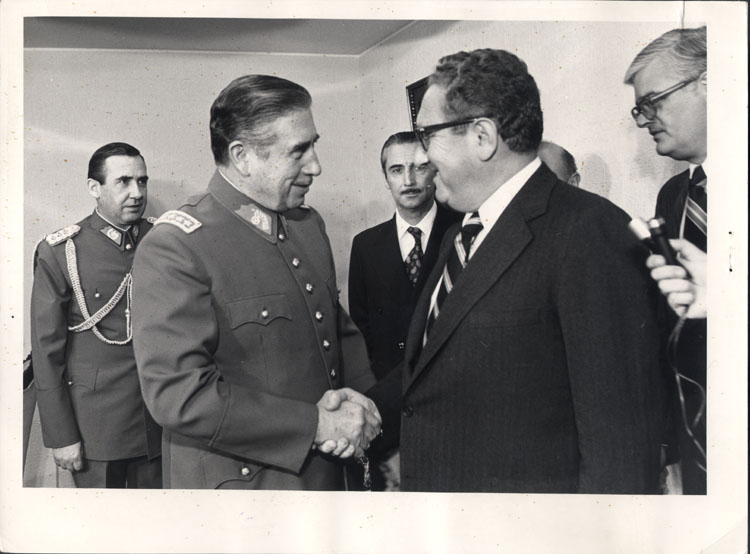
Augusto Pinochet and Henry Kissinger in 1976. (Archivo General Histórico del Ministerio de Relaciones Exteriores)
In Buenos Aires, a former Chilean general returns home, opens his garage door, and is blasted thirteen feet in the air when his car explodes, incinerating his wife. A conservative opponent of the country’s military dictatorship and his wife take an afternoon walk on the streets of Rome and are swiftly gunned down. On a rainy autumn morning, a car blows up in the middle of Washington, DC’s Embassy Row, killing two of the three inside: a leader of Chile’s opposition in exile and his newlywed American friend.
These were just some of the most prized scalps claimed by Operation Condor, officially inaugurated forty-five years and two days ago. With South America in the grip of military dictatorships and rocked by the same kinds of social and political movements that were demanding change all over the world in the 1960s and ’70s, a handful of the continent’s governments made a pact to work together to roll back the rising tide of “subversives” and “terrorists.”
What followed was a secret, global campaign of violent repression that spanned not just countries, but continents, and featured everything from abduction and torture to murder. To say it was known about by the US government, which backed these regimes, is an understatement: though even this simple fact was denied at the time, years of investigations and document releases since then mean that we now know the CIA and top-ranking US officials supported, laid the groundwork for, and were even directly involved in Condor’s crimes.