Capitalist Markets Won’t Solve Pandemics or the Climate Crisis
In the 19th century, capitalist markets combined with environmental disaster to cause famines across the Global South. We might experience a similar tragedy again soon.
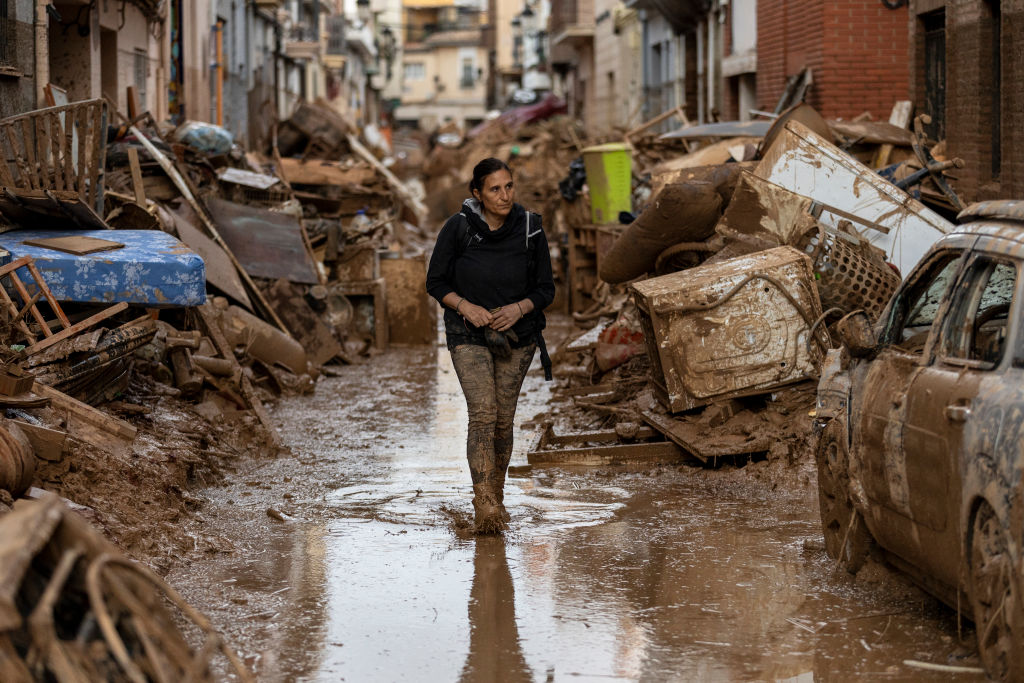
Capitalist doctrines that drove disasters in the nineteenth century remain at work today, and they are constraining our climate crisis response. (Pablo Blazquez Dominguez / Getty Images)
In 2000, the historian Mike Davis published a book that made what was to some a controversial claim: the horrors of the twentieth century had precedents in the era of colonial plunder. In Late Victorian Holocausts: El Niño Famines and the Making of the Third World, Davis explained the scale of what he understood to be the manmade famines that swept through much of the Global South in the nineteenth century. He was far from the first, or the only, writer to make this comparison.
For “most people outside the West . . . the Shoah did not appear as an unprecedented atrocity,” noted Pankaj Mishra in a London Review of Books lecture. Here’s how French resistance fighter and poet Simone Weil put it in 1943: “Hitlerism consists in the application . . . [of] . . . colonial methods of conquest and domination” to Europeans — the very same “evil, which Germany has tried . . . to inflict upon us, we have inflicted upon others.” Colonized populations had seen such colossal cruelty from Europeans for centuries. The Nazis’ main opponents, the British Empire, had also been in the business (as we’ll see the term business is apt) of mass extermination and ethnic cleansing.
Commendably, David Wallace-Wells recently sought to address this holocaust-hiding historical memory hole. In his New York Times newsletter, he wrote about Davis’s Late Victorian Holocausts and linked his arguments to next year’s likely El Niño, a climate event that warms the ocean’s surface temperature along the central and eastern pacific and occurs every two to seven years.
Davis, Wallace-Wells writes, had “urgent reasons for revisiting this secret history.” He specifically sought to strike down standard-century histories that either ignored these devastating famines or deeply distorted their political and economic drivers.
A Deliberate Policy
Whiggish historians usually justify the colonial era by making what Davis described as “smug claims about the life saving benefits of steam transportation and modern grain markets.” But this was a deep misconception. Millions died not as a result of living in the “stagnant backwaters of world history” but “in the very process of being forcibly incorporated” into modernity’s global markets.
This carnage occurred in “the golden age of Liberal Capitalism,” which played a lethal role (through a “theological application . . . [of its] . . . sacred principles”). Though much of this narrative is lost in Wallace-Wells’s brief discussion. Getting these facts right matters because the same capitalist doctrines that drove these old disasters remain at work today.
They’re still constraining our climate crisis response.
Cruelty Without Villains
There were “three global subsistence crises” from 1876 to 1902, Davis writes, resulting in between thirty-two to sixty-one million famine deaths in India, China, and Brazil. Robert Knight, editor of the Bombay Times, judged those involved in British-ruled India’s official famine policy (or in hiding its effects) to be guilty of “multitudinous murders.” Davis explicitly blames “commodity markets and price speculation . . . and the will of the state.” In all but one of the nations involved, “absolute scarcity . . . was never the issue.”
In India, elite Brits oversaw “huge grain exports to England in the midst of horrendous starvation.” The resulting carnage was an “avoidable political tragedy,” not a natural disaster. The culprits weren’t anonymous forces but policy and commercial choices made by identifiable individuals (he names three viceroys: Lyton, Elgin, and Curzon). Rapacity beat morality. This remains a risk today.
Here’s how Wallace-Wells presents Davis’s conclusions: “Environmental disaster punishes those who have been made most vulnerable” and “19th-century El Niños [were] a test for global political economy as much as a parable of ecological frailty.“ He expects 2027 will be a similar (but smaller) test. But reading his abstract villain-less summary, it’s easy to miss the role of market greed and the policy choices that created those vulnerabilities. That all but ignores the most salient of Davis’s lessons for us today: the danger that deference to markets can have morally repugnant results.
Wallace-Wells does mention “imperial cruelty,” but again, his abstract language deserves to be made more concrete. India’s British rulers put self-interest and their beloved free market above the lives of the poor. They imposed the Anti-Charitable Contributions Act, outlawing private relief (which might interfere with market prices). The only aid allowed was at horrifying labor camps, like the one in Madras, featuring rations with fewer daily calories than were given to inmates of Buchenwald.
Davis quotes a British report on one of their holocausts: the famine was “one of high prices rather than scarcity of food.” Amartya Sen’s research has shown this generally applies: famines are often not due to lack of available food but to “entitlement failure” or lack of purchasing power. Their evangelists are correct that markets can do amazing things by using information that no individual has (as Friedrich von Hayek showed). But the only information markets use is prices and ability to pay.
If the poor can’t muster sufficient purchasing power, then even what they need to stay alive isn’t legible to market actors. In that sense, market dynamics structurally deprioritize the needs of the poor. Unless the purchasing power of the poor is guaranteed to be sufficient to sustain life, markets can worsen rather than alleviate suffering. This was a factor, as Davis writes, in the obscenity of the fact that as “Asia was starving the United States was harvesting the greatest wheat crop in world history . . . and . . . worthless surplus wheat was burned.”
To see that this isn’t some old problem that we’ve outgrown, consider the case of the COVID pandemic’s “vaccine apartheid,” where for-profit leaders derailed efforts to act with life-saving decency. For instance, Oxford University’s initial aim of nonexclusive royalty-free licensing of its COVID vaccine was reversed. After interventions by Bill Gates and his foundation, among others, the license was granted exclusively to a for-profit corporation. Once again, our leaders, as recently as six years ago, put profits above protecting the lives of the global poor. There are many things that we must figure out how to do, whether they are profitable or not. Doesn’t decency demand that?
For further cases of morally dubious market misallocations, consider the global food system. More than enough calories to feed all humans are produced, but nearly eight out of ten acres of global farmland fattens meat for the wealthy and their pets. In contrast to those beloved pets, 2.4 billion people are food insecure (that’s one in three humans), and 150 million kids are stunted by malnutrition. Yet grain grown for biofuels could “feed 1.9 billion people annually.”
This avalanche of avoidable suffering is worsened by the atrocity of market speculation. Some of the world’s wealthiest people and institutions (such as hedge-funders or elite college endowments) gamble in food commodity markets. The net result is that greedy ghouls gain by taking calories out of the mouths of the planet’s poorest babies.
For instance, researchers have shown that from 2007 to 2010, world grain inventories increased by an amount that would be enough to feed 440 million people for a year. That grain was hoarded rather than being eaten because of “speculation.” Half of the five million annual global deaths of children under five years old are due to malnutrition. Such food-price speculation is akin to a “white-collar war crime” in which business-suited bandits profit by committing distant murder through markets (though these crimes continue in peacetime).
To really bring home why markets alone can’t be relied on to set morally sound collective priorities, consider that the UN estimates that the cost of ending global hunger would be $93 billion a year. Yet annual global spending on ice cream is $120 billion, on cosmetics $490 billion, and on landscaping is $600 billion. Do these market priorities make moral sense?
The question Wallace-Wells doesn’t face squarely enough is whether under the conditions of the escalating climate crisis our current political class’s market-first inclinations will be any less morally ugly than those of the villainous viceroys or vaccine apartheiders noted above? To see the risks, consider his colleague Klein’s stance on climate.
In an op-ed titled “Your Kids Are Not Doomed,” Klein signals his moral concern for the plight of the global poor: “We will have looted the future of billions of people to power a present we preferred.” He sees the clear trade-off between the basic needs of the impoverished and our lifestyle comforts, but his bottom line is that their suffering can’t be allowed to obstruct a “politics of more.” More, that is, for his global resource-elite readership (median US income puts Americans at the “93rd global percentile,” and a large majority of New York Times readers earn much more than the median). Curbs on the consumption of the well-off could reduce harms on the global poor, but for Klein, lifestyle constraints would be a “sacrifice” that’s politically unrealistic.
Consider the parallels to the priorities of the villains in Late Victorian Holocausts, many of whom called themselves liberals, pursued pro-market policies, and put profit or personal gain above mitigating the suffering of people who were in effect deemed disposable. For example, those exemplary classical liberals at the Economist wrote that it was unwise to encourage “indolent Indians . . . [to believe that] it is the duty of the Government to keep them alive.” Lord Salisbury, secretary of state for India, declared, “It a mistake to spend money to save a lot of black fellows.”
Meanwhile many ordinary Brits were appalled. The Times of London lamented that “the Viceroy had interposed to repress the impulses of charity.” A relief fund was raised from millions of small contributions, which Viceroy Lord Lytton called a “complete nuisance.” There remains today a risk of a similar divergence between mass decency and elite cruelty.
In general, Klein is commendably concerned about suffering that he finds morally repellent. But he seems to devote more coverage to the woes of chickens or hypothetical future digital beings than to climate harms heading for the global poor.
It may be hard to face, but carbon budgets are finite and climate harms are worsened by our consumption choices whenever they’re not carbon-free. This poses a severe test for the liberal no-harm principle. Are we free to pursue consumption that worsens burdens on the planet’s most precarious people? Surely not. Liberals who claim the banner of benevolence should act accordingly. Otherwise they reveal their real tactical liberal priorities, being all for benevolence only if they also gain from it. This costless kindness isn’t truly benevolent or noble.
It is revealing that in his moral reasoning, Klein resorts to an economic vocabulary: the “suffering [of farm animals] is not priced into the meat.” Okay, but a vast amount of human misery isn’t “priced into” the typical lifestyles of New York Times readers. We could define the world’s resource elite as those in the global top-decile income (more than $66,000). Is there an acceptable price for the shorter and immensely impoverished lives of the global poor? Nigerian life expectancy is fifty-four years (2024), during which they get only 3 percent of the “lifetime resource expectancy” of the average Brit (their former colonial oppressor).
Meanwhile New York Times-reading global top 1-percenters secure more money in nine days than bottom-decile earners will over their entire lifetime. Around 7.2 billion people live below — many far, far below — America’s federal poverty line ($43.70 per day). For instance, global median income is approximately $7.60 per person per day (PPP). That means four billion people live below one-fifth of US poverty. These gigantic resource injustices rest on continuing colonial and racial resource disparities and don’t factor in upcoming climate impacts (on those who are least culpable).
The Dark Side of Progress
Again, markets can do marvelous things that we would be fools to ignore. But depending mainly on markets is often not the right way to meet moral obligations. Worse, mixing market and moral logic leads to egregious and immoral distortions, prioritizing so-called assistance that ensures that we gain by it (this is the ugly underbelly of some “win-win” approaches).
For instance, financial flows from poorer to richer nations are “approximately three times as much as development aid,” according to the latest World Inequality Report. And 3.4 billion people live in countries whose external debt service exceeds health or education spending. This isn’t a moral form of “aid.” It’s staggeringly self-serving. And since it perpetuates avoidable suffering, it isn’t really benevolent.
As historian Priya Satia writes, many colonizers genuinely believed they were doing good in promoting a “civilizing mission” — but this was a form of “conscience management.” A strong candidate for an equivalent dodge today is presenting markets as doing a good job of alleviating global poverty. This claim has some narrow truth to it, but the truer picture is that it is a pernicious self-serving illusion. Global extreme poverty has been falling, but the metric used is around one-twentieth of the US poverty level, so this isn’t something that we should straightforwardly celebrate.
Olivier De Schutter, the UN’s special rapporteur on extreme poverty, says current market-led methods will “take 200 years to eradicate poverty under a $5 a day line.” That’s eight generations to bring the global poor to one-eighth of the US poverty level (and many more centuries to catch up fully). Is that morally acceptable progress? Should we really celebrate this, as a World Bank president did, as “one of the greatest human achievements”?
The big picture gets worse when we compare our own typical gains against those of the global poor. We are encouraged to believe that we all have some sort of right to improve our standard of living, as if that was a sacred principle in our politics. But is that really a morally sound position, given gigantically disproportionate resource allocation, such as average recent annual income gains of $4,178 for the global top decile, whereas the bottom decile sees only $9.25 in additional income per year?
Under our current approach, the already rich gain 450 times more than those most in need (the top 1 percent to bottom 10 percent ratio of annual income gains is two thousand to one). And that much-celebrated progress on poverty by global trickle-down effects are tiny that we could double it if top-decile earners cut consumption by just one glass of cheap restaurant wine or two cups of corporate coffee per year (if those funds could be globally redistributed).
None of this makes moral sense, when even small amounts of global redistribution would make a significant difference. Yet the basic moral ugliness remains largely hidden. Klein and Wallace-Wells, as leading advocates of a liberalism that imagines itself to be benevolent, should reconsider what that means morally, given these glaring gigantic disfiguring disparities.
Earlier I noted that Davis used the terms theological and sacred to describe how nineteenth-century liberals viewed markets. It’s illuminating to consider what liberals today hold similarly inviolable. As scholar of illiberal regimes Marlene Laruelle has recently written, the success of post-liberal politics may force “liberalism’s own implicit theology into the open.” As Laruelle notes, “Liberal orders, too, rest on sacred commitments: the equal moral worth of persons, the dignity of conscience . . . or whatever else liberals would like to define as key.”
At times, it can seem as though many liberals hold nothing sacred other than gains in their own standard of living. Proto-liberal John Locke foresaw the perils of holding nothing beyond the self as sacred. He wrote in his journal that man “would be a god to himself, and the satisfaction of his own will the sole measure and end of all his actions.” Locke rejects this as contrary to reason since we have moral obligations. But what obligations do today’s liberals recognize beyond improvements in their own lifestyles? Consider where Klein lands in climate trade-offs.
Ecological burdens imposed on the vulnerable and on future generations are on track to be “the greatest injustice in history,” as ex-NASA climate scientist Dr James Hansen has written. That’s an astonishing claim, given how grotesque and gruesome history has been, but it’s plausible. Fossil fuels today already cause harm on scales akin to transatlantic slavery or holocausts (Nazi and colonial). The UN puts the total number of slaves trafficked at fifteen million (though that doesn’t exhaust the damages, e.g., to descendants), but researchers estimate that the air pollution alone from fossil fuels kills five million people worldwide every year.
The accuracy of such estimates isn’t so crucial, since the scale of chaos from failure to curb carbon quickly enough will affect not millions but billions. Davis puts deaths due to British policy-driven famines in India between twelve and twenty-nine million (exceeding the six million victims of the Nazi holocaust), but this, too, no doubt will be dwarfed by climate harms.
A key aim of Davis’s book was to warn against market-triumphalist histories. We must take his lessons into account in facing the main moral test of our times, which clearly pits our lifestyle enhancements and comforts against the survival, safety, and dignity of the global poor. If we let markets, price-speculation, state inertia, and our comforts shape climate policy and individual action (there’s no getting around the fact that both are needed), it’s likely that future historians will accuse us of benefitting from monstrous immorality. To avoid that, we’ll need strong nonmarket means of doing what’s decent.