In the New Geo-Economic Order, Price Shocks Are Here to Stay
The US-Israel war with Iran has made energy prices soar across the globe. In a world increasingly dominated by imperial war and great-power conflicts, inflation will become an ordinary feature of politics.
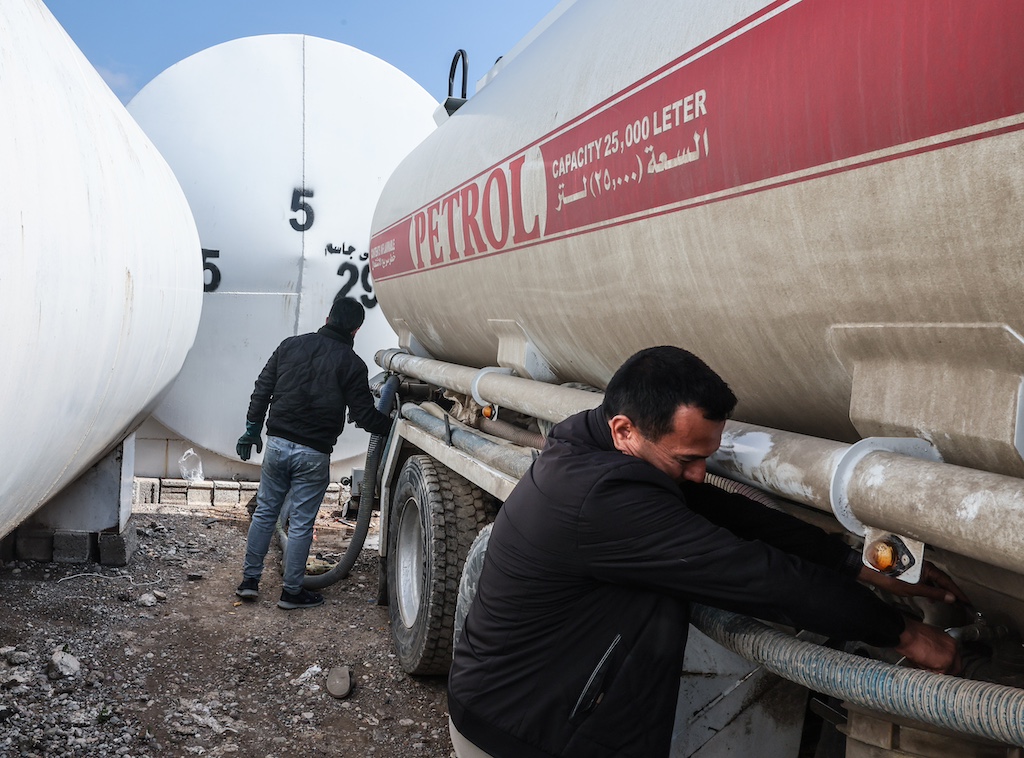
With shipping halted and storage insufficient, most petroleum and liquefied gas production in the region including Kuwait, Bahrain, Iraq, Qatar, the United Arab Emirates, and Saudi Arabia must eventually be shut down. (Sedat Suna / Getty Images)
Less than three years after the disruptions of the pandemic and the war in Ukraine subsided, the world economy confronts another sustained energy and supply chain shock. The war launched by the United States and Israel against Iran, and Iran’s retaliatory strikes against US military assets and oil production infrastructure across the Persian Gulf, have brought shipping through the all-important Strait of Hormuz to a near standstill. The International Energy Agency (IEA) has declared the closure the “largest supply disruption in the history of the global oil market.”
Some 34 percent of globally traded crude oil, 19 percent of liquefied natural gas (LNG) exports, and 16 percent of the trade in refined petroleum products such as diesel and jet fuel travel through this narrow passage between the Arabian Peninsula and the Iranian coast. Although Iranian officials had claimed that non-US and non-Israeli affiliated vessels may transit unharmed, the marine insurance industry responded by canceling war risk coverage for commercial shipping effective March 5. Transit collapsed by 80 percent thereafter and now stands at close to zero.
The situation has been compounded by Iran’s targeting of refineries and storage facilities in Kuwait, Bahrain, Iraq, Qatar, the United Arab Emirates, and Saudi Arabia. With shipping halted and storage insufficient, most petroleum and liquefied gas production in the region must eventually be shut down — and requires weeks to restart and reach full capacity. Iran has stated clearly that it is leveraging the choke point at Hormuz to exert pressure and deter future aggression. Neither side has shown any sign of relenting.
A Geopolitical Price Shock
The fear is that these convulsions will trigger another round of cascading global inflation: an oil and gas supply shock leading to higher gasoline and electricity prices for households and producers, higher production costs in manufacturing where fossil fuels or the by-products of their production serve as feedstock. There is good reason for concern. The realized loss in production already exceeds, by a significant margin, the expected but never fully materialized loss that followed Russia’s invasion of Ukraine in 2022.
The immediate effects have been severe. Sunday night and Monday produced the most volatile session for crude oil prices on record, with the benchmark West Texas Intermediate (WTI) swinging $38 in a single session — from an intraday high of $119.48 down to $81.19 before settling at $94.77. As of March 16, WTI remained roughly 25 percent above its prewar levels in late February. Brent Crude, the other principal benchmark, has closed above $100 for the third session running.
The effect on gas prices has been arguably more severe. While US prices remained relatively stable, Europe’s benchmark Title Transfer Facility (TTF) surged by around 100 percent on March 3 and ten days later remained roughly 56 percent above pre-conflict levels; the Asian equivalent showed a similar rise. Equally alarming are the by-products of Gulf fossil production, which include large global shares of key inputs into fertilizer production — urea, ammonia, and other phosphates — that are no longer being shipped just as demand is set to increase at the start of the spring planting season.
In the face of this disruption, it is worth asking three questions: Who will be most affected; whether recurrent price shocks of this kind are a permanent feature of the new geopolitical dispensation; and how, if at all, they can be prepared for.
Europe and Asia Are Most Vulnerable to the Immediate Shock
The pain is not evenly distributed. Asia is most exposed: it accounts for 85 percent of the liquefied natural gas and around 90 percent of the oil passing through the strait. And this vulnerability has a structural twist. Asian refineries are configured to process the particular grades of crude extracted in the Gulf region — “medium sour” and “heavy sour” crudes, which are denser and contain more sulphur than the “light sweet” crude found in the United States. They cannot be substituted easily. This is not merely a dependency on oil but a dependency on Gulf oil specifically.
This is largely why those who could afford to have built up substantial reserves over recent decades. Japan, Korea, and China constitute the bulk of Gulf export destinations and have all accumulated large strategic petroleum reserves. China alone holds around one billion barrels of crude oil — enough for up to six months — while Japan’s total reserves, including private sector stocks and those held jointly with Korea, amount to roughly 440 million barrels.
Elsewhere, however, reserves and domestic production relative to demand are negligible. Pakistan, Taiwan, India, Thailand, and Bangladesh have virtually no storage capacity and therefore few shock absorbers. They are also the countries most exposed to the disruption of Gulf LNG supplies and, with the exception of Taiwan, to increases in fertilizer prices: their economies remain dominated by agriculture, and a large share of their populations is threatened by food insecurity.
Europe’s position is somewhat more favorable. In relative terms, oil reserves are broadly comparable to those of the large East Asian economies, and the advantage lies in gas storage. Unlike most of East Asia, Europe possesses extensive depleted gas fields and salt caverns — the legacy of decades of domestic gas production — that are ideal for storing large volumes of gas underground at comparatively low cost. This includes both pipeline gas and regasified LNG. East Asia lacks these geological formations in the right locations; in their absence, storing LNG (a cryogenic liquid at –162 degrees Celsius) long-term becomes prohibitively expensive. Most countries there either lack access to pipeline gas entirely or have barred access to it, as the EU has done for Russian imports.
But although European storage capacity is substantial, the actual stock in hand currently sits slightly below 10 percent of annual consumption — lower than at the same point in each of the past three years. And while Europe’s direct trade exposure to the Gulf is relatively modest, oil is a globally traded commodity: there is no escaping the price shock.
It arrives precisely as Europe needs to begin its summer injection season, during which reserves are replenished to a mandated 90 percent before winter. Moreover, natural gas remains the “marginal molecule” in most European countries. Under marginal energy pricing, the most expensive input sets the clearing price: because gas is the most expensive source, the price of gas is effectively the price of electricity. All generators receive — and all consumers pay — the same price.
The United States, too, is not insulated from the fallout, whatever Donald Trump may think. Over the weekend, the president demanded that European and Asian navies secure the reopening of the strait on the grounds that it is their problem, not America’s: the United States does not need oil, Trump declared on Monday.
The United States is indeed the largest oil and gas producer in history and no longer depends on hydrocarbon imports. But its social model is uniquely vulnerable to increases in the retail price of gasoline — and Trump explicitly made cheap petrol a central promise of his second term. Every trip to the pump is a stress test of the fundamentally car-centric American social contract.
US consumers, many already stretched by high living costs, have seen the cost of the average gallon of petrol rise by almost 27 percent in a month, the steepest monthly increase since Hurricane Katrina. This lends credence to persistent rumors that the US Treasury has been intervening covertly in the crude oil market to keep prices down and to insulate the administration from the domestic consequences of its war.
The Causes of Price Shocks Are Structural
The inflationary episode of 2020–23 was instructive. It demonstrated the degree to which the world economy rests on a fundamentally material basis: extremely complicated and fragile supply chains running through key geographic and institutional choke points. It was a test case for how disruptions to these supply chains generate sustained price shocks. Because labor power is weak relative to where it stood during the 1970s energy crises, the demand-side contribution to inflation — the spiral between wages and prices — was limited. The inflationary impulse was almost entirely a supply shock, feeding into energy and food prices, the most volatile components of headline inflation.
A stylized account of this episode illuminates the mechanism. Market power and inequality played a central role. Firms are overwhelmingly price setters rather than price takers. This allows them to pass on higher input costs to households, the majority of which consume most of their income on nondiscretionary items — rent, food, and utilities. Households are, therefore, acutely sensitive to increases in consumer prices. The ability of firms to pass on costs is a function of whether doing so prices them out of consumer segments, which, in turn, depends on the ability of consumers to purchase elsewhere.
Where market concentration is high — where there is less competition on cost — firms are better positioned to raise prices. In the context of large supply shocks, as in 2020–23, they can maintain or even widen their profit margins. And in increasingly unequal “K-shaped” or “dual” economies, the spending power of the upper deciles of the income distribution ensures that aggregate demand holds up even as those further down face real declines in wages and disposable income — shortfalls that are necessarily met by taking on debt.
This should already indicate the structural changes required to soften the economic and political effects of future supply shocks. The consequences of high inequality and oligopolistic market structures extend well beyond prices and warrant significant political investment: higher taxes, antitrust enforcement, and regulatory changes to market structure. But these are deep structural reforms, the pursuit of which would require sustained mass political mobilization and a fundamental shift in the balance of class power across advanced economies. There are no plausible scenarios in which this occurs any time soon.
Conventional monetary policy is also of little help. What we face is not “inflation” in the textbook sense — a broad decrease in the purchasing power of money driven by sustained wage-growth-induced demand across categories. Raising interest rates is a roundabout mechanism to reduce demand via slower credit growth and lower operational expenditure, resulting in higher unemployment and weaker wage growth.
This causes a great deal of unnecessary economic pain, hurts renewable energy deployment (which is highly rate-sensitive), and, above all, hurts developing countries, whose financial conditions are acutely sensitive to rate increases in the advanced economies. Already reeling from commodity price surges, higher import bills, and weaker currencies, the monetary policy response to geopolitically induced supply shocks will likely increase their propensity for debt and balance-of-payments crises.
The Preventative Role of Renewable Energy
There are, however, more immediately available policy levers. In addressing an energy price spike, one can target the demand side, the supply side, or institute temporary price controls. To avoid both shortages and severe social costs, some combination is ideal. A blanket cap on the price of oil or gas functions as a subsidy and risks accelerating purchases at a moment when supply is curtailed. This is why governments engage in “demand destruction”: a suite of policies designed to conserve energy, from instituting four-day workweeks to closing schools early, furloughing staff, and restricting access to petrol.
These contingencies have not yet been fully tested. The EU introduced a gas price cap in 2022, but at €180, it was arguably too high and expired unused last year. The oil price cap instituted the same year, now under reconsideration, was limited to Russian crude.
Still, the mechanisms and institutions for price controls exist, in European and Asian countries alike, and despite legitimate concerns about perverse effects, they should be considered to stave off further social dislocation and adverse consequences for industrial production. The EU caps were specifically designed to cover businesses as well as households. At a time when European industry is already buckling under intense competition from China, softening the immediate effects of the energy price shock is crucial.
The other measure countries can take is to accelerate their exit from fossil fuels entirely. The expansion of renewable energy capacity and the growing market share of electric vehicles will progressively insulate countries from energy market turmoil. The comparatively low volatility in Spain’s electricity prices over recent days may indicate that the country’s aggressive investment in solar energy — and thus reduced reliance on gas as the volatile and expensive marginal input — has paid off.
But this case should not be overstated. Gas makes up around 20 percent of Spain’s net energy generation, giving it a larger role than in Germany, where gas accounts for 13 percent. What matters, however, is the hourly dispatch stack: the share of hours in a day during which gas plants set the marginal wholesale price of electricity. In Spain, this share had fallen to around 15 percent in 2026 so far. Spain has, in other words, decoupled electricity prices from gas prices to a considerably greater degree than other gas-dependent countries such as Germany and Italy.
Crucially, this was not simply a function of the absolute level of renewable generation — Germany’s share of renewables is still higher. What mattered was the rate at which Spain added renewable capacity relative to its demand base: a higher rate of growth translated into a greater marginal displacement effect per unit of demand. This was driven by the deliberate decision of successive Spanish governments since the pandemic to double down on wind and solar.
But the extent of the decoupling was also circumstantial. The “shape” of renewables relative to the demand curve matters: demand fluctuates over the course of a day, as does solar and wind output. Spain is very sunny (producing a flatter midday demand peak) and very windy at the coasts (covering off-peak and overnight hours).
This geographic good fortune means Spain can cover a wider spread of hourly demand slots and rely less on gas than Germany, where price volatility has been higher despite both the renewables share of generation (59 percent) and of total installed capacity (77 percent) exceeding Spain’s (55 and 70 percent, respectively). Germany, moreover, unlike Spain, lacks a low-carbon dispatchable backstop to manage the intermittency of renewables. In Spain, nuclear energy still accounts for 19 percent of generation and plays a central role in providing baseload — the readily adjustable energy input that flattens out volatility in demand and supply — to prevent disruptions during the green transition.
Germany shut down its perfectly viable nuclear fleet after 2011 and is now reckoning with the consequences. It has increasingly relied on imports of wholesale electricity — ironically not just from Scandinavian hydro and wind but also from French nuclear power — and has maintained a reliance on coal, which still accounted for over 20 percent of generation in 2025, much of it the far more carbon-intensive brown coal (lignite).
The mistake of abandoning nuclear energy is now openly acknowledged by Chancellor Friedrich Merz and his counterpart at the helm of the European Commission, Ursula von der Leyen, who on Tuesday announced that the EU will explore the construction of new nuclear reactors. Popular opposition to nuclear power, however, remains a real obstacle to achieving a smooth transition to a renewable share sufficient to insulate against future energy crises.
The most compelling example of managing this transition is China. Despite over a decade of breakneck renewable growth, coal still accounts for roughly 55 percent of total electricity generation. But China is severely underutilizing coal plants while continuing to add capacity. Just as with the accumulation of one billion barrels in crude oil reserves, the maintenance of a large fleet of coal plants reflects an extremely risk-averse approach to energy security in the context of simultaneous decarbonization and geopolitical risk.
At the same time, China is betting heavily on nuclear to replace coal in baseload capacity: fifty-eight commercial nuclear units are in operation and up to forty further ones are planned or under construction. The target is to raise nuclear’s share of generation to 10 percent by 2035 — by which time wind, solar, and hydro will likely account for 70 percent or more, and the coal redundancy will have been steadily phased out.
Will the Oil Shock Hasten Electrification?
“In the rubble of the Iran war,” political economist Cornel Ban wrote last week, “one can glimpse the skeleton of a post-hydrocarbon geopolitical order.” This reflects the fact that the expansion of renewable energy capacity is geostrategically crucial: it eliminates dependency on fossil fuels and exposure to their associated price shocks. As Pierre Charbonnier writes, oil is not the victim of geopolitical disruption; it is itself disruptive, a source of persistent political and economic instability. The case for accelerating the transition away from fossil fuels makes itself and should command broad support, both popular and among competing elite factions.
But structural pressure may not translate into political action. In Europe, the energy transition has become the convenient political foil for both higher prices and rising industrial unemployment. As a new price shock looms, this rhetoric is set to intensify. On Monday, Belgium’s prime minister, Bart de Wever, resurrected the notion that Europe needs to normalize relations with Russia to regain access to cheap gas — regardless of the fact that this is legally impossible and economically unviable (at this point it would likely be the most expensive option available).
It reflects a widely held conviction that the transition away from fossil fuels is the problem rather than part of the solution. Europe’s dependency on Russian exports was the grand security liability that empowered Vladimir Putin’s invasion of Ukraine in the first place.
It is unclear, moreover, how global decarbonization can proceed without a very substantial fossil fuel industry. This is largely because of the role of oil and gas in the production of sulphur. Because sulphur must be removed from fossil fuels to prevent acid rain, fossil fuel production accounts for over 80 percent of global sulphur output; 44 percent of globally traded sulphur originates in the Gulf. Sulphur is the main component of sulphuric acid, which is required for extracting from their ores the metals essential to low-carbon energy technologies — nickel, cobalt, copper, zinc, lithium, and uranium.
There are, of course, other ways to manage fossil fuel shocks short of advanced decarbonization. On the supply side, strategic “buffer stocks” of oil, gas, and petroleum products — and indeed of key commodities more broadly — are a costly but effective means of preventing excessive price volatility. The general principle is to release stocks at market prices during moments of turmoil in order to prevent further supply losses. But it is not yet clear how effective this approach is when the supply shock is sufficiently large.
On March 11, the IEA, which coordinates global strategic petroleum reserves, announced that thirty-two participating countries had agreed to release a record four hundred million barrels of crude oil — likely amounting to fifteen million barrels per day, accounting for roughly 86 percent of the volumes that usually transit the now-closed strait.
But prices have continued to rise, reflecting the supplies already lost, the slow and geographically misallocated pace of the release, and the poor prospects of an imminent reopening. The quality of crude oil after prolonged storage is also uncertain; the need to cycle reserves regularly adds further cost to an already expensive proposition.
Nonetheless, attaining strategic commodity buffers will be essential going forward, given that disruptions of this kind will likely recur with greater frequency in the newly fragmented trading order. The problem is that the developing countries most vulnerable to these energy and commodities shocks — and to the effects of the climate crisis — are least capable of creating buffer stocks. They are also least capable of financing the green transition that their energy security now demands.
The growth of cheap renewable energy exports from China — solar panels above all — has given some hope in this regard, but the cost of equipment is only one element. Actual deployment depends on a host of domestic factors likely to be further undermined by continued price volatility and growing emerging market financial risk.
Ultimately, viewing the new geo-economic risk as the herald of decarbonization is woefully optimistic. Most countries, including those most affected by energy and commodities disruptions, remain ill-equipped to pursue mitigation at scale. As climate disruption worsens and endangers their capital base and financial stability, their capacity to adapt will diminish further.
Even the advanced economies — with the exception of the very largest, endowed with the most spectacular resource and financial reserves, such as China and the United States — will struggle, politically and economically, to adjust. And it is far from clear that even the United States can absorb the domestic repercussions of persistently higher prices.
The most promising scenario, by far, is a moderation of the worst aspects of the new order: war and trade fragmentation. America is the great destabilizing force imperiling the world economy. Together with Israel, it has become a rogue state, unfettered by any consideration of international law, multilateral order, or even hegemonic responsibility. Incapable of dealing with its own domestic dysfunctions, it is wrecking an economic and political system that has so far served it exceptionally well. Its carbon-reliant industries and its defense sector are the only real beneficiaries. As long as these forces remain unchecked, the kind of convulsion we are currently witnessing is here to stay.