Thermonuclear Slop and the Return of the Bomb
We are bumbling toward an AI-enabled, nuclear-curious World War III. A new book urges us to get over antiwar protest burnout and cynicism and to rebuild the long-dormant Cold War movement to ban the bomb.
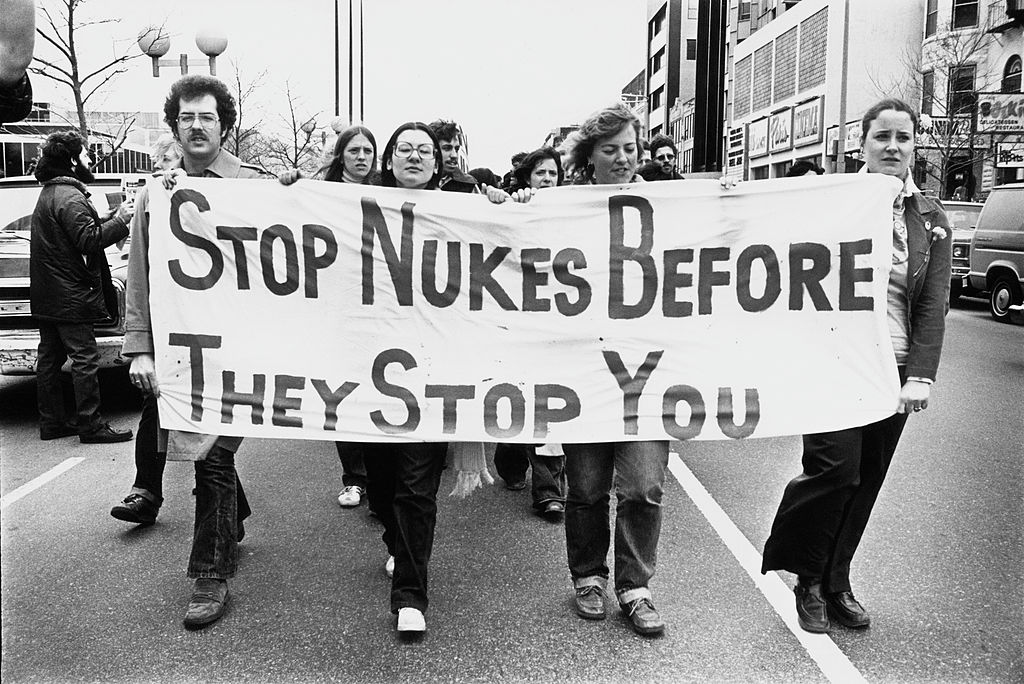
A new book on nuclear winter makes clear the scale of our present danger. It calls for pushing past our collective burnout and rebuilding the movement to abolish nuclear weapons to halt the prospect of human extinction. (Barbara Alper / Getty Images)
There are so many low-quality, kitsch-militarist, cringe aspects to the past several weeks’ bumble toward an AI-enabled, nuclear-curious World War III — or at least some vast, multi-theater, multinational regional conflict — that breed an easy gallows-humor cynicism.
Trump’s straight-to-streaming “Operation Epic Fury” branding of a US-Israeli assault on Iran deploys — with the husky-voiced bombast of a Dodge Ram commercial — the “Unmatched Power, Unrelenting Force of America’s Warriors.” The Department of War floods social media with video-gamified, Hollywood-sizzle-reeled war porn and AI-generated disinformation. Centrist dads choke up online at French President Emmanuel Macron’s staging a Casablanca-style sing-along of “La Marseillaise” in a submarine hangar while announcing plans to reverse course on decades of nuclear disarmament by expanding France’s arsenal. The US “AI and crypto czar” David Sacks warns that Israel could use its nuclear weapons in this conflict. Former House Speaker Newt Gingrich (I know, I thought he was dead too) endorses what he didn’t realize was a satirical article about how to overcome Iran’s control of the Strait of Hormuz by using “a dozen thermonuclear detonations” in friendly territory to cut “a waterway wider than the Panama Canal, deeper than Suez, and safe from Iranian attacks.”
Then there is the discarding of the postwar order itself, in blithe contempt for the UN Charter’s prohibition on what the Nuremberg Tribunal described as “the supreme international crime of aggression” that very straightforwardly boosts the chances of nuclear proliferation around the world — even as the assault was mounted, in Orwellian style, to fight nuclear proliferation in the Islamic Republic.
Every country now quickly realizes that, with international law no longer guaranteeing national sovereignty (however imperfectly and hypocritically it ever did), the only remaining guarantee is to get the bomb as fast as possible. It almost makes one nostalgic for Colin Powell dangling his blue-capped vial of coffee creamer “anthrax” before the UN Security Council. At least the architects of the Iraq War pretended for a while to abide by international law.
And, in a bleak pairing that combines the existential threat of nuclear holocaust with artificial intelligence doom, US Secretary of War Pete Hegseth appears to actually want to build Skynet, bullying frontier lab Anthropic over use of AI for fully autonomous lethal weapons — killer robots — even as King’s College London researchers find that in war simulations, AI recommends nuclear strikes in 95 percent of cases.
But perhaps the most surreal moment of what feels like an ever more degraded reality has been an X post by David Sirota, the writer nominated for an Academy Award for the climate apocalypse satire Don’t Look Up. He and the reporters at his news site the Lever discovered that betting firm Polymarket had created a prediction market to monetize the chances of a nuclear weapon detonation sometime in the coming year. And the news comes amid concerns that government officials are already regularly engaging in “insider trading” by making wagers on military actions they have private information about, such as the extrajudicial assassination of an Iranian ayatollah or kidnapping of a Venezuelan president. Or, put another way, prediction markets are incentivizing government officials to push for or take whichever course of action will win them the most from their flutter on the thermonuclear ponies. Even Sirota’s dark comedy about the end of the world never managed to go that dark.
Call it all thermonuclear slop. And in exhausted rejoinder, we might up-talkingly butcher T. S. Eliot: “This is the way the world ends? Seriously?”
Such understandable cynicism — running from reams of social media snark to Daily Show sketches recycling quarter-century-old recurring segments from the War on Terror (“Mess O’Potamia”) — sits atop widespread protest burnout after two and a half years of global demonstrations that failed to do much to stop Benjamin Netanyahu’s war on Gaza. And that burnout rests atop compassion fatigue and impotence in the face of four years of Vladimir Putin’s crushing of Ukraine. A layer cake of forever-war fatalism and powerlessness. Those of a certain age will note that they’ve been protesting war almost continuously for a generation with apparently little to show for it. War is now just the background to life. The only variable is how close to the front lines one happens to be. And there seems like not a single thing that can be done to stop any of it.
And yet, and yet.
A recent book on nuclear war by British science writer Mark Lynas asks us to put aside this sense of resignation and understandable exhaustion, and to urgently rebuild the Cold War’s movement against atomic weapons. It may be the most important, revivifying thing anyone can be reading right now. “Our collective response, probably because the cause seems so hopeless, is fatalism rather than activism,” he writes. But, he continues convincingly, we simply don’t have time for cynicism and despair.
We might not even have six minutes.
A Climate Change Book Disguised as an Antiwar One
Six Minutes to Winter is in some ways a book about climate change disguised as one about war. Or perhaps it’s the other way round.
Lynas made his name writing about climate change and popularizing the notion of planetary boundaries: a science-based framework for understanding nine major Earth-system processes, from biodiversity to ocean pH levels to the ozone layer, that human activities have been altering sufficiently to threaten our flourishing — or even existence. His 2007 book, Six Degrees (he clearly appreciates a good title with the number six in it), which tracks the consequences of each additional degree Celsius of warming, was later republished in 2020 as Our Final Warning. It is perhaps the urtext on how much worse everything gets between 1.5, 2, and 3°C of warming and beyond.
Lynas spent much of his youth as an environmental activist and continues to campaign for better green policies. But, like any good science writer, Lynas followed the evidence. In the interest of preventing runaway climate change, that meant abandoning long-held green shibboleths against nuclear power and genetic engineering. Today, much of the green left has followed in Lynas’s footsteps and embraced these technologies. Lynas was one of the key figures, especially in the UK, to get the ball rolling on this new, bright green, technologically optimistic left.
However, this struggle to win the environmental movement to the ultra-low carbon intensity of nuclear power has faced a persistent obstacle: the linguistic — and therefore political — conflation, especially in English, of nuclear energy and nuclear weapons. (In German, by contrast, the distinction is explicit: Kernenergie and Atomwaffen).
How can one support one and not the other? Pronuclear environmentalists will regularly stress how they are completely different technologies, even if they arise from the same underlying science of the atomic nucleus. Nuclear weapons are a political choice — they do not flow inevitably from civilian nuclear energy. There are countries with nuclear weapons but no nuclear power (Italy hosts US bombs) and those with nuclear power but no nuclear weapons (like Canada and Japan). Nevertheless, there often remains a niggling suspicion that those who back nuclear reactors must also somehow back the bombs that come with a similar first name.
Nuclear Winter
Six Degrees of Winter handily puts that suspicion to rest — not just through its thunderous moral denunciation of the atom bomb, but also by looking at nuclear war through the lens of global warming, or rather its inversion. The chilly season of the title comes from the concept of nuclear winter, a rapid and prolonged cooling of the planet caused by soot lofted into the stratosphere by pyrocumulonimbus clouds — enormous, violent thunderstorms produced by firestorms, whether from wildfires, volcanic eruptions, or nuclear blasts and the thousands of burning cities the latter ignite.
The famous photograph of the plume rising above Hiroshima on August 6, 1945, is not, as widely presumed, a picture of the post-detonation mushroom cloud itself. In fact, it is a pyrocumulonimbus cloud produced by the urban firestorm that the detonation caused — a conflagration so ferocious it results in its own storm-force wind system. However deadly the initial nuclear explosion, however far radioactive “black rain” may spread, these are not what pose the greatest existential danger. It is the soot injected into the stratosphere. There, far above the clouds, it can no longer be removed by rain.
In a horrible inversion of the greenhouse effect, the soot blocks incoming solar radiation rather than trapping it. The result is not warming but rapid, severe global cooling that unfolds far faster and more dramatically than climate change as we usually think about it.
The possibility of a nuclear winter was first raised in a 1952 US Air Force report, though its authors concluded that there was little chance of it occurring. But the idea did not go away. In 1966, a Rand Corporation investigation suggested it was plausible, but called for further advances in the still-young field of atmospheric science in order to understand the magnitude of the phenomenon. In 1975, a National Research Council study, comparing potential soot levels produced by a nuclear war to the 1883 Krakatoa volcanic eruption, concluded that any cooling effect would probably lie within normal global climatic variability, “but the possibility of climatic changes of a more dramatic nature cannot be ruled out.”
The parallels with how our understanding of global warming developed are important to this story. The possibility that fossil fuel combustion could dangerously heat the planet was put on a firm scientific footing over roughly the same time period (with the greenhouse effect understood in principle since the late nineteenth century). But the scale of the problem was only really established — thanks to computing advances enabling ever more complex modeling of the atmosphere and an accumulation of real-world studies — in the 1980s.
It was not until the late 2000s that scientists fully grasped the implications: emissions would not simply need to be reduced, but eliminated — or, more precisely, brought to net zero, meaning any remaining emissions must be balanced by carbon removal and sequestration. The same maturation of atmospheric science and Earth-system modeling that clarified global warming also sharpened our understanding of its inverse. If Lynas’s earlier books helped popularize the science of warming, this one aims to do the same for cooling.
By the 1980s, the still-developing idea of a nuclear winter was already considered plausible enough to shape policy, contributing to the rationale for a series of arms control treaties beginning in 1986 between Moscow and Washington, committing the two powers to reduce their nuclear arsenals. But it’s remarkable how recently the hypothesis has moved from plausibility to confirmation.
Thankfully there have been no nuclear wars to test the theory (at least up to this point; we’ll see what the coming days bring). But recent years have provided forbidding proxies. A series of devastating wildfires (the risk of which has been substantially increased by global warming) have injected a profusion of soot into the stratosphere. For example, the “Black Summer” fires in Australia of late 2019 and early 2020 reduced solar radiation by about 0.3 watts per square meter — enough to cancel out, very briefly, a substantial portion of global warming.
Forests contain far less combustible material than fuel-dense cities, so researchers extrapolate from the impacts of these wildfires, and compare against modeling results. Volcanic eruptions also provide similarly useful proxies. Together, these lines of evidence have moved nuclear winter from plausible concept to firmly grounded science — backed up not only by the latest climate models, but by real-world observations that help validate them. The same journals that tell us what global warming will bring also publish studies that describe in granular detail what nuclear winter will be like.
And these climate studies looking at the impacts of nuclear winter find it to be far, far worse.
Those Killed by the Bombs Will Be the Lucky Ones
Global warming from greenhouse gas emissions takes effect over the course of decades or even centuries (especially with respect to sea level rise; under current emissions rates, complete melting of Greenland’s ice sheet, for example, would likely take until the year 3000). Even the very worst scenarios are unlikely to result in human extinction — though civilization will be severely strained beyond around 5°C of warming — as people could, in principle, retreat to polar refuges. But the global cooling under a nuclear winter is far more rapid, with far grimmer consequences. There is no refuge anywhere on Earth — outside, perhaps, New Zealand.
There are a handful of climate activists, notably from the direct action group Extinction Rebellion, who claim that global warming will lead to billions of deaths. Climate impact researchers regularly push back against this, noting that their findings do not support such claims. Exaggerating the already dire consequences only undermines public trust in science and support for emissions mitigation policies. However, climate scientists and agronomists working on the impacts of nuclear winter have no such qualms. Billions would indeed starve to death from the resulting yearslong global famine. The wolf, in this case, really is at the door.
In a full-scale nuclear exchange — between the United States and Russia or China — the stratospheric soot would reduce incoming sunlight by a global average of two-thirds. The average global temperature would quickly plunge by 7°C — colder than the lowest temperatures of the last ice age. Higher latitudes would suffer total darkness for weeks. By years two and three, the world would experience half as much solar radiation, while temperatures would drop a further 9 to 10°C. As Lynas puts it: “an ice age within an ice age.” North America and Eurasia would remain 20°C below prewar levels for three years, and much of the United States would remain permanently below freezing all year round.
Yet it is not the cold that kills so much as the darkness. Photosynthesis ceases, both on land and in the oceans, collapsing the food chain. Lynas compares this to the mechanism behind the late Cretaceous mass extinction that killed off the dinosaurs, when the Chicxulub asteroid slammed into the planet, throwing up vast volumes of dust, soot, and other material. “It is as if we have built a fleet of killer asteroids and pointed them at our own planet,” he writes of our nuclear weapons stockpiles.
Lynas then takes us on a grim travelogue of the world, drawing on models of how crops would respond to these conditions — and how societies would respond to the resulting collapse of roughly 90 percent of calories available to humanity. Some 6.6 billion would starve to death within the first year and a half. A table early on in the book projected mortality rates by country: 99 percent of the United States, 99 percent of Canada, 99 percent of France, 99 percent of China, only 98 percent of Japan, and so on.
Even a more limited, regional nuclear exchange — say between India and Pakistan — would be catastrophic. Such a conflict would produce lower volumes of stratospheric soot, but global calorie availability would still fall by two-thirds. America’s food production would collapse by roughly a similar margin; China’s by 64 percent; Russia’s by 85. My home country, Canada, would lose twenty-eight million out of its forty million inhabitants to starvation.
Nuclear weapons are therefore, Lynas points out, an entirely suicidal enterprise. Quoting a 1985 statement by American President Ronald Reagan and Soviet leader Mikhail Gorbachev, he reminds us: nuclear war can never actually be won, and so should never be fought.
The Bomb Never Went Away
The “six minutes” of the title refers to America’s “launch-on-warning” posture: the requirement that nuclear weapons be out of their silos and on their way as soon as there is confirmation of an incoming attack. It is a form of deterrence: if an enemy knows that they cannot avoid massive retaliation, it reduces their propensity to strike first. But launch-on-warning compresses decision-making into the time it takes to confirm that attack. Estimates put it at around six minutes.
In that brief window, the US president has to decide whether to fire those weapons. The recent Netflix nuclear-war thriller A House of Dynamite extends this authorization countdown to twenty minutes, perhaps a more film narrative–appropriate time frame. Either way, the time is too brief for rational decision-making. Lynas quotes Reagan’s own lamentation about this: “Six minutes to decide how to respond to a blip on a radar scope and decide whether to unleash Armageddon! How could anyone apply reason at a time like that?”
For all Reagan’s faults, it must be conceded that he — like his Soviet counterpart — at least grasped the enormity of that burden. Perhaps the same could be said, again for all his faults, of Xi Jinping. But can it be said of Donald Trump or Vladimir Putin?
Lynas recounts the multiple times that the world has experienced near misses, from infamous events like the Cuban Missile Crisis to lesser-known computer glitches and accidents. In 1983, for example, Soviet lieutenant colonel Stanislav Petrov refused to follow protocol and pass up the chain early-warning data that suggested the United States had launched five Minutemen ICBMs toward the USSR. Something didn’t make sense: why would the United States send only five such missiles? He waited a few minutes and then reported a system malfunction. His hunch proved correct. The Soviet satellite system had misinterpreted the sun’s reflection from high-altitude clouds.
Petrov’s judgment — and refusal to act mechanically — saved the world. In other words, we have been very lucky so far. And that luck one day will run out.
Yet that very luck, combined with the end of the Cold War, has encouraged a dangerous complacency. Many people — myself included, before reading this book — assumed that while nuclear weapons still existed, the overall trajectory of disarmament had reduced the risk of catastrophe. Climate change, pandemics, even AI seemed more pressing.
Lynas cites experts in geopolitical risk who maintain the opposite: that we are as close to nuclear conflict as during the most white-knuckle moments of the Cold War. The difference is that today’s tensions are multiple and overlapping — Taiwan, Ukraine, Kashmir, and, of course, Iran and Israel — rather than concentrated along a single ideological fault line. And these multifarious tensions exist even as we now have far more certainty about nuclear winter impacts than anyone did during the Cold War.
The bomb never went away, Lynas writes. “We just stopped thinking about it.” It is time to start again.
The New Arms Race
There have been, however, a series of destabilizing geopolitical events since the turn of the millennium that Lynas does not consider — and that suggest the situation is graver still.
Even during the direst moments of the Cold War, most nations had little reason to seek the bomb. Outside a handful of exceptional cases, national sovereignty was understood to be guaranteed, however imperfectly, by international law. That condition no longer holds.
Until recently, most states refrained from developing nuclear weapons because they believed their territorial integrity was protected by a shared legal order. Those that did seek out nuclear weapons — whether outside or in violation of 1970’s Treaty on the Non-Proliferation of Nuclear Weapons (NPT) — did so because their particular situation led them to conclude that the law would not be able to protect them. It could be argued, for example, that the failure of liberal democracies to prevent the Holocaust or accept Jewish refugees imprinted the belief that only the bomb could guarantee Israel’s survival.
Figures on the Left have regularly pointed out how hypocritical the application of international law has been, how there is no true global sovereign authority to enforce it, and so it is not even possible for international law to be an inconsistent but otherwise neutral arbiter. It can only reflect and reinforce the interests of dominant powers. The historical record bears this out: from the 1953 Anglo-American overthrow of Mohammad Mosaddegh in Iran, to Belgium’s role in the 1961 torture and execution of Congolese pan-Africanist Prime Minister Patrice Lumumba, to countless other outrages, double standards, and injustices.
This critique is not wholly wrong. But it provides no account for how things could become even worse. If this critique holds, then the destruction of Gaza and the war on Iran must be viewed as just more of the same. There would be no qualitative deterioration. Putin’s war on Ukraine remains lamentable, but not distinct from, say, the USSR’s invasion of Afghanistan.
During the first Trump administration, journalist Masha Gessen wrote a meditation on Hannah Arendt’s description of fascism, describing it as inviting people to “throw off the mask of hypocrisy.” Gessen argued that hypocrisy is an essential but often unrecognized element of democratic society and morality, as it implies that politicians still care enough to pretend to respect ethical norms. This at least leaves the door open to holding them to account on inconsistencies in their own arguments. What were generations of Cold War activists pushing for an end to nuclear weapons hoping would be achieved, if not a treaty outlawing the bomb? None of these activists were under any illusion regarding the hypocrisies of international law. The British Marxist historian E. P. Thompson, an architect of the Campaign for Nuclear Disarmament, had written a poetic homage to the Chilean socialist President Salvador Allende immediately after the 1973 US-backed coup that toppled him. Nevertheless, these campaigners kept up the fight, instinctively understanding that use of international law merely as a cudgel of the strong against the weak was not the whole of the story.
Until recently, even the most powerful states felt obliged to argue that their actions did not violate the UN Charter’s prohibition on aggression. They frequently tied themselves into legal knots to do so, but, as Gessen notes, this “aspirational hypocrisy” imposed limits. It meant that greed, vengeance, and cruelty could not be openly avowed as legitimate aims.
For Trump, Hegseth, Stephen Miller and company, there is no pretense to moral and legal consistency — only glorious winners and reviled losers. The response to accusations of war crimes is no longer even half-hearted denial, but indifference: “So what?”
This may seem like a thin, idealist defense of international law. But consider what happens when even this thinnest of protections disappears. If there were nothing at all to the UN Charter’s prohibition of the crime of aggression, then we would surely have seen far more widespread efforts at nuclear proliferation. The bomb would be understood to be the only reliable guarantee of national sovereignty.
Over the last couple of decades — and then, abruptly, over the last five years — even this thin protection has been steadily eroded. We are moving far beyond what Canadian Prime Minister Mark Carney recently called the “partially false” story of the postwar order, in which “the strongest would exempt themselves when convenient.”
The George W. Bush administration’s 2003 invasion of Iraq marked a turning point. When the United States (and Operation Iraqi Freedom co-invaders the UK, Australia, and Poland) failed to secure UN authorization, they proceeded anyway — demonstrating that international law could simply be ignored, with none of Gessen’s aspirational hypocrisy. The subsequent use of torture, extraordinary renditions, black sites, extrajudicial killings, and the legal black hole designation of detainees as “unlawful combatants” instead of prisoners of war only deepened this rupture.
The lesson was clear: Iraq could be invaded because it did not actually possess any weapons of mass destruction. North Korea could not be, precisely because it did.
And if America can flout international law, then why can’t Russia? Putin’s first invasion of Ukraine followed a rough decade after the opening guns of the Iraq War, and then again in 2022. The country would likely not have been invaded at all, had Kyiv held on to its nuclear weapons after the Cold War.
The West’s response further undermined the system it claimed to defend. While rallying to Ukraine’s defense and denouncing Russian war crimes, Western governments proved unwilling to apply the same standards to Gaza or the West Bank. This unwillingness to condemn the crimes of Netanyahu showed the Global South, in particular, that human rights and UN legal frameworks were thoroughly meaningless — not merely inconsistent and hypocritical.
All of this has unfolded alongside the United States pulling out of dozens of international treaties and threatening annexation of Canada and Greenland. The Trump administration’s kidnapping of Venezuelan president Nicolás Maduro was carried out without even a pretense of legality. The US-Israeli assault on Iran was justified in the name of nonproliferation while Israel itself remains a nuclear power outside the NPT. These actions, met with muted or nonexistent criticism from Western leaders, signal something far worse than inconsistency. They signal a breakdown. The international rules-based order established after 1945, for all its many faults, has been replaced by something worse: a return to the great-power rivalry that preceded World War I.
The inconsistency at the heart of nonproliferation has long been obvious. If preventing nuclear war is the goal, then nuclear capability — whether existing or prospective, whether held by signatories or non-signatories — should be treated consistently. Otherwise, the framework designed to prevent proliferation perversely incentivizes its opposite.
The contradiction has been with us for decades. The bombardment of Tehran is merely the final blow to the legitimacy of the nonproliferation framework.
More Fingers on More Buttons
And all of this sits atop the collapse of the broader arms control scaffolding — once relatively stable from the Cold War up to the War on Terror. The United States withdrew from the Anti-Ballistic Missile Treaty in 2002, then from the Intermediate-range Nuclear Forces Treaty in 2019. The Open Skies Treaty followed (with US and Russian exits in 2020 and 2021 respectively). Russia then “suspended participation” from the New Strategic Arms Reduction Treaty (New START) in 2023, a treaty that officially expired last month, marking the end of the era of American-Soviet/Russian arms control that began in 1969.
Meanwhile, during the war in Ukraine, Putin has repeatedly issued explicit nuclear threats, invoking the possible use of “tactical” weapons — smaller battlefield nukes — and thereby erasing a long-standing Soviet/Russian taboo on the bomb as a usable instrument of policy. In 2024, Israeli ultranationalist heritage minister Amihai Eliyahu similarly said the use of some kind of atomic bomb was “an option” in Gaza. He was subsequently reprimanded, but the threat has never been retracted.
Where the Cold War nuclear threat remained primarily restricted to the US-USSR antagonism, today, there are multiple “nuclear dyads”: India and Pakistan; North Korea and the north Asian neighborhood; the United States and China; Israel and Iran. More fingers on more buttons.
A raft of countries will now — quite rationally from their own perspective, however irrationally from that of the species — race toward some form of their own nuclear deterrence.
Even before these recent shocks, most nuclear-armed states were moving from a regime of post–Cold War reductions into cycles of modernization. The Stockholm International Peace Research Institute (SIPRI) and the UN’s own Institute for Disarmament Research (UNIDIR) have both warned that the era of reductions has come to an end and that a “new nuclear arms race” is now gearing up — this time with more diverse and potentially more serious risks from artificial intelligence, cyber warfare, and space-based systems.
Formal withdrawal from the Non-Proliferation Treaty remains unlikely. It has occurred only once, in the case of North Korea. It would signal unmistakable intent to acquire nuclear weapons, triggering sanctions, diplomatic isolation, and, in many cases, domestic outrage. Instead, proliferation will likely proceed more obliquely: through remaining within the NPT while expanding nuclear umbrellas or through “hedging” — the development of the technological and industrial capacity to rapidly produce nuclear weapons without actually doing so. South Korea and Taiwan are already categorized as “nuclear threshold states,” while Japan is said to be “one screwdriver’s turn” from the bomb.
It is in this context that France’s change in nuclear posture must be understood. Plans to expand its arsenal, cease disclosing warhead numbers, and explore conversations about the “Europeanizing” of its deterrent are not just minor adjustments amid the often impenetrable turbulence of EU policy, but significant steps toward proliferation. Across Europe, early-stage proliferation dynamics are coming online even as politicians test the boundaries of what remains of the nuclear taboo.
Macron’s proposals for “advanced deterrence” involve the sharing of France’s bombs via temporary deployment to other EU airfields, while retaining national command authority — in line with the letter of the NPT. This amounts to a replication of the US practice of permanently lending its bombs to certain NATO allies even while Washington keeps control of who presses the button.
This American practice has existed for decades and critics have always argued that it breaches the spirit of nonproliferation. France is now poised to proliferate that breach of the spirit nonproliferation.
For frontline Poland, this is not enough. Polish Prime Minister Donald Tusk, former EU Council president, argued that consultation under a French nuclear umbrella is insufficient. Warsaw wants domestic “autonomy” with respect to nuclear deterrence. German Chancellor Friedrich Merz has floated discussions with France and the UK over the “sharing of nuclear weapons” alongside those the United States loans them, including the possibility of German aircraft carrying French nukes. Even Sweden and Finland, freshly minted NATO members in the wake of Russia’s invasion of Ukraine, have seen the discourse decisively shift from long-standing cross-partisan support for disarmament to acceptance of nuclear deterrence as part of the two countries’ security policy. The taboo against domestic hosting of such weapons, however, remains in place — for the time being.
Many will argue, not without reason: What alternatives do these countries have? What else are they to do in the face of a rampaging Russian bear on their borders regularly teasing use of tactical nukes while Washington threatens to annex NATO allies?
This apparent rationality — proliferation as a defensible response to a deteriorating security environment — only deepens the sense of fatalism. It adds a final, rotting cherry of hopelessness atop the layer cake of despair, burnout, and cynicism.
No Time Left for Despair
Six Minutes to Winter is a bleak book. There is an entire chapter devoted to the uncanny parallels between worldwide nuclear war and the asteroid impact and mass extinction event at the end of the Cretaceous period. It is in many ways the literary equivalent of the infamous British 1980s drama about nuclear holocaust, Threads, widely viewed as one of the bleakest stories ever put to celluloid. But unlike Threads, it doesn’t leave you bereft of hope.
Before anything else, Lynas is — and remains — a climate activist, albeit an ecomodernist one. Why he wrote this book makes a great deal of sense when viewed in that context. Reflecting on how bleak the threat of climate change appeared at the turn of the millennium, when he first started writing about the subject, he notes that now, “thanks to the progress we have collectively made over the last 25 years, none of this should happen.”
In place of the truly existential worst-case scenario of 6°C of warming he described in his earlier book, the world is now on track to experience 2.4°C of warming by the end of the century, with fossil fuel use and emissions set to peak as early as 2030, according to the International Energy Agency. This is still substantially higher than the UN Paris Agreement’s 1.5–2°C guardrail, and Lynas encourages us to keep fighting for more aggressive action to lower the projections still further. “This is why climate activism is so important,” he writes, crediting activists in part for this progress — even as he rages against those activists who irrationally oppose technologies such as nuclear power that are essential in the fight against global warming.
His view of activism is therefore a nuanced one: it is vitally necessary, but not always well directed. “With their bravery and commitment, [activists] are literally making the world a safer place, half a degree by half a degree.” The lesson of the climate struggle, Lynas writes, is a pretty simple one: “a seemingly hopeless situation can be remedied given enough determination mobilized long enough by sufficient numbers of people.”
We might add that even though antiwar activism has failed to stop war, it often constrained it. The global protests against the Iraq War did not prevent the invasion, but they likely played a role in staying the hand of many governments, such as that of Canada or France, who might otherwise have participated. Today, even in advance of major mobilizations, criticisms of the Canadian and British prime ministers’ early circumlocutions over the war on Iran have produced at least moderately more robust stances against the assault.
The Palestine solidarity movement may have failed to bring a halt to Netanyahu’s barbarism — and it is worth examining, as labor studies scholar Eric Blanc has argued, where activist strategies may have proved counterproductive. But it would be wrong to say that the movement enjoyed no victories. The political environment created by the global mobilizations helped generate support for International Criminal Court investigations into war crimes, International Court of Justice orders reminding Israel it is obliged to allow humanitarian aid into Gaza, and pressure that forced periodic temporary (if inconsistent) openings of those aid corridors.
Above all, protests have shifted what is politically sayable. The UK’s current wavering over Iran is surely in part due to the sustained effort to remind governments and courts of legal obligations — even as the framework of international law appears to unravel. Social movements almost never achieve immediate, decisive victories. More often, their achievements are incremental, indirect, and cumulative — as seen in Vietnam War protests and the anti-apartheid struggle.
This Time, No Soup Thrown on Van Gogh, Please
And there is where hope lies: in remembering that the struggle has always been a long one. Lynas argues that it is now time to reawaken the long-dormant Cold War movement against the bomb, “except that this time we need to win.” He concedes that, like other struggles, complete victory may take a generation, built through incremental advances. But we are also not starting from scratch.
One of the more surprising developments, even as global powers have retreated from disarmament, is that, in 2017, the Treaty on the Prohibition of Nuclear Weapons (TPNW) was adopted at the UN and entered into force in 2021. In total, ninety-three countries are signatories. None of them are nuclear powers, of course. But the treaty has made nuclear abolition — not merely nonproliferation — the official policy of the United Nations, placing nuclear weapons in the same category as chemical and biological weapons.
Lynas argues that the TPNW should serve as the lodestar of a new movement: a legal framework already in place, waiting to be built on. The next incremental step, he suggests, would be amending the treaty so that nuclear weapons held by any state are considered by all others to be illegal, and that any use — or even intention to use them — is treated as a war crime before the fact. Along the way, there are winnable milestones: ending hair-trigger launch-on-warning postures, securing no-first-use commitments, and building verification regimes that could advance disarmament actions.
The book was published before the war on Iran. But the conflict — with its rapid escalation, its brush with wider war, and its entanglement with AI-driven decision-making — offers the perfect catalyst for just such a revival of the anti–nuclear weapons movement.
There are, however, obstacles. Lynas admits he is no theorist of movement-building, but he draws on his own years of activism to sketch out some basic principles. The academic, NGO, and think-tank approach is insufficient on its own, he writes, however valuable its research. A far broader coalition is needed — one that reaches beyond what has been described as the “professional managerial class” and demonstrates a true society-wide mandate.
Lynas means action: new tactics, new targets, and a sustained presence in the streets — especially in nuclear-armed countries — for years, even decades. But it also means discipline. Public support must be maintained and expanded. So no chucking soup at paintings by Vincent van Gogh or blocking working-class passengers trying to get to work on the London Underground.
Just as importantly, movements must avoid self-sabotage. We have to avoid being sucked into culture wars that our opponents can use against us. He commends the relatively small pressure group Global Zero for its tireless work but also finds his eyes rolling at its statement of values and tendency to fold every progressive issue into an all-encompassing moral framework in which nuclear violence reinforces white supremacy and patriarchy and so on. “Does it really, though? Are North Korea’s nukes reinforcing white supremacy?” he asks. Nuclear weapons can kill the entire species, black and white, men and women. The minoritarian, middle-class priorities of, as Lynas puts it, “wokery and wonkery can destroy a movement from the inside.”
That many of the above pitfalls are traps that the Left repeatedly constructs for itself in so many areas can also be a source of demoralization and burnout. “Why do we keep doing this to ourselves? Why even bother?” we ask. I often feel the tug of such disenchantment. Another layer of defeatism we can add to our wretched layer cake.
But the consequences of giving into this hopelessness are grave. And the tremendous effort it takes to overcome such moral fatigue reminds us that hope is not, as is often thought, unsophisticated. It is no naïf, untutored compared to the streetwise wisdom of the cynic. Hope is hard, it is muscular. Despair is easy, cheap — the weakling coward among emotions.
Once more, we must dust ourselves off, get up off the mat and continue to make war on war, and keep doing so until the final victory. Hasta la victoria siempre, indeed.