The #Resistance Got a Lot Wrong in Trump I
Today’s liberal anti-Trump Resistance is stronger than it was in his first term, precisely because it has taken seriously some of the arguments of its critics.
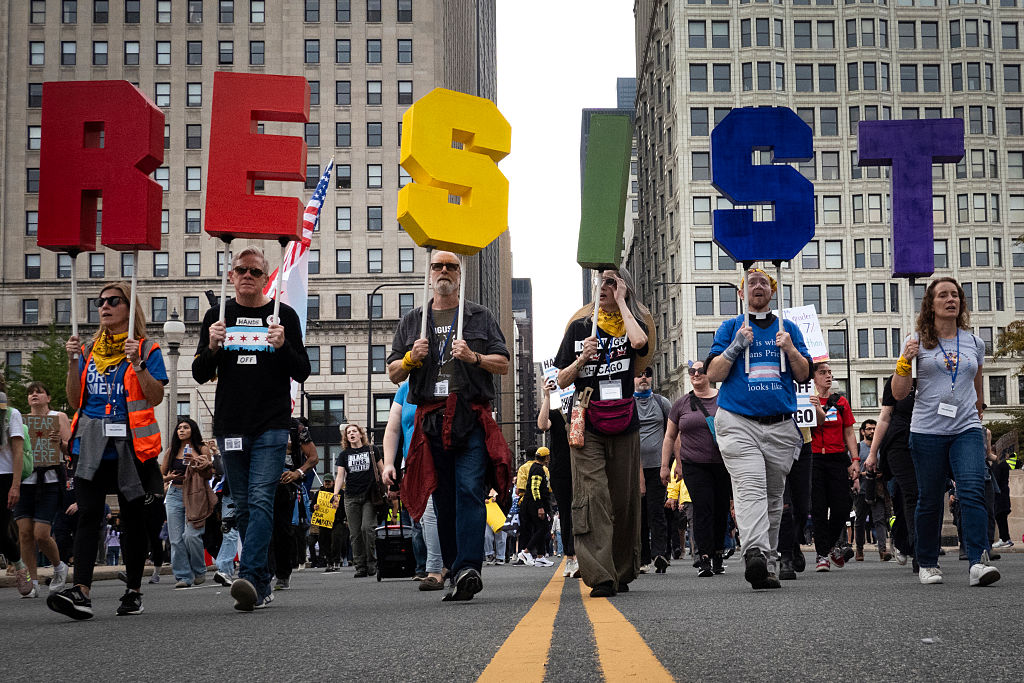
Forgetting the Left’s criticisms of the liberal Resistance during Trump’s first term risks making that movement a less effective bulwark against any sort of fascist or fascist-like movement taking power in the United States. (Scott Olson / Getty Images)
After a year of Donald Trump defying court orders, trampling free speech, and now operating a literal reign of terror against a city that didn’t vote for him, a new refrain is quickly gaining popularity: the liberal “Resistance” has been vindicated by this presidency.
“One day they will admit that the resistance libs were always right,” tweeted Center for American Progress president and CEO Neera Tanden.
That sentiment has been repeated by a slew of liberal commentators recently, who think that what critics in Trump’s first term disdainfully referred to as the “#Resistance” — the coalition of card-carrying members of the Democratic establishment like Tanden and rank-and-file liberals like the pussy-hat-wearing protesters of the 2017 Women’s March — are owed an apology. As Trump increasingly acts like an unstable wannabe dictator, their comparisons of him to Adolf Hitler or Benito Mussolini, or warnings that he was on the road to eliminating US democracy, no longer look like overwrought hysterics. They look prescient.
“If people had predicted back in 2024 precisely what Trump’s return to the White House was going to look like, I suspect they’d have been accused of suffering from Trump derangement syndrome,” New York Times columnist Michelle Goldberg recently wrote. “But the shrillest of Resistance libs have always understood Trump better than those who make a show of their dispassion.”
Goldberg and others are completely right that warnings about the authoritarian potential of Trump’s presidency were not hyperbole. No one watching what’s happening right now in Minnesota or who has observed the administration’s repeated attempts to bully and silence its critics over the past year can deny that.
But taking a victory lap here isn’t helpful. That’s not just because there were very real problems with the liberal Resistance of Trump’s first term that critics were right to gripe about, but, more important, because simply dismissing those criticisms and resting on one’s laurels risks making that movement a less effective bulwark against any sort of fascist or fascist-like movement taking power in the United States.
Socialist publications like Jacobin and Current Affairs were clear-eyed about the threat Trump posed to democracy and Americans’ basic freedoms. In fact, we warned, as countless left-wing voices had during Barack Obama’s first term, that the mounting terrorism-fighting excesses, warmaking powers, and national security–based rights violations that the Democratic president was racking up were ripe for dangerous future misuse by Trump or another authoritarian.
We continued to make this point during Joe Biden’s presidency, calling for urgent reforms to and rollbacks of what liberals once correctly called the “imperial presidency,” only to be completely ignored, often in the name of party loyalty. In fact, it was actually worse than this: many erstwhile “resisters” stayed mum or actively cheered as Biden and the Democrats expanded the government’s potentially tyrannical surveillance powers and targeting of left-wing activists and poured more money into the what Kamala Harris called, to uproarious applause from a Democratic audience, the “most lethal” military on the globe. Building off of all this, we now have Trump launching wars or toppling governments at will, sending weapons that fuel chaos and death anywhere he wants, and blowing up random boats in international waters — not to mention targeting and investigating left-wing activists in ways that we probably won’t fully know the scope of until years from now.
The socialist critique of the Resistance was that simply pointing and shouting “fascism” was not actually enough to stop Trump’s authoritarianism from taking hold. We argued that the only way to effectively resist Trump was to move the focus away from him and other individual figures, and to instead aggressively attack the conditions that let him flourish: growing wealth inequality and the oligarchic power it created, the economic struggles Obama did too little to alleviate, and the cost-of-living pressures that now everyone acknowledges fed Trump’s 2024 victory.
The leading Resistance figureheads didn’t do any of this. In fact, those like Tanden relentlessly defamed and opposed the one leading political figure who consistently called for doing so, Bernie Sanders and later, in the name of party loyalty, shouted down every effort to acknowledge people’s affordability struggles under Biden — as well as dismissing other legitimate criticisms of the ailing, genocide-enabling Democratic president that might have served the party better to air as early as possible.
Instead, the solutions this Resistance poured its energies into were, first, a conspiracist fantasy about Vladimir Putin blackmailing Trump better known as Russiagate— which made no sense next to (and may even have driven) Trump’s consistent and dangerous escalations against the nuclear-armed Russian state. Then, second, a series of feeble attempts at lawfare to simply take him out of the picture. These efforts spectacularly backfired, imbuing Trump and his allies with a drive for vengeance that has fueled his more radical second term, while also persuading them to similarly but more aggressively wield the legal system against their opponents.
There is another point the liberal Resistance would do well to listen to from critics. Resisters had a habit of glorifying Trump’s establishment critics who, when you looked a little closer, were either not all that different from him or actively enabling him, resulting in the rehabilitation of unsavory characters like former CIA director John Brennan and former vice president Dick Cheney, or the absurd spectacle of painting Republicans who voted with near-100 percent reliability to advance Trump’s agenda into his nemeses. It all fed into an all-consuming focus on Trump and nothing but Trump, and a blind faith that simply removing him from public life via lawsuits or jail sentences or some other shortcut would return things to how they used to be.
Goldberg’s claim that the reason Trump “didn’t always act on his most fascistic predilections in his first term” was “because he was restrained by the establishment types around him” suggests not as much has changed since Trump’s first term. It’s true that Trump was restrained by his advisors in his first term. It’s also true that Trump is still surrounded by establishment types, and that they are the authors of some of his most radical actions.
Take Marco Rubio, Trump’s former establishment GOP foe. Rubio was approved last year by a unanimous Senate vote, was responsible for the illegal abduction of former Venezuelan president Nicolás Maduro, is pushing for regime change in still more countries, and has asserted the power to strip green card holders of their residency over free speech. Russell Vought — the mastermind behind Trump’s entire second term, including his dismantling of the federal government through the Department of Government Efficiency (DOGE) — is a longtime GOP insider who first pushed these ideas as the underling of Mike Pence, another Trump ally turned supposed resister. Trump’s mounting wars and bombs are urged through whispers by a near-salivating Lindsay Graham, who just completed his thirtieth year in the US Congress.
Thankfully, the liberal Resistance of Trump’s second term is not the same as the one in his first. Though you can still hear the faint echoes of Russiagate-style conspiracizing here and there, No Kings protesters are more likely to carry signs about oligarchy, spending cuts, civil liberties violations, and Trump’s wars. Rank-and-file resisters have had it with party loyalty, as evidenced by Democratic voters’ deep dislike of their own party and their refusal to abandon Graham Platner and have realized that the first step to defeating Trumpism is defeating a corrupt and impotent Democratic establishment.
Maybe most important, Trump’s second term has meant a historic explosion of protest and on-the-ground, often courageous activism, maybe best embodied by citizens across the country protesting increasingly aggressive and lawless deportation agents. Rank-and-file Democratic voters have come around to a host of positions the Resistance once dismissed, including that Trump’s rise is based not merely on bigotry and the supposed irredeemability of their fellow citizens, but genuine economic pain that both parties haven’t paid attention to.
The liberal Resistance is better and more effective because it has absorbed some of the arguments of a Left that viewed it with skepticism. Just as its critics can acknowledge resisters had a point, the Resistance can only get stronger from acknowledging that it hasn’t been right about a whole lot of things — not by patting itself on the back.