The Resistance Gets Radical

How the socialist left and the anti-Trump Resistance are slowly but surely learning to work together.
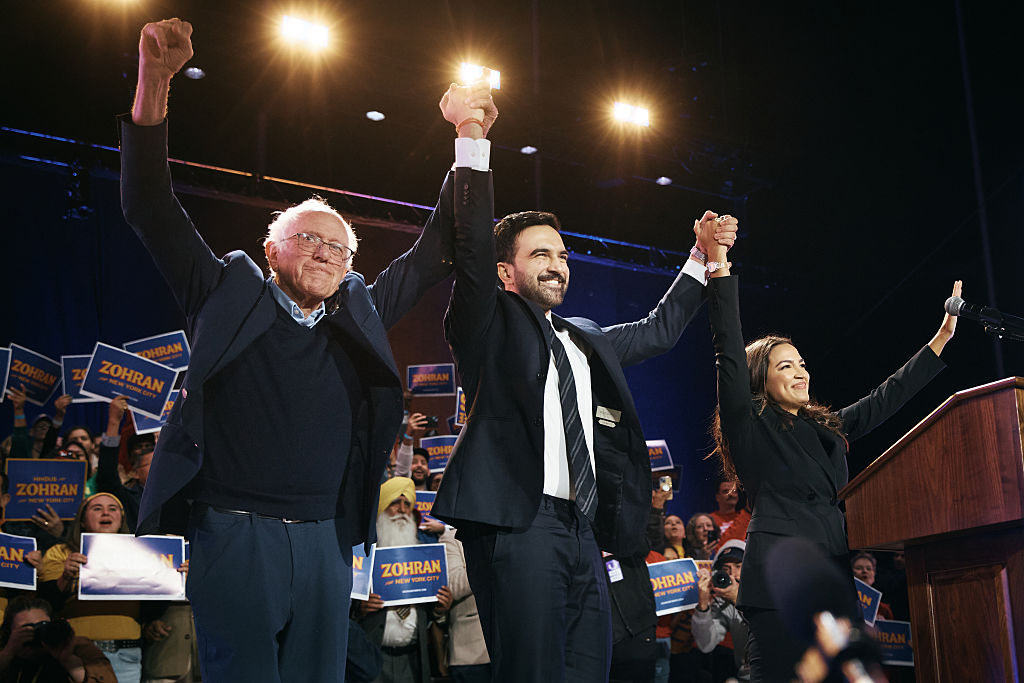
From the “wine moms” of the Resistance to the “bros” behind Zohran Mamdani's campaign, anti-Trump liberals are finally taking cues from democratic socialists. (Andres Kudacki / Getty Images)

Interview by
Daniel Denvir

“Welcome to the Resistance.”

During the first Trump administration, socialists loved to invoke this as a joke. The liberal resistance, socialists charged, was interested only in performative displays of opposition, blaming Russia for everything, and naively hoping Democratic Party adults in the room would take charge and turn back the clock to pre-2016 business as usual. Everything though has changed pretty dramatically since Donald Trump took office for a second time.

Again, much of the liberal base is in open revolt against a leadership that has so clearly failed to stop the inexorable march of far-right politics. But this time, liberals are voting for Zohran Mamdani, shifting left on Palestine, and becoming increasingly favorable to socialism as the solution to the problem of MAGA.

Daniel Denvir, host of the Jacobin Radio podcast The Dig, spoke to organizer and New York City Democratic Socialists of America (NYC-DSA) activist Eric Blanc, progressive political strategist Waleed Shahid, and co–executive director of the Indivisible Project Leah Greenberg about how and why liberals and “the Resistance” have radicalized. This transcript has been edited for length and clarity.


Daniel Denvir

A big part of what the socialist left has been trying to do is to make the case to the liberal Democratic base that the only way to address the root causes of MAGA and of Trump is by confronting neoliberalism and the forever wars, and by overthrowing the Democratic establishment.

And what seems really significant right now is that these left-populist, democratic socialist politics — the kind we see in Zohran Mamdani’s coalition as well as in Bernie’s Fighting Oligarchy Tour — are breaking through in a really powerful way. How did the liberal base, which had placed their faith in the Democratic establishment to protect them from Trump, become so radicalized over the last twelve months?

Leah Greenberg

I don’t think you can separate the reaction that the liberal base has had in this moment from the broader societal dynamics that we have been seeing unfold. In Trump 1.0, there was at least a pretty solid pretense by corporate actors, by a lot of different institutions across society, that they were attempting to hold some set of things around the norms of liberal democracy, protect some set of vulnerable populations, and so on.

We can all be really clear that was not out of the goodness of their hearts. But it did create a pretty significant contrast. And what we’ve seen this time around is just a total elite institutional collapse in the face of Trumpism starting, basically, immediately after he was elected.

So I think for folks who believed what the Democratic leadership was telling them — that this was an “oncoming fascism,” that it was going to be a direct personal threat to them and their communities and their neighbors — to watch this combination of Democratic leadership fecklessness going quiet to the extent that they were having really internal circular arguments about blaming the groups instead of any kind of meaningful accounting about what had happened, and then simultaneously watching a bunch of other institutions across society — everybody from Jeff Bezos and Mark Zuckerberg to Target and basically every corporation you could name — immediately rush to bend the knee, created a much more clear illustration that the project to consolidate MAGA political power and the project to consolidate corporate power were one and the same. That set the stage for a lot of what has unfolded since.

Waleed Shahid

If you look at universities, law firms, the federal government, media, and employees of organizations affected by Big Tech consolidation, there’s a tangible difference between 2017 and 2025 in terms of the kinds of upper-middle-class or middle-class white-collar workers that are probably ideologically or effectively liberal — but are really being squeezed by this administration, being attacked by this administration. Not just in terms of rhetoric but also in terms of policy.

J. D. Vance, Donald Trump, and Elon Musk really hate this liberal class. They have fan fiction about replacing the liberal class with robots and artificial intelligence. And I just think that there’s a way in which that class is being squeezed, and the party and the elected representatives who are supposed to represent that class not really having the fight in them to represent that in a big way.

Eric Blanc

I agree with Leah that the main thing is that not only is Trump way worse this time, but also institutions are fighting way less. That contradiction is a deeply radicalizing dynamic.

It does, I think, predate the election though. For instance, the inability of the Democratic Party establishment to push out Joe Biden and the whole age debacle, which we’ve sort of forgotten all about, really did expose to a lot of the liberal base that, contrary to the rhetoric, the motivations of the people on top seem to be much more about ego and career than about fighting fascism. That really was a very eye-opening experience.

Then there’s just a general dynamic where, because the authoritarian drive of this new administration is so deep, liberals for positive and maybe limited reasons really feel the attack on democracy as core to their politics in a way that maybe other segments of the population don’t to the same extent.

So there’s a radicalizing in response to events, in a way that if you don’t actually think that the system was working as well, as many leftists or maybe like non-college-educated workers do, maybe even attacks on democracy aren’t as at the forefront in your mind. But if you really do believe, and I think liberals are right to believe, in the importance of defending liberal democracy, then it just seems like an all-hands-on-deck moment to them more than any other part of the population.

Daniel Denvir

Joshua Cohen had an interesting post recently where he described the liberal revolt against the Democratic Party establishment as a relatively autonomous revolt that the organized socialist left is in a good position to channel, organize, and help lead — but does not, and maybe cannot, actually control. What do you make of this argument, and what are its implications for how the socialist left should think about building bridges with this liberal insurgency?

Waleed Shahid

Two of the main mass mobilizations that have been successful in the past year have been the Tesla takedown protests and No Kings, which to me are two different iterations of what maybe is called “the autonomous liberal revolt.” I think that these efforts show that people are looking to express their anger and frustration and want to be able to do it in a way that feels not necessarily ideological or even socialist, but as a part of a fight against Donald Trump and fascism.

I think that the third most successful mobilization that had national impact was Zohran’s election. Where the rubber meets the road is obviously in elections because there are very few places where people who are socialists or even social democrats can win an election with just people who identify with those terms. You have to build a coalition across ideology and across demographics. Often the people — some of the younger populist socialist candidates — embody that fight against authoritarianism much better than the Democratic establishment.

Leah Greenberg

Pulling from that argument, around why there’s this crisis of faith right now, the fundamental proposition of Biden 2020 was that Trumpism was a temporary insanity that could be fixed by electing the most run-of-the-mill, most persuasive candidate. You’d get him in, the adults would be back in charge, things would be okay, and this fever would break. That was the promise. And a lot of people went for it or even grudgingly went for it. And so I think the basic issue that is happening right now is that there is no follow-on proposition or no follow-on promise from Democratic elected leadership that explains this moment.

It’s clearly not a temporary fever. MAGA is a force in American politics, and it is going to be a force for an extended period of time. How do you actually fundamentally get out of this situation where every four years, every election is a referendum on democracy and is a threat of authoritarian consolidation? I don’t think Democratic leadership has offered a meaningful theory that replaces the “this is a temporary fever” framing. Someone being able to successfully make a convincing proposition about this is actually how we shift our politics in a direction that doesn’t involve constant confrontations with the worst 30 percent of American society — I think that’s going to be the way that you break through.

Eric Blanc

What I’d add to that is that this is in many ways a surprising dynamic for the Left, which is to say that the liberal vote is in many ways a surprising development for the socialist left. I don’t think that people were exactly prepared to see not just a repeat of Resistance 1.0, and it’s part of the reason we’re having this conversation today. There has been a shift toward trying to make sense of it, but I think we probably have to go further to be really concrete. For instance, DSA only just recently joined the No Kings coalition and I think that’s a good sign that people are trying to figure out how we work with this sort of broader liberal resistance movement.

But there was also a tendency sometimes to be a little bit condescending toward the No Kings protest, for instance. So when we’re thinking about how we relate to the liberal resistance, I think this is a good thing to keep in mind. Our major task right now isn’t only to differentiate ourselves from liberals — especially liberals who are out there fighting — but to engage with them and to be the best builders for No Kings rallies.

Waleed Shahid

One other thing I’d add to the trajectory of Democratic Party liberalism: the Democratic Party establishment warning liberals about the threat of fascism is where immigration becomes a huge issue in the story, where, contrary to popular belief, white liberals tend to be a very big demographic in favor of immigrant rights in this country.

Just this past week from the right and left wing of Democratic Party liberalism, both David Brooks and Michelle Goldberg in the New York Times had columns about immigrant rights. Goldberg’s column was about immigrant rights groups that you should donate to for the holidays. David Brooks had a column about a church in Connecticut that’s helping undocumented immigrants and people seeking asylum from combating ICE [Immigration and Customs Enforcement].

I think that now, because the elected officials aren’t leading the fight on immigration as much, that creates such a huge opening for this class of people who really care about inclusion and pluralism and protecting the vulnerable to have autonomous ways of engaging that are filling a vacuum that isn’t being provided by the leadership class of their party.

Leah Greenberg

If I may offer the reverse, mirror image of that, I think the two early signs of the disjuncture between the base and elected leadership were H. R. 9495, the nonprofit-killer bill, which they tried to move in a bipartisan fashion immediately after the election, and then the Laken Riley Act in January. A very firm memory I have is trying to communicate to Democratic electeds that our base was genuinely alarmed and upset and did not understand why we would be offering Donald Trump more power around enforcement, on nonprofits, more power to go after immigrants and consolidate a secret police force — and getting somewhere between dismissal and contempt in reaction. And people saying, you know, not only do we disagree, but we disagree and this is why we lost the election.

Then by mid-February, when the calls and the volume and the anger was boiling over, having a lot of those people be like, “Why is everyone so mad?” Our reaction was, “We’ve been telling you this has been building. There’s actually just a consistent gap between the communications you’ve made to people about what you care about and the things you’re doing. And that’s coming back to attack you.”

Daniel Denvir

Leah, many have remarked that for the liberal base, it’s not so much “Left versus center” so much as “fighters versus folders.” But are they increasingly becoming one and the same?

Leah Greenberg

I would describe it as an x-axis and a y-axis around how far to the left your politics are and how much you think this moment is an emergency that requires using all the tools in the toolbox. That ultimately requires structural reforms that meaningfully address the roots of the crisis.

What I would say with our folks is that people identify in a lot of different places on the x-axis of left to center but are all at really, really high levels on “this is an emergency requiring everything that we have.” And there tends to be a lot of correlation in people who are both on the left axis and “this is an emergency” axis. There’s a lot of overlap in what’s required.

When we talk about structural reforms at this point, it’s not just what we were talking about in 2021. It’s not just the For the People Act. We are talking about the Voting Rights Act, but it is voting rights plus what are we going do about the Supreme Court? What are we going do about the two-party system that keeps creating these conflicts? What are we going do about the consolidation of corporate power that has allowed Big Tech fascists to operate as a backstop to this administration?

I think there’s a lot of overlap when you talk about what is the ultimate set of solutions to the moment that we are in that would allow us to meaningfully create a country where people belong and are dignified and have a voice. So I’m not sure I would focus on the labels per se, but I do think that when you’re actually talking about what gets us to the other side of this and what gets us to a genuine improvement in people’s lives, there’s a lot of potential for overlap.

Daniel Denvir

It’s not just liberals who have changed since the first Trump administration, as a number of people have commented already — the socialist left is in a pretty different situation too. In the years following the 2016 election, many on the Left rejected or were at least skeptical and suspicious of a lot of aspects of the liberal resistance. Many on the socialist left saw this resistance politics as framing Trump’s election as the product of “Russian interference” and wanting to just turn back the clock to the pre-Trump politics — as Leah mentioned, this idea that “the fever will break once the adults are back in the room.”

At the same time, there was this intense debate within the socialist left as to whether Trump’s project was fascist. Everyone on the Left opposed Trump. But there was a sometimes interesting, sometimes arcane debate over whether “fascist” was the right concept. But now, everyone on the online left loves Jennifer Welch and agrees that Trump’s project is fascist. While there are some on the Left who might have some reservations about the Resistance, I think increasingly the majority agrees that we should definitely be linking arms and joining in.

Eric, how would you describe that trajectory on the socialist left and the politics internal to the socialist left on how to relate to the liberal resistance?

Eric Blanc

The first thing I would say is that it’s a game changer, as we’ve been already talking about, that the liberal resistance this time around is very explicitly being pitted against the Democratic establishment. If there’s one thing socialists like to do, it’s to fight the Democratic Party establishment. So there’s an obvious affinity there, which explains a lot of the openness to engaging.

There’s also, I think, a question of urgency. A lot of the Left last time around, myself included, had a somewhat valid take that the Trump administration wasn’t as much of a radical departure from Republicanism and right-wing politics.

And as liberals suggested, if anything, maybe we downplayed the threat even this time around. I would say, just fess up — I didn’t think Trump this time around was going to be as bad as he’s been. I think a lot of us underestimated that. And then there’s an immediate thing, not just in the abstract, but like, what does it mean that, speaking from personal experience, I’m a leftist — I really have for the first time in my life had to consider what’s going to happen if I lose my job for speaking out.

There’s an urgency, and I’m coming from a place of relative privilege. I have a union job. I’m teaching at a public university. But I think there is an extent to which just the intensity of the authoritarian attack across the board has led to a feeling among the Left that it is “all hands on deck” to an extent that didn’t feel as much the case last time around. So the question I was asking is, what do you do with that?

I actually feel like what the Left knows how to do really well is fight the Democratic establishment. I don’t think we have as much recent experience with what it looks like to work in coalition with liberals against the right wing. It’s not that anyone’s opposed, but it just requires different things that we haven’t consistently done in a recent period. So the question of really trying to scale up a broader fight is the task. It does require continuing to make these cases that our main fight right now is with the right wing and not with the liberal Resistance.

Waleed Shahid

One other thing is that there’s always — it’s very rare, almost never happens — a candidate on the Left who wins an election by being publicly known as a leftist or the campaign is waged on those terms. So there’s constant rebranding of what the fight is in the Democratic Party — a rebranding that I’ve participated in between the old guard and the new generation. Change versus status quo establishment. There’s a way in which sometimes the political weather is blowing in the right direction, where liberals become the kind of place where you have to figure out which one of those you’re going with, and that switch becomes really effective for elections.

Another thing I think about is in 2020, the two congressional elections that were very much buoyed by the racial justice movement during the George Floyd protests — Cori Bush and Jamaal Bowman . . . when the New York Times endorsed Jamaal Bowman, the polling that we saw among white college-educated liberals, went from like 17 percent to like 70 percent overnight. In retrospect, when you look at Zohran Mamdani being rejected by the New York Times several times by their editorial board — the New York Times told New York voters not to vote for him, and yet he still won. This gives me a sense that the gatekeepers of liberalism, particularly in the Times, are becoming less and less salient between 2020 and 2025.

Daniel Denvir

And Zohran’s biggest neighborhoods were brownstone Brooklyn. Actually, his highest percentages were in Park Slope, Cobble Hill, and so on.

Waleed Shahid

One way you can think about that is that No Kings is the “over forty-five” expression, and the anti-oligarchy tour by Bernie Sanders and Alexandria Ocasio-Cortez is the “under forty-five” expression. Maybe age is primarily the divider there due to different experiences of the financial crisis and politics since Barack Obama.

But the point I’m trying to make here is that liberals become a really important fulcrum in these kinds of forward-movement-backlash moments of a more progressive politics. Because in 2023 to 2024, I think we experienced a little bit of that backlash to Black Lives Matter in particular. Now that we’re experiencing a backlash to the backlash, there’s a real opening here to combine those two spirits of the anti-oligarchy tour and the spirit of the No Kings marches.

Leah Greenberg

I do think there’s also an important kernel in there about the delinking of mainstream liberals’ faith in mainstream media as well. One of the big shifts that we’ve seen is around where people have confidence to get their news and analysis from. The reality is that, I mean, obviously the Washington Post is not where it was, given the Bezos takeover. But even with institutions like the New York Times, there’s just a great deal more distrust in the role that the mainstream media has played.

Waleed Shahid

Hence the rise of Jennifer Welch.

Daniel Denvir

I want to get into that generational point you just made. I’ve been doing a lot of work in Rhode Island building coalitions with liberal Resistance groups. I have two separate meetings this week with local Resistance groups around the state to build for the 2026 primaries. One of them is an Indivisible chapter.

One thing that I found surprising since starting to do this work more intensively is that we all know that the crowd at protests like No Kings can be on the older end. But when I started to have conversations with a lot of these leaders, they were like, “Where are the young people?” And I was very surprised because I think of it the opposite way — that young people are extremely involved in groups like DSA, doing the encampments against the Gaza genocide, and so on.

So there was this total fun-house-mirror situation where you had the older folks in the liberal Resistance thinking that younger people are just totally demobilized in the face of the fascist threat. I was like, who do you think organized the Zohran campaign in New York initially? This discussion that we’re having about building socialist and left-liberal coalitions seems to also be fundamentally a conversation about building intergenerational coalitions.

Waleed Shahid

It’s really an interesting phenomenon that the No Kings protest tends to be attended by people with multiple degrees, sixty-years-old and up. And while my sense of the anti-oligarchy tour is that it’s much younger, I don’t know how race and gender play into those two different things.

But yeah, I think the marriage of those two fights and the tension between them is the future of a kind of progressive realignment in the Democratic Party. In 2020, it was obviously divided through an election that was not ranked-choice voting, and in which I would imagine many of the people who are powering the No Kings protest did not vote for Bernie Sanders but maybe voted for Biden or Elizabeth Warren or Pete Buttigieg.

Obviously, it’s the opposite with the anti-oligarchy tour, where I assume the vast majority of the people voted for Bernie Sanders. The interesting thing is that the No Kings protests don’t have an elected leader who’s the spokesperson. And there’s something really inspiring about that, about a citizen-generated endeavor that is not carried through the star power of someone like an AOC or Bernie. And at the same time, the policy or ideological components can be a little less clear compared to the anti-oligarchy tour, where I think it’s clearer what the politics are.

I’m also curious about both your experience, Leah, and your experience, Dan. There was so much discussion in the middle part of this year about a word we haven’t used but that’s been thrown out for the liberal wing of the Democratic Party, and that’s “abundance” [based on the book Abundance by Ezra Klein and Derek Thompson]. I feel like on the rank-and-file level, driving the political expression in the No Kings mobilization or Indivisible, “abundance” is not the thing that’s animating them.

That’s an assumption I have. I don’t know if it’s true or not, but I think there’s a way in which the elite discourse among liberalism is not mapping onto the mass discourse of where people are every day, where rank-and-file “wine moms” are at.

Daniel Denvir

One really remarkable thing is that for the recent No Kings protest, there was a breakthrough agreement to have a Palestinian speaker and have a whole Palestinian liberation contingent in the No Kings protest. I think this was debated and decided among a group of grassroots liberal Resistance organizers in Rhode Island, and there was some dissension. But they ultimately came to a solid decision to coalesce with specifically Jewish Voice for Peace. That represents not just this breakthrough between the socialist left and left-liberal Resistance, but it was also a fundamentally intergenerational coalition because it was much more gray-haired people sitting on one side and much more millennial and Zoomer on the other.

Leah Greenberg

I think that mirrors a lot of where we’ve ended up in terms of the national framing. In the first No Kings march in June, I marched next to Ruwa Romman of Georgia who was one of the speakers. And we have tried to be really intentional about balancing the fact that No Kings is not an entity that has a platform — it doesn’t have a set of policy ideas that it’s advancing; it is a broad front against authoritarianism — and also being really clear about inclusion of voices that recognize the Palestine movement.

So there is a continued negotiation, and there’s a continued process of building together at the local level that has been ongoing, and it’s in different places, in different contexts. I do really think that that knitting together of the intergenerational context and the broad front is really important.

There are so many different threads that I want to respond to here. First, in terms of the 2020 cycle, we had a really extended conversation with our leaders in 2020 around whether we were we going to endorse in a presidential cycle. Should we endorse? Who are we for?

We have some data out of that that suggests that the top candidate among our folks was Warren, very strong. There was a strong but smaller Bernie faction. There were some folks who were kind of scattered around the different moderate candidates. Things shaped up in the later stages pretty quickly in a way that limits our ability to say who went where as different candidates came in and dropped out. But the bigger dominant feeling for folks was that they didn’t really think that a presidential endorsement was the top priority for locally based organizing hubs that often had a very strong foot in a local race or a congressional race or a broader suite of activism that they couldn’t disrupt in order to have some effect on the presidential race.

That was where people ended pretty consistently. We respected that very much on a national level after having that conversation. And so we have some sense of where people’s optimal politics are.

Also, people had a really different take on primaries overall during the first Trump term than they do this time around. That’s where people were, just practically speaking, on abundance. I think this has been one of the places where there is just a huge gap, as you put it, between the conversation that is preoccupying elite commentators and the conversation that is happening among grassroots activists and rank-and-file folks.

Because immediately after the election, I think there’s this very confusing moment where Abundance, which is a book that was intended for a Kamala Harris term or a second Biden term, gets kind of rebranded as an answer to why we lost and gets sucked into this super toxic discourse around the recriminations post-2024 and this extended set of arguments and discussions around remaking the party.

I can’t stress enough how much none of that was of interest to people who were freaking out about fascism — which is actually unfortunate in a lot of ways. As somebody who has a lot of enthusiasm for abundance politics myself, I think that conflation set the stage for a number of things that were not super healthy. And while I think you’ve done a lot of work trying to untangle those currents and appreciate that, the functional impact was that I think a lot of people who might well have been open to various parts of that argument mostly perceived it as kind of irrelevant to the questions of the day, which were, “What are we actually going to do to protect fundamental rights, to fight back against this massive onslaught?”

Eric Blanc

The depth of youth radicalization that’s continued really puts a lie to one of the major talking points that happened after Trump’s reelection in 2024, which you might remember when there was this move from the establishment to fight against the groups and to say, “We need to pivot to the center, drop fighting for immigrants and trans people.” Part of the argument was, young people are making this dramatic shift to the center — if we don’t meet them —

Daniel Denvir

As part of a “vibe shift.”

Eric Blanc

I was always really skeptical of that. I didn’t think it was in the data. There was a marginal thing with young men, and it seemed like a lot of the youth vote was over economic anxiety. The experience of the last year decisively proves that contrary to that claim, young people remain very consistently on the Left.

If anything, on the radical activist young left, which I am pretty deeply involved with, I think there is actually still or was somewhat of a hesitancy to go all-in on the fight against authoritarianism. Part of that has to do with Palestine. It’s worth flagging because it’s true that we’re coming together with more liberal people. But there was also an experience that so many young people had of going to encampments and feeling like big liberal institutions essentially were screwing them over. Think about university elites, but then also a lot of the punditry, the New York Times. . . . There’s a real polarization, and I think there was also maybe a skepticism of some liberals for not foregrounding the fight against the genocide more. We were still living a little bit in the shadow of that, and it hasn’t been fully overcome.

The other thing I would add is that the Fighting Oligarchy tour and the Zohran campaign — these were not exclusively or only about fighting authoritarianism. It had this combination of [fighting authoritarianism and] a radical economic approach.

The place above all where we can reconnect the radical young activist left with liberals is on fighting ICE. This is one thing that really brings everybody together; there’s a real deep revulsion among both of these wings at what the Trump administration is doing against our undocumented friends and family and neighbors. That is a place I would hope that we can, in the immediate term, scale up far more.

Daniel Denvir

One big shift that I’ve noticed between the first and second Trump administrations in terms of ordinary members of the liberal Resistance is a stronger emphasis on fighting the Trump regime, rather than derogatorily speaking about or demonizing ordinary Trump voters.

Notably, Zohran launched his campaign by standing on a street corner and asking people why they’d given up on Democrats and why they voted for Trump. And he went on about a year later to win those neighborhoods back.

Leah, you’ve touched on this, but we’re seeing this really powerfully right now through the anti-oligarchy framing, which was first put forward by Bernie and then AOC and these rallies and has become the dominant left and liberal way to interpret what’s happening right now. What it’s doing, I think very powerfully, is connecting the dots between economic and political authoritarianism.

But that really wasn’t part of the mainstream discussion or liberal Resistance discourse during Trump 1.0. What is it about the conditions of Trump’s second administration that have allowed for this anti-oligarchy framework to become perhaps the dominant one? And what sort of political work does that framing do?

Leah Greenberg

There are two pieces. First, the mask is fully off. You have a bunch of corporations that had a frame around corporate social responsibility, a frame around, for example, doing meaningful work to protect the 2020 election from sabotage. If you go and you look at the list of corporations that tried to donate to protect that election compared to who has donated to the Trump ballroom, I think the degree to which corporations have been very visibly avid and enthusiastic collaborators with the Trump and MAGA agenda — how even the corporations that people ostensibly think of as “good corporate citizens” have behaved, have gotten rid of their DEI policies, have trashed their climate policies, have donated to the Trump ballroom or to the inauguration — there is no meaningful, credible argument that delinks the consolidation of corporate power in this country from the consolidation of right-wing white Christian nationalist power. I think that is a revealing reaction.

The other thing is that there was no meaningful Democratic leadership interpretation of what was happening in the first four months. There was this powerful Fighting Oligarchy tour with Bernie and AOC making a really clear connection between what was happening on the corporate power side and what was happening in Washington. I think the fact that the act of stepping into that leadership vacuum was very important for linking those two things together.

Now, there’s sometimes a framing that suggests that there’s a lot of daylight between a No Kings and a “No Oligarchs” frame. I think that that’s not particularly valid on the ground. What we’ve experienced is that there’s a lot of openness to an overarching story about corporate power. Bernie spoke at our most recent No Kings in Washington; he was the headliner. We do see people really making those connections. We see a lot of enthusiasm among our own folks for corporate campaigns, for theories of how you actually dissuade this kind of corporate collaboration and enablement.

Daniel Denvir

I think we can’t overstate the role played by the world’s richest man becoming a freakish fascist accelerationist, in the powerful DOGE way that he did, in really waking people up to the connections between economic and political structures.

Leah Greenberg

A hundred percent.

Waleed Shahid

I imagine one of the most foremost intellectual leaders of the liberal resistance is Erica Chenoweth, who’s a scholar of antiauthoritarianism and resistance against dictators across the world. They are someone who is not very Pollyannaish about the kind of economic leverage needed to get rid of authoritarians and dictators. And a lot of their work revolves around things like boycott strikes and noncooperation.

After Trump was elected, Erica did a whole tour among liberal media about their research. If you’re a liberal or someone who participates in the No Kings march, that is another place of synergy, where the intellectual you’re reading is saying, you need to figure out a way to generate economic leverage and create consequences on the regime for their actions, whether it’s lowering their public opinion or breaking apart their coalition or creating resignations. That’s a form of politics that’s much more common in other parts of the world and less common here.

Eric Blanc

I want to talk a little bit more about what you mentioned in passing, Dan, which is why there’s significantly less blaming and focus on Trump supporters than there was last time around. Part of that is there was an open acknowledgement from all parts of the Left and the center that the Democratic Party is losing working people.

That wasn’t exactly as prevalent last time around. There was some talk about the white working class, but this time around, from above, you have the Democratic establishment blaming the groups and “woke” for why we’re losing workers. Then on the Left, there’s a strong case that essentially it was economic anxiety, and the fact that Trump did so much better than last time around among Latinos and, to a certain extent, among black voters — I think that undercut an assumption that people had under the first Trump administration that racism was a sufficient explanation for what was going on.

From the second you have to start talking about losing the working class of all backgrounds and economic anxieties, this has a really different valence for how liberals and the Left look at who voted for Trump and how we relate to the moment we’re in. It’s really positive to a certain extent that people are talking so much more about the working class and economic anxiety. The answers we give are very different than the Democratic Party establishment, certainly for MAGA. But the fact that there is this sort of talking about class is new. I don’t think that was the case in 2016, or certainly not before that.

Daniel Denvir

Not to be too much of a partisan socialist here, but I do recall in the first years of the first Trump administration intense hostility from many liberal commentators when people on the Left, myself included, tried to contextualize Trump’s rise in economic misery, anxiety, contradiction — not just in terms of working-class people being disaffected with the Democratic Party, but also in terms of the economic system that we have creating a class of McMansion-dwelling small businessmen who are fascists.

There was an intense hostility from many liberal commentators to discussing that at all. They were simply saying, instead, what I think is far more comforting for some people: “This is the eternally racist soul of working-class white America reasserting itself.”

Leah Greenberg

I wouldn’t underestimate the psychological impact, and what it sets in motion, to win the popular vote versus losing the popular vote. In the first Trump term, I think a lurking assumption underlying a bunch of the strategy was, this guy got elected by a fluke. It’s a quirk of the political system that we have that he has been able to take office. And our job is to create as much visible opposition, so that people who might go along with his agenda understand up front that they’re going to face electoral consequences for it on the back end.

The second term, if you lose the popular vote, by definition, you’re going to need more people the next time around. So the first strategic imperative is to drive down that popularity and win more people over, and then start to create the sense that there are going to be consequences for enablers. That, I think, is the arc that we saw this year.

Waleed Shahid

I want to go back to the 2020 data that Leah mentioned, where it just shows a deep divide between the kind of liberal commentariat and the liberal rank and file, and then a distinction between partisan Democrats in the coalition versus partisan liberals in the coalition. The plurality of people were with Elizabeth Warren, who I think fits within the anti-oligarchy politics. The plurality of Indivisible’s base was not Joe Biden voters, in the primary at least. That maps on to the Zohran/Brad Lander/Andrew Cuomo electorate — where people who are older tend to be much more attached to partisan Democratic language and framing than what I imagine is true of Indivisible’s base. That also shows the divide between the liberal intelligentsia and commentary versus the liberal rank and file.

Daniel Denvir

Let’s tease that point out a little, because the militancy of the proverbial “liberal wine mom” has become an iconic, ubiquitous, celebrated point of reference for us on the Left in the last few months, exemplified most powerfully by the wonderful Jennifer Welch.

But it points to this question of who we’re talking to and who we’re talking about and who we’re not talking about when we talk about the liberal Resistance. So to break this out into two parts — first, who are the “wine moms”? What do we mean when we invoke them? Are they the latest iteration of “suburban soccer moms”? Do we mean something else by that? Do we mean contradictory things?

Then, to get to that point you just made, where do other key segments of the Democratic Party coalition — black people, Latinos, Muslims — where do they fit into the emerging political conjuncture. Not to suggest that these are neat categories either, but—

Waleed Shahid

“Bros.” You forgot “bros.”

Daniel Denvir

Yeah. What about bros? It does recall that amazing video from Zohran’s election night when it was Mehdi Hasan, Jamaal Bowman, Hasan Piker, and Prem Thakker, like bro-ing out on camera at the victory party. Mike Cernovich had a meltdown about the intense virile masculinity that the socialist left was putting forward.

Waleed Shahid

That’s what they wanted, sorry! In primary elections, people are trying to campaign out their path to 50 percent. The way that’s often divided out is there’s like white college-educated, self-identifying liberals over the age of forty-five versus under the age of forty-five. Then there’s often black voters and Latino voters split out as separate demographics from that group of people.

What I’ve noticed is we’re kind of doing category illusion here, where I do think there’s a difference between the voters who can be described as Biden, Warren, or Bernie; they could also be described as Cuomo, Brad Lander, or Zohran Mamdani. But that difference is significant. In the Biden camp, there’s a lot of pride among that crew of people of the New York Times 2020 endorsement process where Biden was flatly rejected by the New York Times editorial board. Then there was that viral video of Biden talking to a black worker at the New York Times, I think a security guard who was in the elevator, and she said she was voting for him. We shouldn’t delude ourselves with the fact that that demographic is a huge part of primary elections.

The Democratic Party coalition and the antiauthoritarian coalition that is happening — its politics are happening with one foot in the things we’re talking about and one foot out. There’s a really big Target boycott being led right now by many black churches. And so there is antiauthoritarian and anti-oligarchy activity happening. My sense of that demographic is twofold, which is — one, we had the largest civil rights protests in this country’s history since the 1960s in 2020. That didn’t result in very much legislatively. Because when it comes to racial justice, the country is very schizophrenic. Second, there’s a feeling where I think the idea of competent leadership was huge in that election. Andrew Cuomo being Mario Cuomo’s son and a governor for three terms — that was also really significant. There’s two things happening with black voters in the Democratic coalition that is unique and pretty distinct from both the young socialist crowd and the older No Kings crowd.

Daniel Denvir

One quick thing that I’ll add before we hear from the rest of you is that, on the one hand, we have clearly seen black voter consolidation around what we might call the Democratic establishment pretty powerfully in multiple cases over the last decade. Yet when you introduce generational analysis to that, it gets a lot more complicated.

Eric Blanc

I have those numbers. Eighty-six percent of young Latinos voted for Zohran, 84 percent of young black people voted for Zohran, and then young white people were something more like 65 percent. So it really shows you how much of an age cleavage there is and how much potential is mostly still untapped for reaching into much broader segments of the working class than we currently have via the generational route. To me, that’s the next frontier where we can build out a more left base.

Daniel Denvir

Leah, you mentioned earlier a shift among the liberal Resistance base in terms of interest in primarying establishment Democrats. We saw this broad left-liberal coalition unite behind Zohran in New York, and it seems like we’re seeing something similar in Maine. To what extent is the liberal Resistance converging with DSA and the Justice Democrats’ strategy in terms of prioritizing primaries against establishment Democrats?

Leah Greenberg

We’re watching it unfold right now, and we’re trying to get more information. What I can say is that the overall orientation that people are starting from is categorically different than it was at this time around the 2018 cycle.

I think people have a much clearer understanding that there is a very direct relationship between the frustrations that they have with overall Democratic Party leadership and the need to get involved in the primary and the candidate cycle. There is a much stronger sense that there are a lot of people in elected Democratic leadership or in the Democratic establishment who are simply not up to the job — whether it is because they are of a generation that is simply not grappling with the challenges, or whether it is because they are corporate Democrats who are institutionally incapable of taking on the challenges that we have right now.

We’re seeing a ton of focus on money in politics, on crypto, on AIPAC [American Israel Public Affairs Committee] money, on corporate money in general. We’re seeing a ton of focus on, are people compelling fighters who are capable of making the case about what they are doing? Not only people who are using their leverage, but who are actually also public communicators who are able to tell the story of what is happening.

For folks like Chris Van Hollen, who was nobody’s idea of a breakout star last year but who has done a combination of compelling public communications and genuinely meaningful actions that demonstrate how you use your leverage as a senator, I think we’re gonna see how it unfolds. But what we’re hearing from folks is just a totally different level of interest and engagement already, with a combination of getting involved in open seats and with taking some real direct action in relation to folks who are simply not living up to the job.

Daniel Denvir

If you look at the [difference in] net favorability among Democratic voters in New York between AOC and Schumer, it’s pretty wild.

Leah Greenberg

We called for Schumer to step down back in March after the first shutdown fiasco. I have never experienced a decision that involved such a disjuncture between the reception in Washington around the country. We had, I think, 93 percent of New York leaders and 97 percent of leaders around the country; we convened an emergency call of about a thousand-plus folks to talk about it the weekend after, with near unanimity. We got basically no blowback from anyone, because people were really clear that there’s no reason to have somebody representing the Democratic Party who is simply not capable of doing that on a public stage, who has a 17 percent approval rating, and also was struggling to actually successfully build out strategies and lead the caucus around them.

Daniel Denvir

Waleed, you recently wrote a piece intervening in a strategic debate on the progressive left over whether to prioritize running left-wing primaries against established Democrats in deep blue districts versus trying to flip Republican seats in swing districts. You make a very persuasive case that it’s the Left’s job, first and foremost, to primary incumbents and take over the party. Of course, it’s not that we don’t want median Democrats to beat median Republicans. But I think it’s pretty clear — clearer than ever since Zohran’s victory — that we can build far more power by building deep power at the core of the Democratic base.

Lay out your argument here and what the state of play in this debate is.

Waleed Shahid

A metaphor I use for this is thinking about the Democratic Party as a big ship sailing and drifting, and the political currents and swing-district Democrats are like the sails. They move with the winds. If the wind shifts right, they shift right. If the wind shifts left, they nudge left.

But the left flank in deep blue districts, they can be an anchoring force. Whether it’s AOC and the Green New Deal, or Jamaal Bowman in 2020, or even Zohran with affordability. . . . The number of Google hits after Zohran wins his primary for affordability skyrockets. It consolidates a term for Democrats to focus on because of his election.

Centrist and moderates use this term “wins above replacement.” I think what they mean by that is, does this Democrat — someone like Sherrod Brown — perform better than a generic Democrat? I think progressives [have] the idea of primarying incumbents and defeating them and then being able to tell a story about them and the platform you won on — that has such a big ideological value in the party for changing what it means to be a Democrat.

So instead of trying to take on these quixotic adventures in Montana or even Idaho, I think we should consolidate on home turf. We have limited resources. The donor class does not love our candidates, and we’re playing way too many away games and burning a ton of resources and energy trying to flip red and purple seats. We don’t have a ton of resources, and I think our real leverage for realigning the party is in electing people where many more of our voters currently are and aren’t fully organized into a political vehicle and political force.

I think about the Squad: on any given day, it is only six to eight members of congress, maybe a little bit more. There are a ton of seats in the country that are similar demographics to the Squad’s demographics — younger, urban, diverse — that could have a candidate that represents them.

Justice Democrats have a candidate in Memphis right now. They have a candidate in Harlem. This is what party-building looks like in some ways. If you’re in a Trump +3 district, you are going to be forced to moderate on a couple of different issues because of the pressure you’re facing from genuine Republicans and genuine conservatives. We still live in a democratic system, more or less, in which you are accountable to your voters. You might be a decent vote for Democrats, but I think about someone like Chris Deluzio or Pat Ryan, who are often held up as the populist candidates you could have in these purple districts. I think they’re great, but they’re not like Squad members or DSA members —

Daniel Denvir

Pat Ryan’s terrible on Gaza.

Waleed Shahid

Yeah. There are always exceptions to their populism in a way that you can’t count on them to be a part of a coherent political force. That said, I prefer Pat Ryan to a generic Democrat.

Daniel Denvir

One thing I’ll note to maybe complicate this — is there always a neat trade-off between the two? After all, we’re speaking on a day when there’s a special election in Tennessee with a very progressive state legislator, Aftyn Behn, hoping to pull off an upset. I have no idea what the real odds are, but it seems closer than people imagined against a Republican incumbent.

Leah Greenberg

We’ll see how it goes. Aftyn’s actually a former Indivisible organizer for Tennessee. What I would say is that when you’re in a year where there’s a wave, everyone should just start swimming.

I think that when you’re making decisions about where you concentrate resources on a set of strategic plays, you have one set of calculations. For us, it’s about supporting thousands of different groups that are making different decisions in their districts and then figuring out if there are a few places where we go in collectively in order to support decisions that are happening on the ground. Because fundamentally, a firm position that we have for our own folks is, it doesn’t matter if a national organization has come in with an endorsement unless it’s backed up by a genuinely significant level of local grassroots engagement in support of that candidate.

So it’s hard for us to have a really clear analysis. But the connection that people are making between, “Wouldn’t it be nice if I didn’t have to just constantly beg my Democrat to do what’s right?” and “Maybe I should look at this challenger” is a lot stronger than it has been in the past.

Eric Blanc

I agree with all that. What I’d add is I think there’s an additional part of the country, which is so deeply red, in which the Democratic brand is so toxic, that there is space [to run] more economic populist, independent candidates, someone like Dan Osborn generally. I think that that is something that we have to do. It’s an open question. I don’t know how far that will go, but I think it’s really smart and good to try to make that happen.

I don’t think it makes sense for DSA or Justice Democrats to endorse someone like Dan Osborn, who certainly doesn’t have our position on immigrant rights, for instance, or Palestine. But nevertheless, I think it’s a really positive development if that type of thing could happen more broadly.

I’d like to see more experimentation. Frankly, I think there would be a role for unions to play in some of these red states to anchor just straightforward economic populist — I would hope that they wouldn’t take bad positions on things, but maybe they wouldn’t take just any position on some of the hot-button questions we might have disagreements with. But that does really have a possibility of gaining traction right now. We maybe underestimate the extent to which there are huge divisions and demoralization in the MAGA base that could open big openings in places that we don’t currently think of as in play.

Daniel Denvir

Just look at Zohran — a huge victory — and at the way, generally speaking, NYC-DSA has been able to effectively build out their organization as a party-like formation with power and political independence, which is the gold standard for what the socialist left has been trying to do for a decade.

On the other hand, this proliferation of left insurgent campaigns is, by necessity, larger and broader than DSA and thus beyond its full control. Eric, how can DSA simultaneously stick to its focus and also help lead this broader set of currents? How does DSA help guide this broader front without liquidating its own identity and independence, which has been really important for the revival of left politics in this country?

Eric Blanc

It was an overall huge step forward that after Bernie 2016, DSA started moving toward a new type of left politics electorally, which was different than really what was the dominant trend before then, which was just to support any progressive and sort of anything goes.

The reason that that was limited was not just about the politics, although that’s part of it, but it also just didn’t build your organization. It didn’t build an independent identity. It didn’t build power from below. You couldn’t get volunteers to be excited time and time again afterward. So New York City DSA in particular, but also [chapters] elsewhere throughout the country, were right to build a socialist wing and to develop a huge amount of volunteer infrastructure out of that.

I would flag that it’s still quite uneven across the country. There are a lot of DSA chapters that still just do progressive endorsements.

Daniel Denvir

Katie Wilson — who is a more than sufficiently left-wing challenger, she’s a socialist as far as I can tell — did not get Seattle DSA’s endorsement for reasons I don’t know about.

Eric Blanc

I think there’s a difficulty in DSA now in how you respond to new terrain, where there are genuine left fighters who certainly aren’t DSA cadre, maybe they call themselves socialists or don’t, but they’re not necessarily sharing our politics.

There are also a lot of good and hard debates that need to be happening right now to figure out how we relate to someone like Graham Platner in Maine. How could you not want to go all in in Maine around someone like Graham Platner? My response in the internal debates in DSA on this stuff is — keep in mind, DSA arose out of, and we’re still basically in, the Bernie moment, right? Bernie was not a DSA cadre member. Our growth came largely out of, and in response to, Trump’s election but then also the Bernie moment, which was much bigger than DSA.

I think that there’s a possibility and necessity to walk and chew gum at the same time. What I mean by that is it makes sense for an organization like DSA to primarily focus on running socialist candidates. But particularly when there’s high-profile, very important battles in which you have essentially a Berniecrat running, I do think you need to be more flexible.

Waleed Shahid

I was someone who worked hard to get DSA to endorse Cynthia Nixon and also, on the other side, to get Cynthia Nixon to be open to the DSA endorsement. Same with AOC; same with Jamaal Bowman. Endorsements go both ways.

I think it’s a genuinely difficult problem in the American political system because elected officials in this country are much bigger than any organization or even party. We have a uniquely individually driven political system where every elected official ultimately ends up becoming their own small business owner and running their own brand.

Daniel Denvir

Following up on some points that Waleed made earlier, why is the Democratic establishment the way that it is? Why do it and its favorite media mouthpieces so stubbornly cling to convention even as conditions become so clearly entirely unconventional? Why are they so resolutely in denial of or hostile to their base? Why do they insist on concepts like “popularism” when they just mean moderation and triangulation?

Waleed Shahid

I was recently on a panel with someone from the WelcomePAC, which is one of these PACs that are political outfits attempting to elect “heterodox Democrats.” So what they mean by heterodox is anti-trans, often pro-life Democrats, anti-choice Democrats, pro-fossil-fuel Democrats, people who are a little bit more right-wing on immigration.

The moderator asked me and this other person, “Do either of you feel welcome in the Democratic Party?” Both of us said no. Then she asked, who is the Democratic Party for then? It was a challenging question where I’m like, I think that who the Democratic Party is for is embodied in the politics of the leadership of the party, which is, how do you create the math equations that will get you to 50 percent? How do I manage the coalition in a way and manage the groups and manage the message in such a polished way so that adds up to 50 percent — rather than just being a person a leader in the world and trying to mold a consensus?

It reminds me of the Whig Party in the nineteenth century where it doesn’t really add up. . . . The politics of the leadership and the politics of the establishment class is vote for me, because what else are you gonna do?

Eric Blanc

I would add that I think Trump winning is not an existential threat to them, but the left insurgents taking over the Democratic Party is an existential threat to that establishment class. That explains a lot of their behavior, because the reality is if we can both defeat Trump and do that in a way that is closer to Bernie politics than to fifty years of neoliberalism, all of them just lose their jobs. But it also proves them wrong about saying that the way you win is pivoting to the center.

Leah Greenberg

The vast majority of Democratic electeds are lawyers with degrees from Ivy League institutions or business owners. They are not themselves in any meaningful way credible representatives of the working class. The fact that that was often not even part of the conversation suggests some of the deeper problems.