John McCain Wasn’t a Hero
John McCain's greatest achievement was convincing the world through charming banter and occasional opposition to his party's agenda that he was anything other than a reactionary, bloodthirsty war hawk.
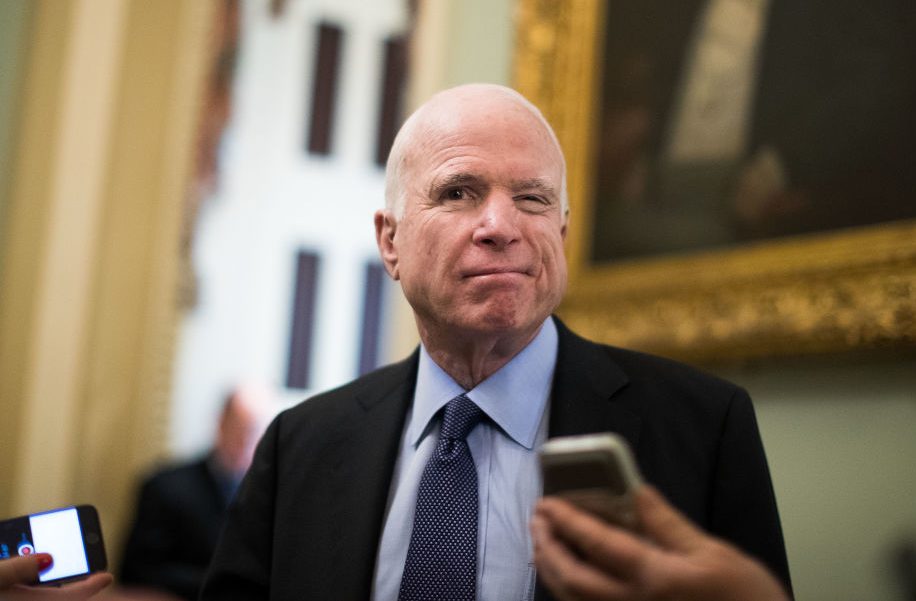
McCain speaks with reporters outside of the Senate chamber on March 23, 2017. Drew Angerer / Getty Images
John McCain, the six-term senator from Arizona who succumbed to cancer over the weekend at the age of eighty-one, was less an enigma than a paradox. For every version of McCain that existed, there seemed to be some other, shadow iteration of the man that contradicted, yet somehow coexisted, alongside it.
One John McCain was Trump’s greatest “nemesis”; the other was one of his most reliable congressional allies. One McCain left a legacy eulogized by a prominent socialist as “an unparalleled example of human decency”; the other was known for his vicious temper tantrums and for engineering the wholesale slaughter of millions of civilians. One McCain was a straight-talking “maverick” and principled statesman who was not made for this post-Trump world of craven opportunism; the other was a reliable right-wing Republican who changed his spots as often as he ran a campaign. How could this be?
The story of McCain’s life and career is as much a tale of the obsessions of a media and political culture as it is the story of a man. Fixated on symbolism, rhetoric, war stories, and the concept of bipartisanship for its own sake, the political establishment found a tailor-made idol in McCain, who could deftly feed these compulsions on one hand while dutifully advancing the agenda of the postwar conservative movement of Buckley and Goldwater with the other. In this sense, McCain was one of the most successful politicians of the last forty years, even if his ultimate prize of winning the presidency forever eluded him.