Post-Independence Africa Had Dreams of Freedom. Neoliberalism Offers Nothing But Subordination.
While flawed, African governments in the early post-independence years projected a vision beyond neocolonialism and subordination to the Global North. Neoliberalism has deepened the continent's subjugation — and dressed it up as non-ideological.
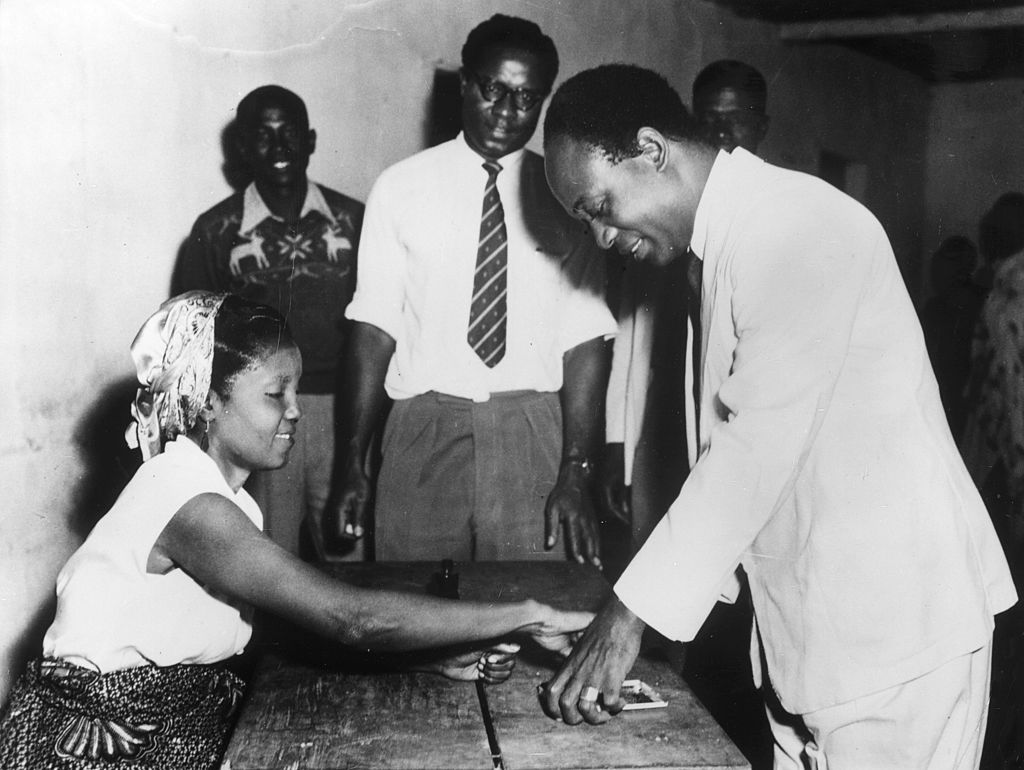
Kwame Nkrumah at a polling station in 1956, a year before Ghana won independence. (Central Press / Getty Images)
In 1965, Kwame Nkrumah described the paradox of neocolonialism in Africa, in which “the soil continue[s] to enrich, not Africans predominantly, but groups and individuals who operate to Africa’s impoverishment.” He captured what continues to be an essential feature of Africa’s political economy.
Enforced through neoliberalism in the contemporary period, many African states remain dependent on exporting primary commodities to enrich the Global North, with their domestic policy constrained by unequal aid, trade, and investment regimes, and what is now, after almost four decades of structural adjustment, an almost permanent state of austerity. Despite its manifest failures, neoliberalism continues to dominate the continent, bolstered by an ideological onslaught and a Global North–imposed policy regime that has stifled any space to imagine and pursue alternatives.
African governments in the immediate post-independence period challenged the neocolonial exploitation of the continent. Whatever their ideological inclinations, governments saw the key task of their time as securing their political and economic agency by breaking out of their subordinate place in the global economic order and imagining a new one.