Anti-Colonialists Wanted the World
The anti-colonial struggle of the twentieth century wasn’t just about winning political independence — it was about shattering the global hierarchies that subjugated the Global South and winning an egalitarian world for all.
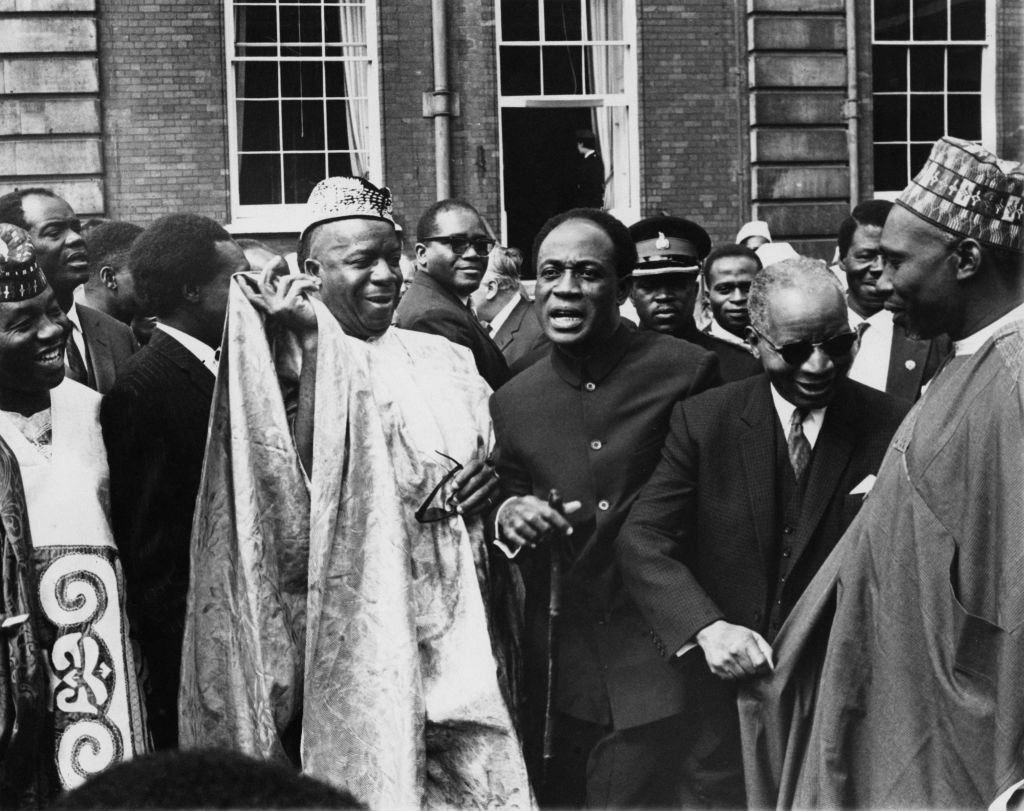
From left to right, Sir Albert Margai, prime minister of Sierra Leone, Kwame Nkrumah, president of Ghana, Dr Hastings Banda, prime minister of Malawi, and Sir Abubakar Tafawa Balewa (1912-1966), prime minister of Nigeria, at Marlborough House in London for the opening of the annual Commonwealth Prime Ministers’ Conference, 17 June 1965. Keystone / Hulton Archive / Getty
In the three decades after World War II, anti-colonial activists attempted to throw off the shackles of colonialism. But their aims went far beyond winning political independence or building a new nation. For many, the goal was nothing less than the reinvention of the international legal, political, and economic order — to create a world where dominated peoples would finally secure self-determination and true national independence.
Postcolonial statesmen like Kwame Nkrumah, Michael Manley, and Julius Nyerere successfully pushed to enshrine a right to self-determination at the United Nations (UN), proposed ambitious projects of regional federation, and called for a rebalancing of the world economy that would redistribute wealth and power to the Global South. Anti-colonial nationalists, Adom Getachew shows in her new book Worldmaking after Empire: The Rise and Fall of Self-Determination, were also egalitarian internationalists.
Jacobin contributor Sa’eed Husaini recently spoke with Getachew about the “worldmaking” of the anti-colonial project in the postwar period and the need to topple the global hierarchies that have survived long after the formal fall of colonialism.