Why Kwame Nkrumah’s Socialist, Pan-African Vision Continues to Inspire Radicals Today
Ghana’s Kwame Nkrumah was a postcolonial icon who tried to fight the forces of imperialism and capitalism to build a nation, continent, and world based on equality and self-government. That’s why, despite his faults, young people in Ghana today are resurrecting Nkrumah’s vision as a radical alternative to neoliberalism.
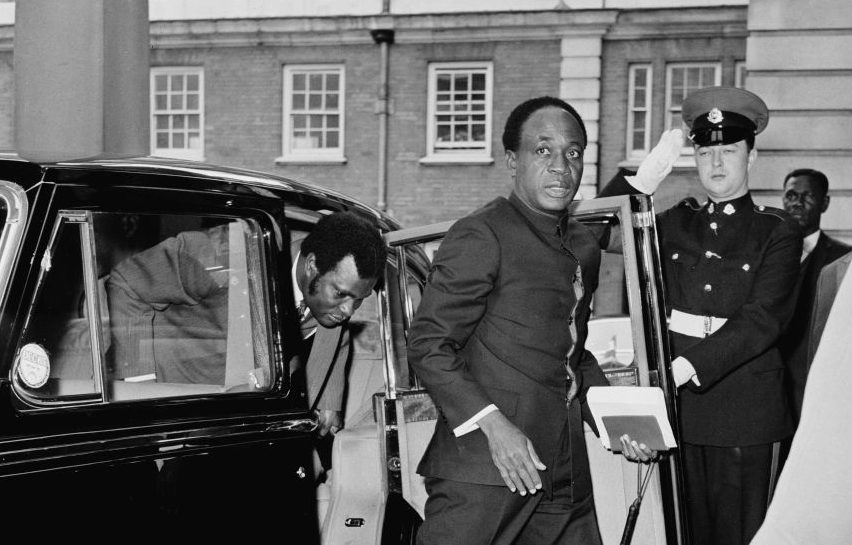
Kwame Nkrumah, president of Ghana, arrives at Marlborough House in London on June 25, 1965. (Roger Jackson / Getty Images)
On March 6, 1957, Kwame Nkrumah took to the stage in Accra to announce the independence of the Gold Coast, renamed Ghana in homage to the ancient West African empire. Nkrumah declared that 1957 marked the birth of a new Africa, ready to fight its own battles and show that black people were capable of managing their own affairs. “Our independence is meaningless,” Nkrumah famously maintained, “unless it is linked up with the total liberation of the African continent.”
Ghana was the first African country south of the Sahara to win independence, and three years later Nkrumah promoted himself to president of Ghana, a post he held until 1966. A Pan-African socialist, he sought to unite and quickly industrialize the country, putting it on a path that could resist the twin threats of capitalism and imperialism. When his efforts attracted internal dissent, however, he cracked down. Ghana became a one-party state (led by the Convention People’s Party, the CPP), with strong repression of dissent.
In 1966, Nkrumah’s enemies in the army overthrew him, as Western powers, as they usually do, looked the other way. His ideas — partly formed in the United States, where he spent a decade in the 1930s and ’40s — were largely marginalized in the 1970s as the successive government made a rightward turn. He died in Romania in 1972, following his exile in Sékou Touré’s Guinea.