Sex Workers’ Rights Are Workers’ Rights
Sex workers don’t need saving. They need what every other worker needs: the power to dictate the terms of their labor.
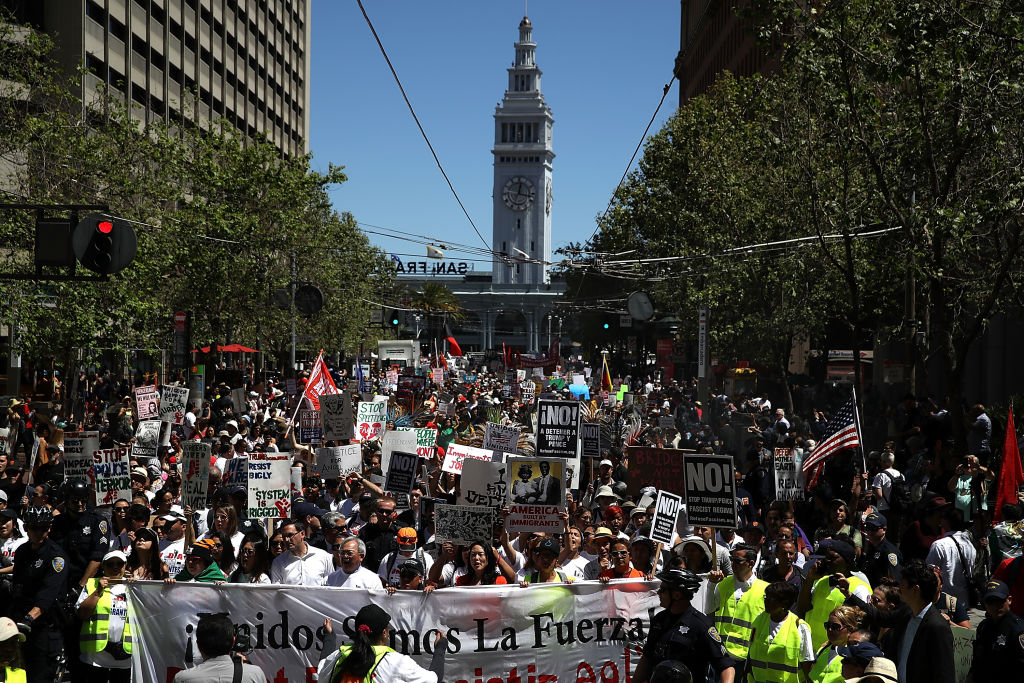
Thousands of protesters march down Market Street during a May Day demonstration on May 1, 2017 in San Francisco, California. Justin Sullivan / Getty
The gathering in Manhattan’s Washington Square Park on June 2, 2018 felt like a watershed moment: hundreds of sex workers and their allies showed up to commemorate the first International Whore’s Day since the passage of FOSTA/SESTA, a federal law that many sex workers say makes them less safe.
It was the largest sex workers’ rights demonstration Kaytlin Bailey, director of communications for Decriminalize Sex Work, had ever seen: “There were hundreds of people there instead of dozens,” she recalled. “Just to see the energy and the mass of people coming together in public space to declare themselves either out as sex workers or as their allies felt like a transformative moment. And it was caused, I think, by the immediate impact of FOSTA/SESTA.”
FOSTA/SESTA allows the government to hold online platforms liable for facilitating illegal sex trade, incentivizing websites to crack down on a broad range of users’ erotic content. Passed under the guise of halting sex-trafficking, critics say the law endangers sex workers by preventing them from finding and screening clients, as well as maintaining critical networks with colleagues that share resources, warnings, and other forms of support in an often perilous industry. As Bailey explained, unlike localized brothel raids or policing of street-based sex work, FOSTA/SESTA targeted all forms of sex work at once — inadvertently binding sex workers together by making visible their shared struggle.