Heading to Congress, Will Lawrence Still Has Some Questions
The election of left-wing environmental activist Will Lawrence to Congress from Michigan offers hope for American democracy. But in a conversation with Jacobin, the congressman-elect is sober about just how much our system can change.
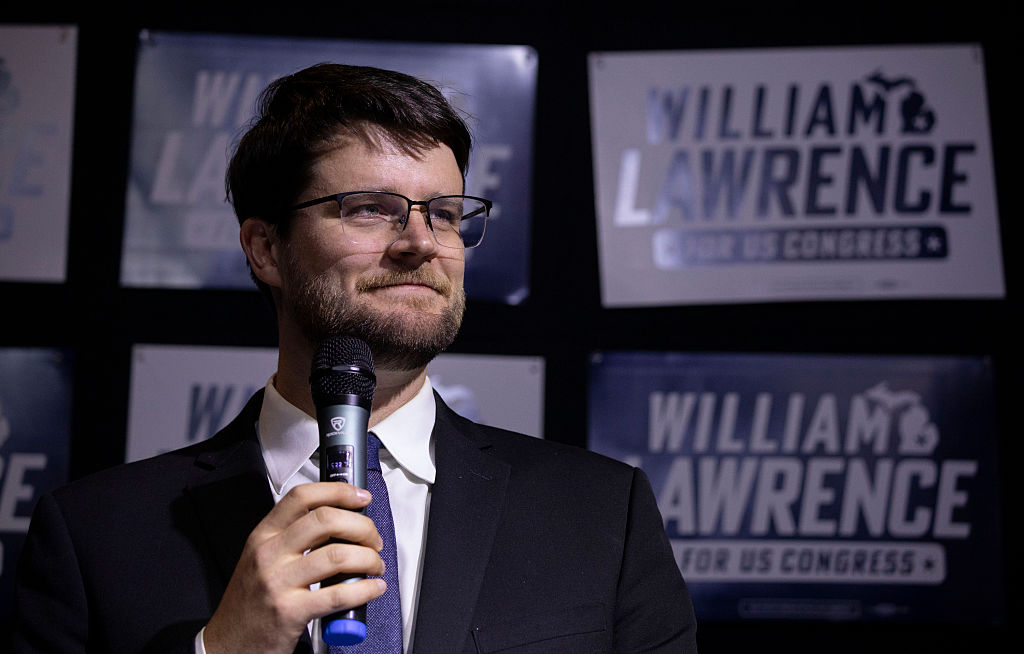
Michigan Congressman-elect Will Lawrence: “The project of reconstituting the social and political compact for the twenty-first century has to be based in the bid for a supermajority of the people of this country.” (Bill Pugliano / Getty Images)
Will Lawrence has been part of every anti-oligarchic organizing effort that has mattered over the last two decades: Barack Obama–era climate activism, Occupy Wall Street, Sunrise Movement, housing justice, the Bernie Sanders campaigns, the Democratic Socialists of America (DSA), and resistance to artificial intelligence data centers. Before the recent midterm election, the thirty-six-year-old East Lansing, Michigan native was exactly the sort of candidate who, according to conventional wisdom, could maybe beat establishment Democrats in liberal blue districts but would lack traction against the Right in a general election.
Yet on Election Day, Lawrence proved that conventional wisdom wrong. He flipped a Republican seat in Mid Michigan and is now headed to Congress.
Lawrence is not the only one showing that an anti-oligarchy, pro-working-class politics can succeed in purple and red America. From Maine to Montana, Bernie Sanders–style politics beat Trumpism across the nation. In Washington, DC’s incoming Congress, Lawrence, reached by phone while walking through the tunnels of Capitol Hill, joins numerous “regular people, many of whom are complete outsiders,” newly taking their place in Congress.
They’re not just “regular” in the sense of not being billionaires. They’re also not career politicians. They “owe nothing to anybody” in power, Lawrence emphasizes, and they “have a mandate to root out corruption, get money out of politics, deliver economic security for their constituents, stop stupid wars, and stabilize the climate.”
But Lawrence has serious questions about what’s possible in this moment.
“We can undo everything that Trump has done,” he vows. “We can undo the Big Beautiful Bill. We can restore SNAP [the Supplemental Nutrition Assistance Program], Medicaid, and the ACA. We can take action to lower prices in certain sectors,” he says:
And yet, economic volatility will continue. People will continue to feel that the future is looking worse. And we’ll still be stuck with the questions of, “What is America’s global role in the twenty-first century? How do we deal with the billionaires, the oligarchs, at the commanding heights of the economy?”
He pauses, aware that he’s brought down the mood. I feel a bit superficial bringing us back to the elections, asking how he won his congressional seat, but it turns out not to be a change of subject or tone. Lawrence’s refusal of sunny platitudes continues.
“Acknowledging the despair and disillusionment that people feel as rational and legitimate, and then drawing on those who have come before, to remember that people have dealt with adversity, uncertainty, and volatility and have fought back against the powerful of their time to win the rights and freedoms and quality of life that we have until recently enjoyed,” is crucial, he says. “The social compact of the New Deal era was fought for and won with blood.”
Lawrence’s parents, like my own, worked at Michigan State University, and I’ve spent a lot of time in his hometown, a land grant university town bordered by flat cornfields on one side and Lansing, the state capitol, on the other. I’m not surprised his bleak honesty and capacious politics could draw Michiganders together.
Lawrence unseated Republican incumbent Tom Barrett, a Trumper who staunchly supported the war in Iran and opposed extending the Affordable Care Act (ACA) tax credits at the beginning of this year. The district backed Donald Trump in 2024 but has flipped so often that it is regarded as a bellwether for the presidential election.
“There are a lot of bad people,” Lawrence continues,
and a lot of reasons to feel disillusioned when bad people manipulate their way into having a lot of power. And yet we have it inside of us to become the better versions of ourselves, to build a better version of our society. [The campaign] was all about that: giving people a reason for hope, creating space for community, for people to make friends and get to know each other, challenge each other, challenge themselves to take action and to take responsibility.
“And it did,” he allows, passing the hopium pipe for just a second, “make me feel more optimistic about democracy. There is some juice left.”
Lawrence isn’t calling himself a socialist these days. He let his DSA membership lapse, which he announced during the campaign, wanting to focus, he told CNN at the time, on uniting the district. He said that he wanted his constituents to feel he represented and was listening to them, rather than any specific organization.
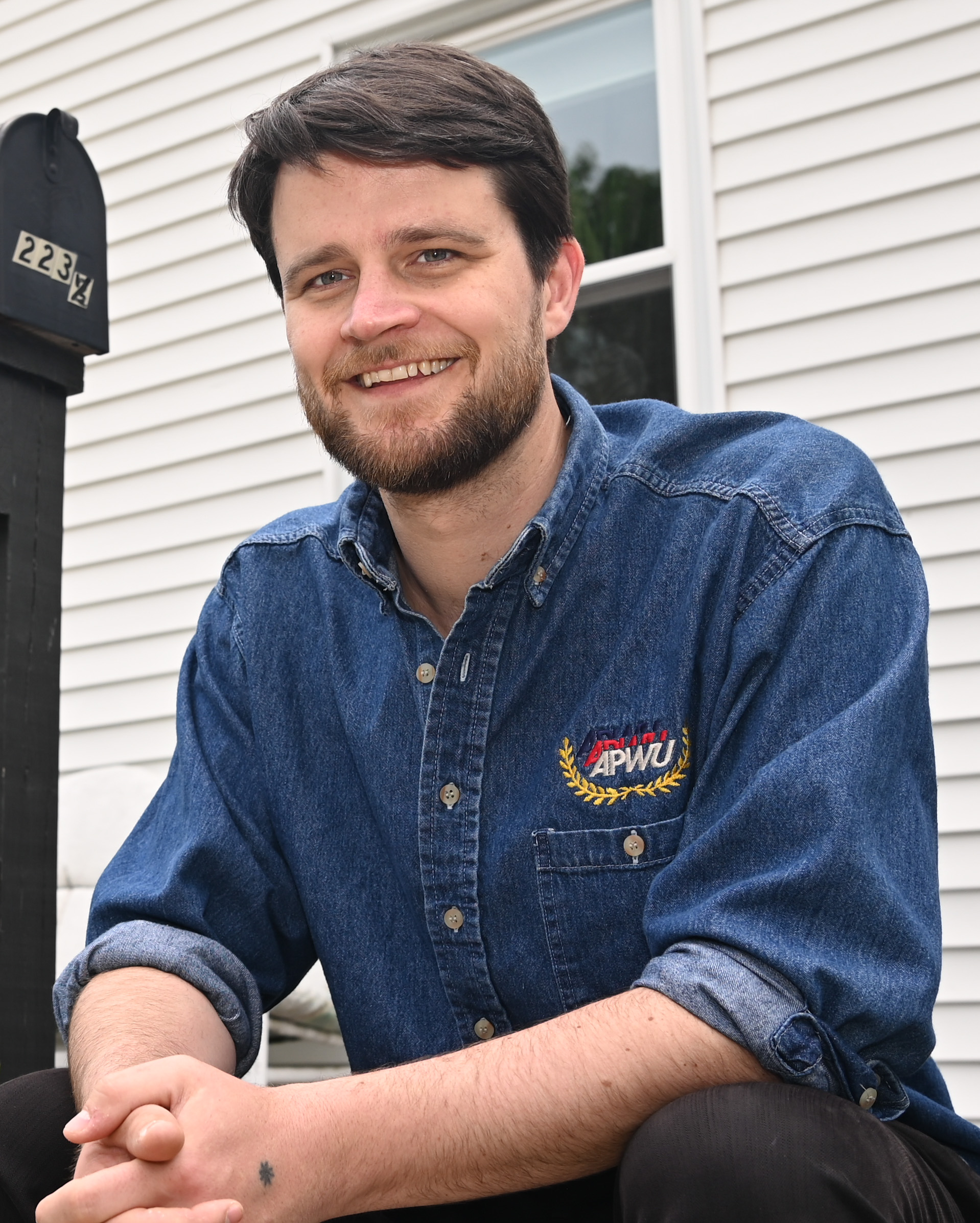
Whether he was wearing his green-and-white Spartans hat at the tailgating parties on Michigan State’s massive campus, where the student vote shapes elections more than it does anywhere else in the nation; or canvassing or conducting town halls across the district, in small cities and towns like Grand Ledge and Brighton — this approach clearly resonated, winning over independent voters and even Republicans.
“The more I continued with the campaign,” he tells Jacobin, “the more I just chafed at some of the attempts to label me as ‘socialist,’ ‘communist,’ or whatever, in a way that was about making people fear me.” So he decided, “Let’s just focus on the values and the issues. When we start there, there’s tons of common ground.”
As he points out, he’s not alone among the incoming left wing of the party in taking this approach. While the new Congress includes New York City socialists Claire Valdez and Darializa Avila Chevalier, it also includes Lawrence’s fellow Michigander, incoming Senator Abdul El-Sayed, who beat a Republican with a Bernie Sanders platform and no “socialist” label; or Troy Jackson in Maine, who did the same.
“With this incoming freshman class that is large and historic,” Lawrence says, “people identify themselves in a variety of ways: progressive, moderate, none of the above. But everybody campaigned on the same issues. And they feel a mandate to deliver change.”
It has been striking to see the continuity, across the country, of Sanders-style issues in the winning candidates’ platforms: Medicare for All, taxing the rich, childcare, defunding the war machine, a moratorium on AI data centers. It is a mandate against billionaires and for the common good. And, Lawrence suggests, there may be a variety of ways to express that:
For the self-identified Left, my push is not to get too hung up on labels or making assumptions about others based on their labels. . . . The project of reconstituting the social and political compact for the twenty-first century has to be based in the bid for a supermajority of the people of this country. And there is no supermajority of this country who currently identifies with any common label. So, we have to be willing to listen beyond that and then find new symbols and perhaps new labels that allow us to establish that majority.
Lawrence feels strongly about changing the direction of foreign policy, and this incoming class has a mandate to do that, probably for the first time this century. But he’s very worried about whether it can be done — and not for the reasons I’m expecting, like the American Israel Public Affairs Committee (AIPAC) and defense lobbyists.
“For me, this is one of the lessons of Joe Biden’s administration, which I do really believe tried to do something good for the American working class and wanted to deliver on economic security,” yet was “so militarist and hawkish.” He points to the administration’s position on Israel and Palestine: “It completely undid the coalition that Bernie and Biden supporters had painstakingly built together for the sake of building a united front to defeat Trump.”
Lawrence is worried about whether, in America, we can have peacetime social democracy. “Social democracy without a Cold War posture is unproven,” he says. “Social democracy was forged in the context of the Cold War. And in the attempt to reforge a social democracy [today], there will be those, like in the Biden administration, who believe that a new Cold War is a natural part of that project.”
He’s right: During the Cold War, workers’ material gains — including civil rights for black Americans — could often be framed as part of an anti-communist argument that capitalism could deliver a better life for the working class than communism. And a state of permanent war readiness fueled the economy, bringing billions of federal dollars into defense spending and creating millions of good jobs.
Lawrence worries that many Democrats still can’t separate militarism and social democracy, that they believe that ongoing war can “clarify the resolve and the sense of national purpose, but also that it’s the only way that we can have an economy which is prosperous, with a broad-based growth that includes a strong deal for the working class.” That won’t cut it today, he says: “I don’t believe that that will work for the twenty-first century, because the conditions of the political economy are different. It’s not 1946 anymore. And we’re not going to recreate the economic conditions that existed then. So we have to find a different way.”
One of the fights that politically shaped Lawrence, a Sunrise activist, was the campaign for the Green New Deal during the Biden administration; it seems possible that an energy transition off fossil fuels could contain the seeds of that “different way.” Maybe in Congress, Lawrence can help bring those ideas back to political life.
Maybe. But he’s certainly not overpromising. It’s jarring to talk to a politician who has thought so deeply about the perils and limitations of our moment and speaks so frankly about them. Not only does Lawrence not think perpetual geopolitical conflict can deliver for Americans. (Americans, squeezed by gas prices during the war in Iran, seem to agree.) “I really don’t want to see World War III. It’s as likely as not that that’s where things are headed,” he warns. “Preventing that is one of my main missions.”