Abdul El-Sayed’s Plan to Win in Michigan

Abdul El-Sayed

US Senate candidate Abdul El‑Sayed explains to Jacobin why establishment attempts to “cancel” left-wing voices keep backfiring, how corporate money distorts democracy, and what it takes to organize a state as fractured — and as pivotal — as Michigan.
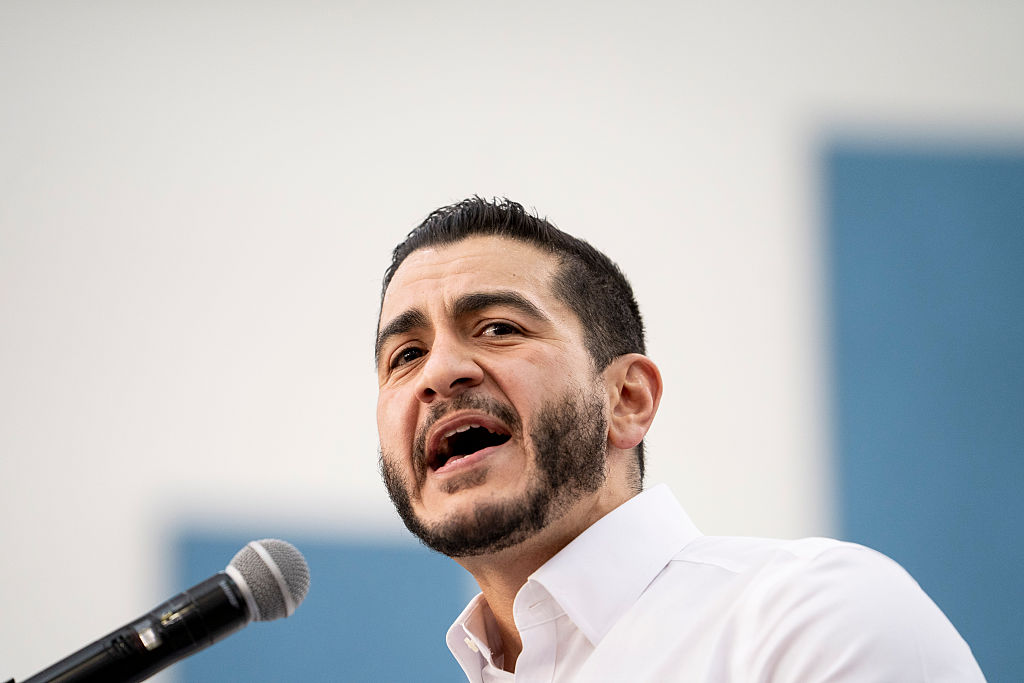
Abdul El-Sayed, candidate for US Senate in Michigan, speaks at Mumford High School on May 3, 2026, in Detroit, Michigan.

Abdul El‑Sayed tells Jacobin he is running for the US Senate on a simple premise: the real divide isn’t left vs. right, it’s the locked‑out vs. those holding the keys. (Sarah Rice / Getty Images)


Interview by
Daniel Denvir

Less than a decade ago, electing even a single left-wing progressive to a city council or state legislature was treated as a political earthquake. Today, they hold major offices across the country — and candidates running on unapologetically left politics are mounting serious campaigns at every level of government.

Abdul El‑Sayed is one of them. The Michigan physician and organizer is running a competitive race for the US Senate on a platform aimed squarely at corporate power, economic inequality, and the political establishment that protects both.

This conversation between Daniel Denvir and Abdul El-Sayed was recorded for the Jacobin Radio podcast The Dig.


Daniel Denvir

Michigan is home to Detroit, battered by decades of deindustrialization and white flight, suburbanization. It’s also home to Flint, where people were forced to drink poisoned water, and Dearborn, which is the capital of Arab America. And of course, the entire region is the birthplace and headquarters of the United Auto Workers and the Big Three automakers. Macomb County, north of Detroit, is where white working-class people shifting rightward were first called “Reagan Democrats.”

The Right has for decades used those differences to divide people against each other. How do you and your campaign map out the state you’re running to represent in the US Senate? How do you encounter those divisions and then begin to stitch together common purpose and solidarity across them?

Abdul El-Sayed

You’re right about Michigan. It is a beautiful tapestry of a number of different types of people who have all come to one place to become one type of person, which is a Michigander, who right now is struggling under a profound amount of economic and political pain. And rather than think through all of these differences, our campaign is about connecting across all of the similarities.

No matter who you are, how you pray, who you love, what you do for work, you really want to make sure that you can do work. You want to make sure that that work is commanding a fair wage. You want to make sure that you can keep a roof over your head. You want to make sure that you can see a doctor when you need one, and you want to make sure that you have the right to be able to voice your opinion in our democracy.

Those are the things that connect a “Reagan Democrat” in Macomb County to an Arab mom in Dearborn to a black autoworker in the city of Detroit to a farmer in Traverse City to a miner in the Upper Peninsula. And so we’re focused on a message that steps past the ridiculous divisions that MAGA and other culture warriors have tried to put in front of us and brings us back to the fact that it’s not about left or right in our politics anymore. It is about the fact that too many of us are locked out, and then there are the folks who are doing the locking out. And what you can get from me is that I will always be on the side of the locked out against the folks who hold the keys. So we’re fighting to get money out of politics, put money in your pocket, pass Medicare for All.

That means ending corporate contributions. It means standing with unions and small businesses against big corporations. It means taxing billionaires and their wealth. It means keeping our money here at home to invest in our schools and our health care rather than dropping bombs on other people and their schools and their health care.

And it means finally guaranteeing health care to everybody through Medicare for All.

Daniel Denvir

The entire establishment-manufactured controversy over Hasan Piker was initially sparked by your decision to host a rally with him, and the move backfired pretty spectacularly. You stood firm, and all it did was raise both of your profiles and introduce you to a lot of new people who might like what you both have to say. What did opponents of the Left hope to accomplish by ginning up this fake scandal, and what does it mean that these old tricks used to shut down or stigmatize the Left just don’t seem to work anymore?

Abdul El-Sayed

Let me tell you about what we accomplished: First, a whole swath of Michiganders learned who I was beyond the talking points, because I think people are sick and tired of the fact that these old-time institutions think they can tell you what you can think and who you can talk to. All that does is encourage people to go figure out who it is that they’re trying to cancel today.

And so a lot of people figured out who I was and what I wanted to do. I want to get money out of politics. I want to put money in your pocket. I want to pass Medicare for All, and most folks are like, “Oh yeah, that’s why they’re trying to cancel him. I get it.” Number two, I think people realize I don’t back down to anyone ever on anything, and we probably need a couple more of those on the anti-fascist side of things right now, on the anti–Donald Trump side of things.

And then the third thing we were able to accomplish through all this is that we were able to get our message out to folks who felt locked out of our politics structurally, young people, people who felt like there is actually no political conversation that’s being had for them.

And, you know, it’s interesting, right? Because you asked the question about why they did this. I am an existential threat to a system of politics that tells us that corporations should be able to dominate our lives and get to dictate what happens to our tax dollars; that war is the best outcome of what government can offer you; and that you cannot have health care because it is just too expensive to offer in the richest, most powerful country in the world. But you’d think that the establishment would have learned its lessons from the great “cancel culture” fights of the early 2020s.

Daniel Denvir

In the streamer world, Hasan models this progressive feminist version of what it means to be a man. And you’ve articulated similar thoughts in terms of communicating directly with men about a different way to relate to masculinity. What’s your diagnosis with what’s going on with men and boys in this country and how you think the Left should be approaching it?

Abdul El-Sayed

There’s a structural diagnosis, and there is a cultural one. Structurally, let’s not forget that we all live in a hypercorporatist type of capitalism where huge sectors worth trillions of dollars get made and weaponized against men’s dopamine circuits. There’s a good friend of mine, our whole relationship is basically comprised of discussions about Detroit athletes of the 1980s and ’90s. And my guy can’t watch ESPN anymore because ESPN has basically become a sports betting platform. This is a big part of his life that’s basically off-limits to him because we’ve allowed the fusing of corporate media and the gaming industry, all existing to weaponize men’s dopamine circuits to take their money.

Then you think about gaming, then you think about porn. If you’re fourteen years old and you’re on Instagram, chances are you’re being fed softcore pornography that’s two clicks away from actual pornography. And that’s not to say that any of these things should not be allowed. That is to say that we need to put some real thought into whether we want young people, or people who have gambling problems, to constantly have to be exposed to this. Why do we do this? So that a huge industry can make billions of dollars? That’s the structural part. And when too often men find themselves at the wrong end of the dopamine high, and they feel terrible about themselves in the moment, then you have the sort of “masculinity industrial complex,” the Andrew Tates of the world, right there to blame it on a woman.

The version of masculinity I was raised with was the idea that any strength you might have over anyone should be used to empower them, not to hurt them. That your job is to figure out how to use that to serve people. That’s the job. And I think if we’re serious about taking on the crisis, then we’ve gotta be serious about two things. You can’t just label all masculinity toxic because all you’re doing is driving people back into the arms of the Andrew Tates, who are willing to tell them that they’re just fine as it is, and that the real problem is somebody else. And then you have to be able to demonstrate that kind of benevolent masculinity, and you need to empower those voices who can speak equally to men and also speak to men about what our responsibilities look like. So put your pants on, go to the gym, go to class, speak respectfully to the people around you, and figure out how you become a positive member in society.

But also, a lot of this is not exactly your fault. There are huge corporations who exist specifically to weaponize your dopamine circuits against you, and frankly against all of society, and we have a real responsibility to be able to stand up to them and put calipers upon where, when, and how these kinds of products can be offered so that we can protect kids.

Daniel Denvir

Two decades ago, the Council on American-Islamic Relations estimated that a huge majority of Muslims voted for George W. Bush. Then for decades after 9/11, we had a country consumed by right-wing Islamophobia that painted both Arabs and Muslims as violent, backward reactionaries. But here we are today in a pretty remarkable place. What do you make of this arc with the important place of Arabs and Muslims at the center of a reviving, ascendant US left?

Abdul El-Sayed

Part of that is, in Muslim culture, there is a real commitment to integrity. The sword that the prophet, peace be upon him, used to carry said, “Speak the truth even if it be against yourself,” right? There is a real commitment to integrity that is sewn into the fabric of Muslim belief. And then American Muslims have often lived on the wrong side of the worst excesses of the proto-MAGA movement, now the real MAGA movement. You think about the wars that have been fought in our name, you think about the legalized system of surveillance that is as anti-American as it gets, those things have often targeted Muslims.

And it is a response, a logical response that the Arab and Muslim community has said, “Okay, well, we came here in the generations before us believing in the ideals of this country,” right? Ideals that we hold deeply sacred. We hold these truths to be self-evident that all men — all people it should say — are created equal. Government of the people, by the people, and for the people, often leaving countries where those things didn’t exist. And then to find yourself the victim of a culture that is weaponizing government against those ideals, right? If you’re somebody who takes integrity seriously, you’re going to step up and be like, “No, our job is to be the America we say we are.” And then you’ve got generations like mine who were born and raised here that . . . We are as American as anyone else, right? Apple pie with maybe a little bit more cardamom. But that responsibility to stand up and say, “We’ve got to fight back against the forces that are weaponizing government against all of us,” right? And that’s the thing: if you’ve been thrown under the bus enough times, you start to get to know the people under the bus, and you start to realize that none of us should be under the bus.

So what happens when all of us working people come up and step up together, fighting for the integrity that should be the foundation of this country in the first place? As I’ve said so many times, it doesn’t matter how you pray, where your family comes from, who you love, how you identify. You need a good roof over your head. You need to be able to afford groceries. You need to be able to send your kid to a good school, and you need health care. And so this is about more than any one identity, more than any one faith perspective. But maybe it takes communities who have been ground down, told that in a country where we believe in freedom of religion, that you can’t actually pray a certain kind of way, or being told that you’re less than, when you can then build a movement of people all coming together and saying, “Well, you’re under the bus for who you love. You’re under the bus because you can’t afford a dignified life. You’re under the bus because they’re discriminating against you because of the color of your skin. You’re under the bus because they’re discriminating against you for how you pray. Why don’t all of us get out from underneath the bus and actually build a bus that is worthy of the ideals of this country?”

And I think that’s where you’re starting to see some of that. And so I’m not running to be the first Muslim anything. I am running because my belief in this country and its ideals, and my belief in my own faith, suggest that we have a responsibility to stand up for justice and the ideals of this country, and to lead in a moment where too often people are told that they’re not enough. And that leaves us with this sort of white nationalist movement that is now dominating our politics and telling us that the best use of our collective money isn’t to provide our kids health care and to provide our kids good schools, but instead to go drop bombs on other people and their kids.

I think there’s a collection of people of all faiths, of all backgrounds, who are coming together around those ideals to push back. And it’s not surprising to me that you’ve got a good representation of Arabs and Muslims in that mix, alongside atheists and agnostics and Christians and Jews and Buddhists and Hindus, all fighting for the same goal, that none of us want to be under the bus. All of us want to be able to afford our lives, and all of us deserve that this country holds itself to that standard. And the last point I’ll make here is that I love America. I know exactly what my life would’ve been but for America. I used to spend a lot of my childhood summers basically with a front-row seat to what my life should’ve been but for America. I just want America to be America for all of her children, and I think that’s true for all of us, regardless of how we come to this.