In Last Night’s Midterms, the Left Proved It Can Win
Democratic voters have long sided with socialists on policy but feared they were a liability in elections. Last night’s results finally proved that wrong.
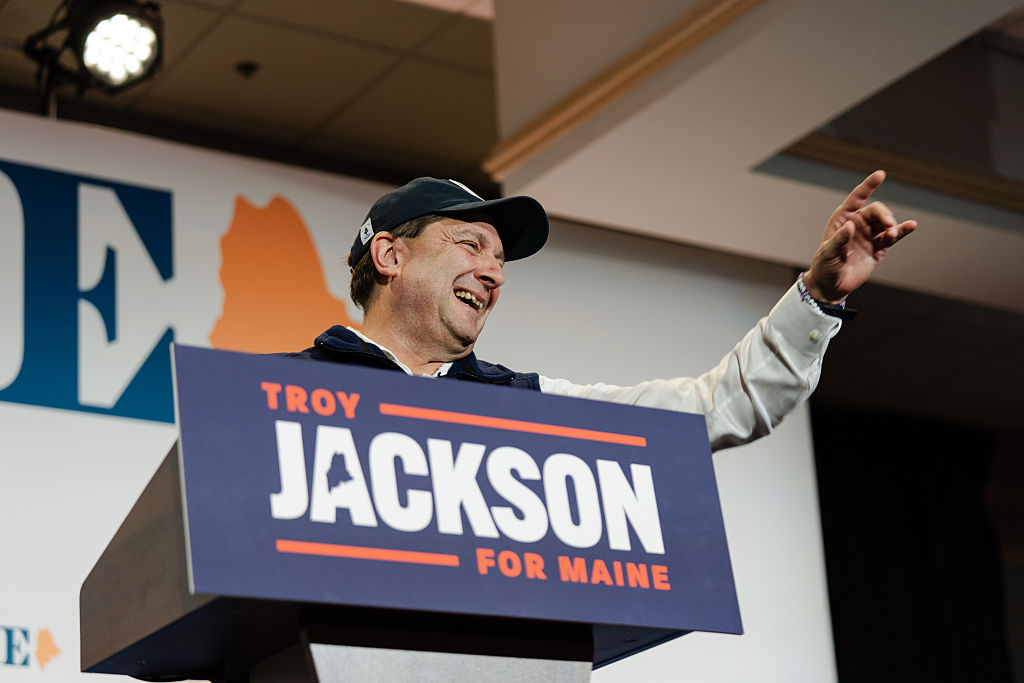
Last night’s midterm results showed that Democrats need not fear leftist policy ideas, because those ideas can win. It portends well for running a left candidate for president in 2028. (Sophie Park / Bloomberg via Getty Images)
The Left has been so conditioned in the Trump era to look aghast and horrified at election results that it is still hard to fully believe the outcome today. Yet the historic events of last night really did happen: Donald Trump and Republicans suffered a historic rebuke from voters, handing Democrats wins up and down the ballot all across the country, flipping both chambers of Congress in their favor, and handing them the largest congressional majorities they’ve had since Barack Obama’s election.
In many ways, the result is simple. Across poll after poll leading into the election and exit poll after exit poll leading out of it, the message from voters was the same: they think the economy sucks, they think prices are too high, and they’re angry at Trump and blame him squarely for this entire situation. To send this message, voters turned out in droves to hand power to a Democratic Party that these same polls show they have very little love for, sometimes viewing the Dems even more dimly than they do Trump.
Democrats were expected to take the House. They were not expected to win a majority of more than 250 seats in it, as current estimates have them winning. Nor were they expected to win a Senate majority, let alone a Senate majority of at least fifty-four seats. And they were not expected to flip deep red seats across the country, to sweep Republicans from control of Texas at nearly every level of power, and to win a majority of the country’s governorships, achieving wins and trifectas in states they’ve been practically locked out of for sometimes decades. Obama referred to his 2010 midterms rout as a “shellacking.” Last night was an annihilation.
This is not just good news for Democrats. For the Left, which operates within these Democratic majorities at both the state and federal levels, the results present a historic opportunity to turn its political priorities from words into tangible reality across the country, further building the power it has patiently and, for a long time, quietly been constructing from the ground up these past ten years.
That includes at the federal level. Even though Trump has two more years in the White House, and Democrats are threatening to zealously turn their powers of oversight on the vast record of abuse and criminality he’s racked up during that time, there is some, extremely slim reason to believe something could actually get done.
Trump phoned Politico last night to make clear he was open to working with the Democrats and didn’t “want to be just sitting there for two years vetoing everything.” The last time Trump was in the White House with a Democratic Congress, the pandemic, the United States saw the largest expansion of the welfare state in decades. Trump’s ideological malleability and the fact that he is currently looking at a legacy as a historic failure presents at least the possibility of an opening for something better to happen.
It’s an opening the Left will be able to take advantage of, too. The Left will enter this new Congress with far more formidable numbers than it’s had in decades: at least seven members of the Democratic Socialists of America (DSA), creating the historic opportunity to for the first time form a distinct socialist caucus in Congress and a Squad-like progressive “Bloc” that could have as many as twenty members.
The massive Democratic House majority means “the Bloc” will not have the expected leverage of being able to block House Democratic leader’s Hakeem Jeffries’s bid for Speaker, or to hold up legislation Freedom Caucus–style. But it will have influence. Much of the generous pandemic policies of 2020, including both Trump and, later, Joe Biden’s stimulus checks, originated with the public demands of socialist and progressive members of Congress that later found their way into legislation on the back of their clear public need and popularity.
This time, the Left will be making these arguments in a world in which socialists have already transformed the way even centrist Democrats talk about politics. The party’s years-long obsession with “norms” and rescuing democracy having largely faded into the background in favor of the affordability-focused and anti-billionaire rhetoric popularized by, respectively, New York’s socialist mayor, Zohran Mamdani, and the socialist duo of Sanders and Alexandria Ocasio-Cortez on their “Fighting Oligarchy” tour.
Just as importantly, it’s a world in which the Left, thanks to a spate of major wins last night, has thoroughly discredited the arguments used to marginalize and dismiss its basic case.
Earthquake in Michigan
No left-wing victory last night was bigger than Abdul El-Sayed’s Michigan Senate win over Republican Mike Rogers by a whopping 7 points. It was the exact, hefty margin El-Sayed himself had promised he would win by back in May and defied the incessant predictions that he would end up badly underperforming.
There was arguably no more important race this year than for the purple state’s Senate seat: for the Left, which sought to prove progressives could run and win outside of blue strongholds; for corporate Democrats, a segment of whom feared losing the ability to fearmonger about supposedly risky left-wing candidates; for the pro-Israel lobby, which feared that the success of a stridently pro-Palestinian message would obliterate its claim that blind fealty to Israel was “good politics”; for Trump and the MAGA movement, whose loss of the key state could be a harbinger of even worse political defeat to come.
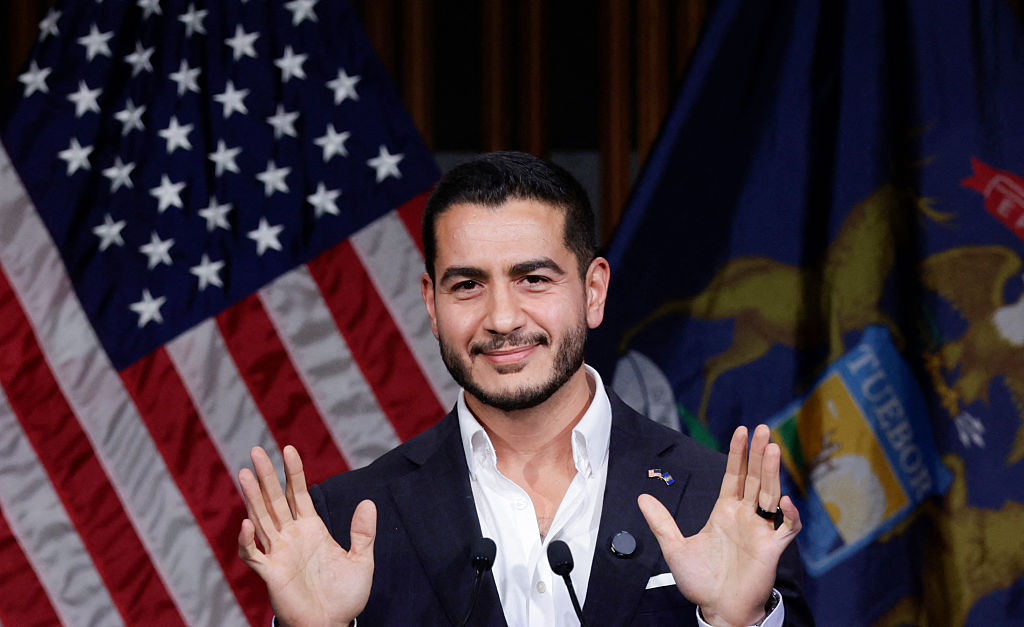
El-Sayed’s win has confirmed all of these. It represents not just a failure for MAGA, in the form of now two-time loser and career-long warmonger Mike Rogers. It’s an absolute disaster for the pro-Israel lobby and the American Israel Public Affairs Committee (AIPAC) in particular, which blew tens of millions of dollars over the course of both the primary and general to defeat El-Sayed and tried every trick in the book to defame and make voters, particularly Jewish ones, fear him.
Instead, both exit polls and voting data indicates El-Sayed comfortably won Jewish voters despite this ugly, Islamophobic campaign against him. He outperformed Kamala Harris in the heavily Jewish Oakland County, the home base of his Democratic primary rival, Haley Stevens, who humiliated herself trying to kneecap him in the final days of the race.
Catastrophically for the pro-Israel lobby, he did all this while maintaining an unabashed opposition to further US aid to Israel, proving unambiguously that left-wing criticisms of Israeli policy are not only broadly shared by voters in battleground states, but that they are shared by Jewish voters, too.
That he managed this is especially impressive given that, unlike his Democratic colleague running for governor, El-Sayed had to overcome not only an avalanche of big money spending but also members of his own party working around the clock to sabotage him, from Stevens’s last-minute endorsement of Rogers to Rep. Hillary Scholten’s support for a write-in campaign against the Democratic nominee in the final days.
Democratic defectors to the GOP had a variety of motives, but at least some of them made publicly clear they hoped El-Sayed’s defeat would nip the growing Democratic opposition to US aid to Israel in the bud — something they were willing to elect a candidate who included actual antisemites in his campaign to do, as well as to empower an administration that makes common cause with literal neo-Nazis and white supremacists. Instead, they lost and disgraced themselves for nothing.
El-Sayed also did it on a progressive platform of Medicare for All and taxing the rich, two ideas that, when Bernie Sanders first popularized them in 2016, the public was told were too controversial with swing voters and risky to run on. A decade later, these ideas have such widely understood, popular support that Republicans didn’t even bother attacking them. Instead, they put all their eggs in the race-baiting basket, making El-Sayed’s Arab ethnicity and Muslim faith the overwhelming focus of their attacks in what turned out to be one of the most shockingly racist election campaigns this century — and another disgraceful failure.
Wins and Losses
El-Sayed’s win wasn’t the only bright spot for the Left last night. There was also Troy Jackson’s win in Maine, who succeeded where four others had failed in unseating the seemingly untouchable thirty-year Republican incumbent Susan Collins from her Senate seat. Though Jackson, an eighteen-year state legislator and former state senate president and Democratic leader, was far from your typical image of a left insurgent, he quickly consolidated socialist and progressive backing after former nominee Graham Platner’s personal scandals pushed him out of the race.
Though not a socialist, Jackson’s genuine working-class background — as a fifth-generation logger who entered politics to win collective bargaining rights for his fellow woodworkers — and robust progressive record made him closer to the kind of candidates the Left hopes to see in power. In the end, Jackson was able to secure victory by neutralizing Collins’s ability to run up big scores in otherwise blue-voting areas.
The other major progressive win was by James Talarico, who became the first Democrat to win a Texas seat in thirty-eight years, part of a historic blue sweep across Texas that saw Democrats end nearly three decades of GOP rule of the state. Talarico is not a socialist, despite old comments criticizing capitalism that briefly became a campaign issue, and like El-Sayed, he took pains to insist that he was a capitalist. Even so, he was backed by groups like More Perfect Union and the Progressive Change Campaign Committee and drew support from prominent socialists like Hasan Piker, who has said that the Left was “the force that backed him early on” and “allowed him to win.”
Maybe more important, Talarico ran on a class-based message decrying “billionaire mega-donors” — one of whom, Elon Musk, lit at least $47 million on fire trying and failing to beat him — and insisting that the fundamental political divide in the United States was “top versus bottom,” a more progressive message than many Democrats ran on even in solid blue states. So his emphatic 12 point victory over the scandal-plagued Ken Paxton is a victory for the kind of populist message the Left has long advocated, even as Talarico did things like refusing to back Medicare for All and declining to campaign with Bernie Sanders when he visited the state.

Speaking of Sanders, as of the time of writing, seventeen of the twenty-one candidates endorsed by the socialist senator have won their races, while only two have lost, and two are in races that are still to be called. Sanders’s endorsements were less straightforwardly left-wing than those of organizations like DSA or Justice Democrats. They included candidates like El-Sayed and Jackson, but they also included more establishment candidates like Minnesota Senator-elect Peggy Flanagan, who beat corporate-friendly rivals in their primaries. They ran the gamut from DSA candidates like New York’s Claire Valdez and Colorado’s Melat Kiros to candidates like Rebecca Cooke, the less progressive candidate in her primary but someone who flipped a Trump-voting, rural Wisconsin district that for decades was represented by a Democrat.
They also included William Lawrence, the Sunrise Movement cofounder who has flipped a swing district in the swing state of Michigan despite having one of the more left-wing résumés of any Democratic candidate — something that, like El-Sayed, we were told would make him a guaranteed loser. The fact that Lawrence left DSA mid-campaign and had to distance himself from old tweets that included calls to nationalize the fossil fuel industry should not take away from the magnitude of his win. On the back of a progressive populist campaign that pushed a data center moratorium and Medicare for All, Lawrence won a purple district that used to belong to the Democrats’ patron saint of centrism, former CIA analyst Elissa Slotkin.
Even some of the defeats were surprisingly good for the Left. In ruby-red Florida — where Republicans outnumber Democrats by 1.5 million and a Democrat hasn’t won statewide office since 2012 — DSA member Angie Nixon lost by less than 3 points, little different from the 2 point losing margin of the ex-Republican candidate who Democrats ran for governor. The state’s last three Democratic losing margins for Senate are 13, 16, 0.2, and 8 points. And that’s after being outspent nearly four-to-one and getting no help whatsoever from the national Democratic Party, which should be kicking itself for missing the opportunity to win another gettable Senate seat.
That a DSA member would even be competitive in Florida — the heartland of right-wing Cuban extremism and the home of both Marco Rubio and now two Bolsonaro sons — would have sounded laughable five years ago, or even five months ago. That Nixon could do this well with this little help will, together with El-Sayed’s win, make it that much harder to argue that the socialist label is an inherent electoral liability.
It should spark some soul-searching among the Democratic establishment and its decision to preemptively write off the race as a foregone loss. But it will no doubt also spark debate within the socialist movement, too, given Nixon’s result was built partly on distancing herself from alienating positions like defunding the police and abolishing prisons. Her strong showing, along with the success of other left-wing candidates who similarly moderated or eschewed contemporary left orthodoxy on some issues, points to the benefits of DSA candidates having the flexibility to tailor campaigns to local electorates.
The Left also suffered a defeat of sorts in Nebraska, where independent Dan Osborn fell short at a second tilt at a Senate seat in a state where a Democrat hasn’t won statewide election for twenty years. Osborn, a union leader who led a successful 2021 strike against Kellogg’s over planned benefit cuts, was something of a proof of concept for the Left: that, as per research from the Center for Working-Class Politics, the way to win in such states is to run genuine working-class candidates with populist platforms outside of the Democratic Party brand.
To some extent, both of Osborn’s campaigns proved this true. The last four Democratic losing margins in Nebraska Senate races were 41 points, 19 points, 24 points, and 16 points; by contrast, Osborn has fallen short by roughly the same, single-digit margin of 7 points both runs. Clearly, if pro-working-class candidates are going to flip a deep red state like Nebraska, Osborn’s campaign is a model for how to do it.
But a losing margin is still a loss. Despite combining left-populist policies like “right to repair” with centrist messaging on issues like immigration — Osborn famously ran ads declaring he backed Trump’s border wall — the former union leader was unable to shake attacks that he was a secret Democrat. A particularly damaging set of “scandals” had Osborn on tape bashing the border wall and other Trump policies and using insulting language about his voters. On top of an avalanche of outside spending aimed against him, it proved too much to overcome.
These are on top of a few other stinging defeats for the Left, including Justice Democrats–backed Justin Pearson’s razor-thin loss in Tennessee’s Ninth District, who looked like he might be able to overcome a Republican gerrymander thanks to a surge in black voter turnout.
Socialists may instead be heartened by the victory of Scott Houldieson over a Trump-endorsed candidate in the Republican-held Indiana First Senate District. Houldieson, a union autoworker who cofounded and led the reform effort within the United Auto Workers that resulted in Shawn Fain’s leadership of the union, easily flipped the seat with a 14 point victory on the back of an affordability-focused campaign. Though not DSA-backed or a statewide race, it is to some extent a vindication of the kind of approach the Left believed would see success in Nebraska.
The Local Game Continues
Meanwhile, as usual, socialists and progressives continued their steady accrual of elected office at the state and local levels.
As of the time of writing, DSA has notched 130 wins in everything from state legislatures and city councils, to mayor’s offices and ballot measures, with forty-two losses and fifty-eight races still to be decided. While Angie Nixon fell short of her Senate bid, environmentalist Ashley Herrmann became only the second socialist to win elected office in Florida and the first to be elected to its state legislature in more than a century, flipping a swing district that the Republican incumbent had won with 58 percent of the vote two years earlier. Other notable socialist wins included Robert LeVertis Bell’s election to the Kentucky state house and Mathewos Samson’s election to the Georgia General Assembly, which, together with Gabriel Sanchez’s reelection, makes him one of two socialists in the state legislature.
Particularly notable are several mayoral races that were foregone conclusions after the primaries. Janeese Lewis George is now officially Washington, DC’s first socialist mayor, having won on the back of an affordable housing plan that combines “abundance”-style reforms with expanding rent stabilization. In Providence, Rhode Island, socialist David Morales has similarly cruised to an expected win and, together with a socialist-led city council, will now work to pass a robust rent control measure in the housing-crisis-stricken city — a measure the incumbent mayor he successfully primaried had vetoed.
More complicated is the Los Angeles mayor’s race, where socialist City Councilor Nithya Raman is currently on track to unseat Karen Bass as Los Angeles mayor. Raman’s candidacy was the subject of some controversy, after she was endorsed by the local DSA chapter despite not fully embracing the Boycott, Divestment, and Sanctions movement against Israel and not being questioned about it, leading the DSA’s National Political Committee to nearly strip her of the endorsement, an effort that failed by one vote. If Raman does win, she’ll be the first candidate to unseat an incumbent LA mayor in twenty-one years.
This is on top of a host of progressive ballot measures pushed through by majorities of voters countrywide: the defeat of an abortion ban ballot measure in Missouri, a successful ban on dark money in elections in Montana, and divestment from Israel in Providence, to name a few. Maybe most notably, ballot measures restricting the construction of data centers have so far won overwhelmingly around the country, thirty-eight to one, with eight still to be counted — a clear public vindication of a position championed and popularized by the broad Left.
What’s Smart Is What’s Right
For the past decade, socialists and progressives have often had good election nights even when the Democratic Party has suffered, and they have had bad nights while Democrats rejoiced. Last night may be the first one where both the Left and the centrist party establishment have seen historic wins in tandem.
Over the past two years, the Left showed it was the force most willing to fight against Trump’s right-wing assault and to come up with an effective argument — affordability and fighting oligarchy — to do it. Last night finally proved left policies and rhetoric are not the electoral liability Democratic voters have been told for decades it is.
For decades, Democratic voters have had to make the agonizing decision every election to choose between their heads and their hearts. The Left may have just freed them of it.