Claire Valdez Plans to Take the Labor Movement to Washington
Claire Valdez argues that worker power is built through organizing unions on the shop floor. Days after winning New York’s 7th District Democratic primary, she returned to the labor fights she says elected office should serve.
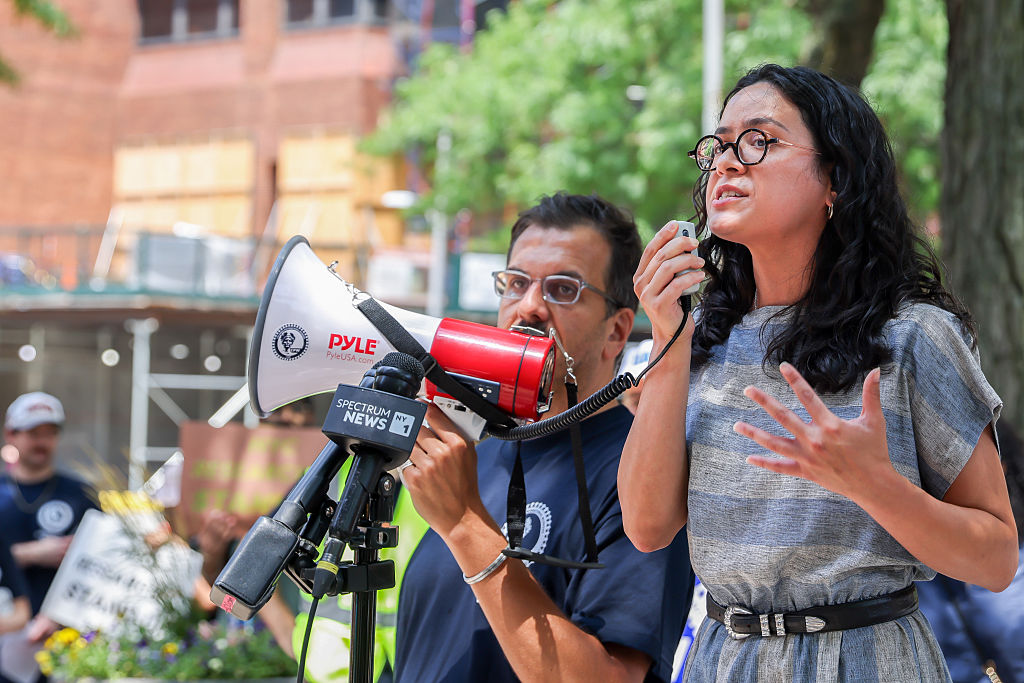
Just a few years ago, Claire Valdez was struggling to make ends meet and organizing with her coworkers through her union. As she now heads to Congress, Valdez is assessing how she can use her position to support union organizing efforts. (Michael Nagle / Bloomberg via Getty Images)
After fifteen years cleaning rooms at the Fairfield by Marriott in Times Square, Ramona Garcia told the crowd, she earned just $22 an hour. Every week, she paid about $100 for health insurance. She had no pension. After finishing her shift at the hotel, she cleaned private homes to make ends meet.
“We need higher wages,” she said. “We need health care we can afford. We need to have a way to retire. But what we need most of all is respect.”
It was July 1, and hundreds of members of New York’s Hotel and Gaming Trades Council (HTC) were gathered outside the Fairfield and the neighboring Four Points by Sheraton Midtown Times Square hotel on West 40th Street. Nearly four years earlier, workers at the two hotels had voted to unionize. They were still waiting for a first contract and had launched an unfair labor practice boycott of the two locations. The union accuses management of refusing to bargain in good faith, discriminating against union supporters, and replacing union positions with subcontracted workers.
The Midtown picket line drew an unusually large contingent of elected officials, including Mayor Zohran Mamdani and Democratic congressional nominee Claire Valdez. They spoke beneath a giant Scabby the Rat, a fixture at labor disputes throughout the city and the country, as rush-hour traffic moved along West 40th Street.
Mamdani pointed to the workers’ four-year wait for a contract. “Nationwide,” he told the crowd, “unions that are organized for the first time never get a contract half the time.” Employers had learned that even after workers successfully voted to unionize, delaying negotiations could become a form of union busting. Introducing Valdez, he borrowed a line that had become one of her campaign’s slogans: “Workers deserve it all.”
“What they are counting on is for you to get tired, for you to get worn out, for you to give up,” Valdez told the hotel workers. “Are we giving up?” The crowd shouted back that they were not.
“As long as you’re in the struggle for exactly what you deserve, for being the workers that uphold the hospitality industry in New York City, for welcoming the world to our fair city, I’m going to be here with you in that fight,” she continued. “You are not alone. The labor movement is behind you.” When hotel workers won what they were owed, she argued, “you are fighting for the entire working class, the entire labor movement.”
Since defeating Brooklyn Borough President Antonio Reynoso in the Democratic primary the previous Tuesday, Valdez had spent two days moving from one labor fight to another. New York’s 7th Congressional District stretches from western Queens through north Brooklyn into Lower Manhattan and includes one of the country’s strongest bases of democratic socialist politics.
In the two days before the hotel rally, Valdez visited postdoctoral researchers bargaining with Columbia University, public defenders preparing for a possible strike, and journalists at Scientific American fighting what they described as an attempt to derail their newly certified union.

“What these bosses are counting on time and time and time again is that workers will give up, that we will move on, that we will . . . it will be too hot, that this will take too long, that we will be too tired,” she had told the crowd at the Scientific American picket, before launching into a call and response. “Are we going to let them win? Are we going to stand side by side with our coworkers in this fight for as long as it takes? Are we going to fight for the wages and the dignity and the stability that we deserve?”
Valdez defeated Reynoso despite entering the race with the backing of few of New York’s largest unions. Reynoso assembled a much broader roster of institutional labor endorsements. Valdez instead drew support from a coalition rooted in union reform, newly organized workplaces, and New York City Democratic Socialists of America (NYC-DSA). Citywide, DSA-backed candidates won nine of the organization’s ten endorsed races.
The campaign argued that the labor movement should send one of its own organizers to Congress. What did Valdez think the office was for?
“The labor movement isn’t going to be built because we pass legislation,” she told me. “It’s going to be built because workers take power into their own hands. Our job is to make that as easy as possible.”
Organized to Run
On a cold January morning in Maria Hernandez Park in Bushwick, Brooklyn, Mayor Mamdani, United Auto Workers (UAW) President Shawn Fain, and UAW Region 9A director Brandon Mancilla launched Valdez’s congressional campaign alongside union members and organizers.
Fain called Valdez “a proven leader and soldier for working-class people.” Mamdani recalled that he had been among the first people to ask her to run for office. “Claire came to politics as a worker,” he said. “She was at Taco Bell and Pizza Hut, and she was also at a union that quite literally changed her life.” UAW Local 2110, the Columbia University–based local where Valdez served on the bargaining committee, he argued, had given her “agency, the power to organize with her coworkers, to confront bosses and oligarchs.”
Mancilla, who had known Valdez through the UAW reform movement, told the crowd, “No one will represent us, the working class, better than we will represent ourselves.”
Valdez moved to New York from Texas hoping to become an artist. Instead, years in low-wage service jobs left little room to make art.
“So much of being an artist is having time to f–k around,” she said. “It’s really hard to have that time in New York. People should have the opportunity to get into a hobby and then not be good at it. Or just go to the beach and spend time with their friends. They should be able to go hang out with their kids or whatever they want to do, and it shouldn’t have to be ‘productive time.’”
Valdez joined UAW Local 2110 while working as a clerical employee at Columbia University.
“I was organized to run for office,” Valdez told me. “I got involved with my union because my union siblings asked me to. I got involved with DSA because I was asked. You get organized, and then you turn around and you organize other people.”
The day of the January campaign launch concluded with supporters packing Silo, a club in Bushwick, for a kickoff party. Speakers included an Amazon Teamster, a Starbucks strike captain, socialist state assembly members Phara Souffrant Forrest and Emily Gallagher, Palestine protest organizer and Trump administration target Mahmoud Khalil, and labor organizers from across the city. Antonio Rosario, an Amazon Teamster organizer and former UPS worker, told the crowd that Valdez had repeatedly joined Amazon workers on the picket line.
“Working people don’t need a politician who just shows up when it’s convenient,” he said. “We need leaders who understand whose side they’re on and prove it in their actions.”
“We don’t need representatives who can sympathize with our struggles,” said Starbucks Workers United member Rami Saied. “We need representatives that have known our struggle and have lived our struggle.”
“[Legislative reforms] won’t matter if workers aren’t then able to organize themselves,” Valdez said. “My role is to make it as easy as possible for people to step into their power.”
By lunchtime on Tuesday, June 30, one week after her decisive Democratic primary victory, Valdez was beneath the trees outside Columbia University Medical Center in Harlem, where roughly 1,600 postdoctoral researchers and associate research scientists were marking the expiration of their contract. Standing alongside Valdez were Brad Lander and Darializa Avila Chevalier, the other two congressional candidates backed by Mamdani who had also won Democratic primaries the previous week.
Workers gathered in the dappled shade holding circular blue-and-white UAW signs while television cameras from local news stations crowded around a portable sound system. Bargaining committee members passed out flyers comparing the union’s latest proposals with Columbia’s offers before preparing to head back across the table that afternoon; the contract was expiring at midnight. Until organizers called her forward, Valdez was easy to miss. In a gray-and-blue-striped dress, black sandals, and round black glasses, she blended into the crowd of researchers milling around the edge of the rally.
The postdocs and associate research scientists were bargaining a third contract with Columbia. The union was seeking stronger appointment guarantees, visa reimbursements for international researchers, greater childcare support, anti-bullying protections, and raises that kept pace with New York’s cost of living. As the flyer a union member handed me read, “We do the research. We deserve a fair contract.”
Isabel Low, a postdoctoral researcher in neuroscience at Columbia’s Zuckerman Institute, said she hadn’t thought much about the union contract when she started at Columbia. When she arrived in 2022, she told the crowd, she had a grant, a supportive principal investigator, and enough financial stability that the union’s contract felt almost incidental to her own career. Then she and her husband began trying to have children. Over the next three years, she underwent fertility treatments, suffered two miscarriages, spent thousands of dollars on medical care, and relied on the union’s hardship fund while trying to continue her research. Eventually, after in vitro fertilization, she became pregnant with twins.
“I have seen a possible future for academic workers,” she said. “A future where our medical bills are covered. A future where we have protected time to bond with our new babies and heal from giving birth. A future where postdocs can have a career in research and have a family.”
UAW Region 9A’s Mancilla said Columbia’s postdocs had helped pioneer private-university postdoctoral unionization, setting a standard that workers across the country were now trying to defend. “Density is destiny,” he told the crowd. “But once you set the standard, you have to protect that standard.”
When Valdez took the microphone, she described bargaining with Columbia as a Local 2110 member. Management at “a $16-billion-endowment institution,” she said, had insisted that “the only thing on offer is austerity.” “When we organize together,” she said, “we can win the wages we deserve, the housing we deserve, the health care we deserve, the childcare that we deserve.”
Asked why she had spent the week after her victory at picket lines and contract rallies, Valdez laughed.
“The labor movement is the most important democratizing force in the United States,” she told me. “Any time any worker is going up against a bad boss, trying to win their contract, trying to fight for a first contract, I want to be there in that fight. It’s the whole reason I ran for Congress.”
“We can use this office to propagandize for worker power,” she added. Members of Congress, she said, “can use every single lever of power that we have at the federal level to stand with workers” facing corporations and powerful institutions like Amazon, Starbucks, Walmart, and Columbia. She named the PRO Act, federal funding for new organizing, and Medicare for All. Universal health care, she argued, would make workers less dependent on employers for insurance when they organized.
“Law in this country is stacked against workers,” she said. Congress can change labor law, but “that’s just one piece of the problem workers are facing.”
“We need people in Congress who have literally sat at the bargaining table,” she said. Bargaining had taught her “to see my employers as an equal, not as more powerful.”
Making the Work Possible
The day’s next stop was a few miles south, where workers at the Neighborhood Defender Service (NDS), which provides legal services for low-income people in Harlem and the Bronx, had gathered outside their Lower Manhattan office beneath another giant inflatable Scabby the Rat, Valdez’s second Scabby that week. Public defenders, investigators, social workers, paralegals, and administrative staff picketed holding handmade signs reading “NDS open your BOOKS you CROOKS,” and “Low raises. . . . Expensive healthcare, F–k this s–t I’m out” as passing cars leaned on their horns in support. Their contract was expiring that day, and for the first time in the organization’s history, they were preparing for a possible strike.
At NDS, the dispute was over whether workers could afford to continue doing work they believed in. Union members said management was demanding concessions on the no-premium health insurance workers had previously won while offering raises that failed to keep pace with inflation. Workers argued that newly secured city funding should go toward salaries and benefits. If negotiations failed, the chapter’s chair, Jeremy Tinsley, warned the crowd, workers were prepared to walk off the job.
Among the speakers was Avila Chevalier, who had worked as an investigator at NDS and organized with UAW Local 2325 before winning the Democratic primary in the neighboring congressional district.
“The bosses are telling us that the work you all do is not worth a living wage,” Avila Chevalier told the crowd. “Benefits aren’t a bonus — they are what makes this work doable. You cannot pour from an empty cup.” She said higher health care costs and sub-inflation raises would drive more workers out of public defense.
After the rally, Susie Charlop, a staff attorney in NDS’s criminal defense practice, said the union’s health insurance helped make it possible for her to leave another public defender office for NDS and remain in public defense while raising a family in New York.
“No one’s in public defense to make money,” she told me. “We do it because we love our clients.” But commitment, she said, does not pay rent. “In order to do that and take care of our families and sustain, we need no-cost health care and salaries that support the work that we do.”
I asked what difference it made to have both Avila Chevalier and Valdez heading to Congress.
“They’ve stood alongside members of our community,” she said, “both on a worker side and also on a client side. Having their voices in those halls of power will only make them louder.”
By late afternoon, Valdez had reached the granite plaza outside Springer Nature’s headquarters in Lower Manhattan. Members of the Writers Guild of America East (WGAE) stood on the steps holding signs reading “We Are Scientific American,” and “I Stand With SCIAM.” A black-and-red WGAE flag snapped above the crowd while office workers lingered at the edge of the plaza to watch.

Three days before workers at Scientific American were scheduled to count ballots in their union election, Springer Nature announced that it was selling the 180-year-old magazine to LabX Media Group. Workers were divided into conference rooms according to whether they would receive offers from the new owner or lose their jobs. Eleven employees — including a majority of the organizing committee — were laid off. Springer Nature then asked the National Labor Relations Board not to count the votes, arguing that the sale had fundamentally altered the bargaining unit. The board rejected the request. When the ballots were counted, workers had voted 31–1 in favor of unionizing.
Brianne Kane, the publication’s associate books editor, said management had “split us up and sold us off like we’re scrap parts.”
“We passed with over 96 percent of the vote in our favor,” Kane told me when I pulled her aside at the picket. “We couldn’t be stronger.”
The union vote had not ended the dispute.
“Springer Nature is trying to bust our union,” she said. “That shouldn’t be legal.”
The researchers, public defenders, and journalists Valdez visited were all white-collar workers. Their organizing brought to mind an old debate on the Left about the professional-managerial class. When Barbara and John Ehrenreich introduced the concept in 1977, they were not describing everyone with a college degree or a white-collar job. They were identifying what they called “a salaried mental workforce” whose “major function” was “the reproduction of capitalist culture and capitalist class relations.” As Barbara Ehrenreich later told me, “We wanted a movement that would include the college teachers and the warehouse workers.”
Labor historian Gabriel Winant argues that the question is whether unions can organize across those differences. As he wrote in n+1, “the best way for unions to grow is to combine the strengths of these different strata of the working class.”
Valdez pointed to her own Local 2110 shop, which included “administrative assistants, call center workers, dining hall cashiers, and print shop workers.” At Columbia, she said, those workers had the same employer and had to organize together. “I’m well positioned to work to bridge these two sides — if they are two sides — of the labor movement.”
What Kind of Labor Politics?
During the postwar decades, unions such as HTC, the Service Employees International Union, 32BJ, District Council 37, and the building trades became major forces in New York electoral politics. Valdez’s core base of supporters came out of a different set of institutions: UAW reform circles, Labor Notes, NYC-DSA, and organizing campaigns at Amazon and Starbucks.
“These are all workers who are coming to this organizing from nontraditional sources,” Valdez said, pointing to Amazon workers, Starbucks Workers United, and independent unions taking on “enormous multinational billion- if not trillion-dollar corporations.” Their campaigns, she added, were “driven by this kind of worker-to-worker organizing.”
Many are still waiting for first contracts. “They’re still organizing despite that fact,” she said.
“There’s broad recognition that shop to shop, warehouse to warehouse, just as many people as possible need to be organized,” Valdez continued. The result, she said, was “a greater sense of militancy” and “maybe a more ambitious” horizon.
Valdez will enter Congress through the Democratic Party, not an independent labor party. For more than a century, organized labor has largely pursued political influence through the Democratic Party even as socialists have argued that the party’s institutional commitments place limits on what labor politics can accomplish. As labor historian and analyst Kim Moody has argued, the modern Democratic Party has become a “professionalized, well-funded, and elite-run multi-tiered conglomerate with a permanent bureaucracy at its core.” Valdez will now have to pursue her labor agenda from inside the Democratic caucus.
The labor movement has tried this before. From Minnesota’s Farmer–Labor movement of the 1920s and ’30s to the Congress of Industrial Organizations’ mid-century work through labor-backed candidates and political action committees, unions have periodically sought to place their own people in government rather than rely only on friendly politicians.
“Good labor leaders, good elected officials recognize that they are not the kind of force that will mobilize the working class,” Valdez said. “The purpose of running for Congress is to try to make that terrain more favorable to organizers to do the work that they need to do.”