Is This the End of Pedro Sánchez?
Spain’s premier, Pedro Sánchez, is a famous political survivor, and his Socialists could still top the poll in November’s general election. But while Sánchez has won the trust of many left-wing voters, his allies’ support is fast melting away.
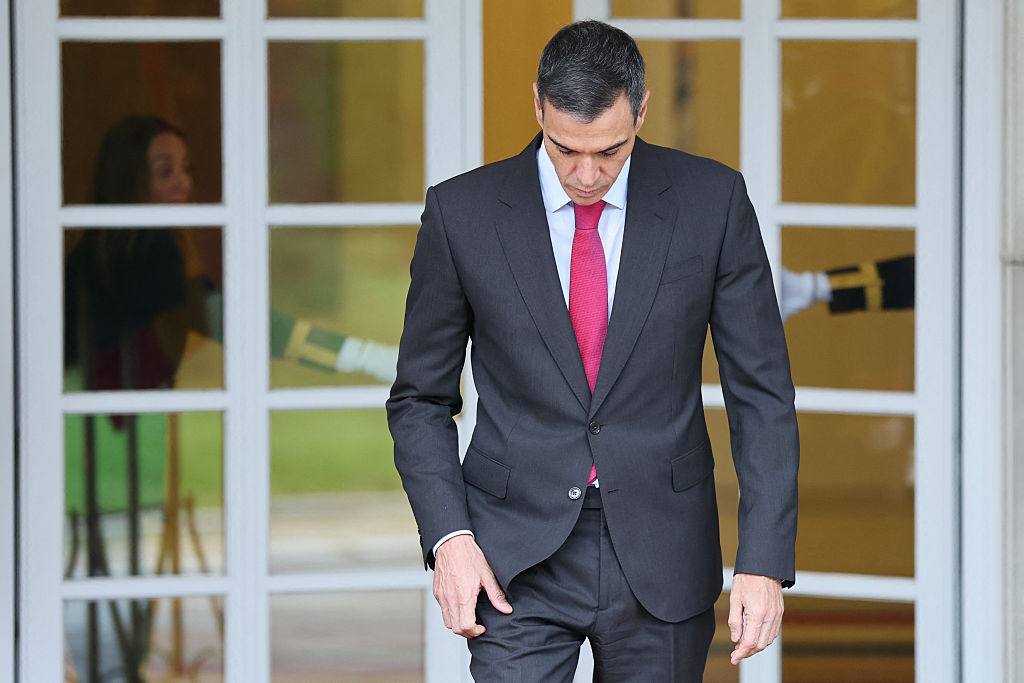
Polls suggest the right-wing alliance is set to win Spain’s November 29 election. While Premier Pedro Sánchez has won plaudits for his criticisms of Donald Trump and Israel, in recent years his government has struggled to deliver practical change. (Thomas Coex / AFP via Getty Images)
In recent years, Pedro Sánchez’s Spanish government, formed by his Socialists (PSOE) and the left-wing alliance Sumar, has been a reference point for the global left. Rarely among social democratic politicians, Sánchez has become well-known for his confrontations with Donald Trump and Benjamin Netanyahu, and for his governing coalition’s progressive social and economic policies.
However, Spain’s government could soon fall into the hands of a new alliance of the conservative Partido Popular (PP) and the far-right Vox party. At least, this is what almost all polls now suggest, less than two weeks before the general election on November 29.
There are many reasons for the electoral weakness of the PSOE and its further-left allies, now grouped in the Frente Amplio alliance. The broad-left government had already lost its majority in parliament in 2023, forcing it to rely on the votes of regionalist parties. But it has also been hit by its own mistakes as well as a ruthless offensive by traditional Spanish elites.
Here are six reasons why the snap elections on November 29 could force Sánchez from office.
1. Complicated Parliamentary Arithmetic
After the last general election in 2023, Sánchez only remained prime minister thanks to an eclectic coalition of progressive parties and Catalan, Basque, and Galician nationalists, including conservatives. They were united only by fear of a PP-Vox government that would be very hostile to the cultural and national diversity that defines Spain.
Because of the tight electoral results in 2023, the current legislative term has been marked by parliamentary instability and by a no-holds-barred war by the Right against a government that it considered illegitimate from the outset due to its reliance on parties who want independence from Spain. That dependence on conservative formations such as Catalonia’s Junts and, to a lesser extent, the Partido Nacionalista Vasco (PNV) has forced the government to lower its ambition regarding some laws and has cost it important votes in Congress, especially on housing issues.
The most serious parliamentary defeat came this October, when PP, Vox, and Junts together rejected two emergency decrees on housing tabled by the government following the eviction of an eighty-seven-year-old woman in Madrid and the subsequent massive demonstrations for the right to housing. Much of the mobilization centered on the government’s inability to curb rents. However, Sánchez also called this snap election hoping that the debate on housing would distract attention from the migration crisis in Ceuta.
2. Stormy Relations With Catalan Conservatives
Among the numerous parliamentary groups on which the PSOE-Sumar coalition government depended, the one that has set the highest price for its support has been Junts, a Catalan party which supports pro-business economic policies.
This party is led from exile by a former president of the Catalan government, Carles Puigdemont, who until last month feared arrest over his role in organizing the unofficial 2017 independence referendum. Following the 2023 general election, Junts set a price on supporting Sánchez’s investiture as head of government. It said it would only vote to keep him prime minister in exchange for an amnesty law that ended the judicial prosecution of Catalan pro-independence leaders.
The approval of the amnesty law in 2024 unleashed a nationalist campaign by the Spanish right, which considers the pro-independence supporters “coup plotters.” This conflict, too, fed Spanish nationalist party Vox’s electoral rise. The PSOE lost the support of numerous voters, and the Right exploited to saturation the idea that Sánchez has no principles and is capable of doing anything to stay in power. The Supreme Court, controlled by a judiciary heavily tilted to the right, has battled to prevent the full application of the law, but it has ended up being applied by order of the Constitutional Court.
3. Lawfare and Corruption
The justice system has been one of the main arenas of a fierce opposition to Sánchez. Right-wing ideas are clearly overrepresented in the Spanish judiciary: the two conservative judicial associations gather more than 40 percent of judges, while less than 10 percent belong to the only progressive association (the rest are not part of an association or belong to smaller groupings). To this unbalanced picture is added the growing shamelessness of the most reactionary judges in using the justice system for political ends. This is already shown by the judicial harassment against left-wing party Podemos and, more seriously, against Catalan independence supporters.
Various conservative judges have initiated proceedings of dubious justification against Sánchez’s brother and wife, confirming, in the eyes of the right-wing electorate, the idea that the Socialist prime minister is surrounded by corruption. The accusation is especially damaging because Sánchez himself reached the head of government in 2018 thanks to a motion of no confidence after the then-ruling PP was convicted in a serious corruption case. Unfounded accusations against Sánchez’s relatives have been mixed with real cases that have contributed to damaging his popularity: his former number two, ex–Minister of Development José Luis Ábalos, has been sentenced to twenty-four years in prison for taking bribes and awarding public contracts for the purchase of masks during the pandemic, and Santos Cerdán, who was also the PSOE’s organizational secretary, is likewise being investigated for corruption.
4. Insufficient Action on Housing and Inflation
The PSOE-Sumar coalition government has managed, despite its parliamentary weakness, to approve important measures such as increases in the minimum wage, the expansion of paternity leave, a boost to pension rates, and a law — albeit an insufficient one — to regulate rental prices. These added to the labor reform that has reduced temporary employment and the creation of a minimum living income to fight poverty, both introduced during the previous PSOE-Podemos government (2020–23). In addition, the macroeconomic data is good: Spain has for years been top of the table for GDP growth among the major European economies, and unemployment is at its lowest level since 2008.
However, a large part of the working class has seen its standard of living worsen. The minimum wage has risen almost 75 percent since 2018 (from €858 gross to €1,500 per month), but it has not pulled up wages in general: according to the Juan de Mariana Institute, three out of four wage earners earn under twice the minimum. Meanwhile, inflation reached close to 5 percent this October, and food has become 41.5 percent more expensive since 2018. Even more serious is the escalation of rents, rising 43 percent on average in a decade; in large cities, renting an apartment is equivalent to 100 percent of a young person’s income.
The housing situation, which is the main problem for Spaniards according to all polls, translates into more than forty evictions per day, despite the fact that Sánchez promised that this parliamentary term would be “the legislature of housing.” The explosion of the housing movement in recent weeks, which has included the first general strike on this issue in the history of Spain, demonstrates the failure of the coalition government in this key area for the Spanish working class.
5. Immigration and the Rise of Vox
The worsening of the material living conditions of much of the middle and working classes has opened up space for Vox’s racist messaging, which has only in recent years managed to sink roots among the lower-income electorate. The sudden entry of more than seventy thousand migrants into Ceuta (Spain’s North African enclave) on July 30–31 seemed to confirm Vox’s rhetoric, which warns of a supposed migrant “invasion.”
Santiago Abascal’s Vox has turned the rejection of immigration into its absolute priority, with a discourse that connects it with crime, even though the latter has declined while the number of migrant workers has grown. Its radicalism is akin to that of Germany’s ultranationalist Alternative für Deutschland: in 2025, Abascal incited the racist riots in Torre-Pacheco (Murcia), and a spokeswoman advocated the “remigration” of between seven and eight million people, including Spaniards descended from foreigners.
As in other European countries, the conservative PP has contributed to normalizing Vox’s discourse, forming governments with it at the regional level (in Spain’s so-called autonomous communities) and hardening its anti-immigration line. Driven by the reactionary wave that began with Donald Trump’s reelection in 2024, Vox is approaching 20 percent in polls, and no one doubts that it will form a coalition government with Alberto Núñez Feijóo’s PP if the results allow it.
6. A Divided and Weak Left
Sánchez could reestablish his coalition government in 2023 thanks to the electoral comeback achieved by his PSOE, but also by Sumar, the formation led by Deputy Premier Yolanda Díaz, which scored 12 percent of the vote. Podemos, which split from Sumar, today has only a small parliamentary representation. For several weeks in October, the alternative left starred in a real soap opera about whether it would form a single candidacy. It was even mooted that such a list would be headed by Gabriel Rufián, of Esquerra Republicana de Catalunya (ERC), the most popular politician to the left of the PSOE in all of Spain, despite his pro-independence stance.
Finally, a coalition called Frente Amplio was formed, led by former Barcelona Mayor Ada Colau and including fifteen parties. Podemos refused to join the Frente Amplio despite the great similarity between their programs, and now Podemos is polling under 2 percent support. This division has aggravated the disenchantment of the left-wing electorate. It also reduces the chances of a new broad-left majority, since the electoral system penalizes parties with few votes spread across many provinces, such as Frente Amplio and Podemos.
Less than two weeks before the elections, Frente Amplio is aiming for 10 percent of the votes, which would give it between fifteen and twenty seats. But if Colau’s candidacy sinks, even if the PSOE has a decent result, there will hardly be a parliamentary majority willing to keep Sánchez as prime minister. Paradoxically, part of his Socialists’ now-scant hopes lie in the good prospects for Euskal Herria Bildu (in the Basque Country), the ERC (Catalonia), and Adelante Andalucía, three left-wing sovereigntist formations that are growing in the polls and would also vote in favor of Sánchez returning as premier.
But Nothing Is Set in Stone
To these structural factors was added, a few weeks before the elections, a collision between two trains that caused sixty-nine deaths. This was the second high-speed accident in a year, revealing the deplorable state of the country’s railway infrastructure. The disaster prompted the resignation of Transport Minister Óscar Puente, a Sánchez loyalist.
In addition, the accident has weakened one of the PSOE’s main lines of argument: the defense of public services against the “chainsaw” of the Spanish far right, which admires the ultra-free-marketeer economic policies of Argentina’s President Javier Milei.
At the time of writing, almost all polls show a considerable majority for the right-wing camp, but they also detect a recent rebound by the PSOE. Both the Socialists and the Frente Amplio want to believe in a scenario like 2023, in which the charismatic Sánchez’s effective campaign and fears of the Right ended up mobilizing the broadly left-wing electorate.
However, the government parties would today need to recover much more ground during the campaign than they managed in 2023. A long-enduring right-wing campaign to delegitimize the government, Vox’s strength, and the sustained wear and tear of office means that, for now, the most likely outcome is that Spain loses its luster as a model for the Left.