Spain’s New Protest Movement Is Putting Class Center Stage

The occupation of Madrid’s Puerta del Sol by housing protesters has brought back memories of the anti-austerity revolt that began in 2011. But where the Indignados used generic populist language, this new movement has a clear left-wing focus on class.
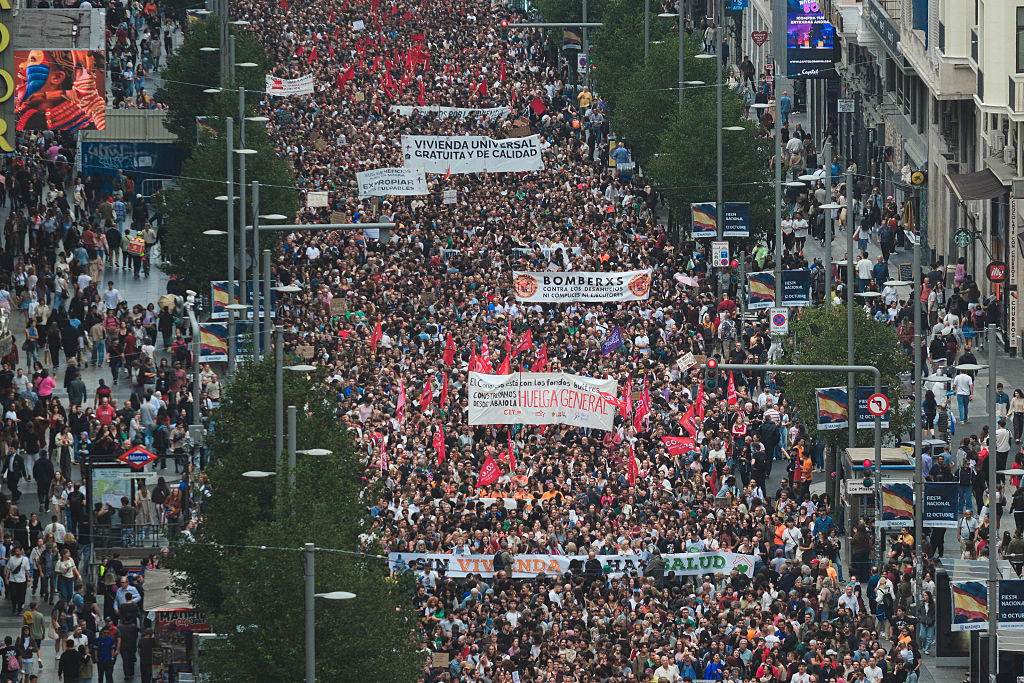
Demonstrators gather in Madrid’s city center during a housing rights demonstration outside Madrid City Hall in Madrid, Spain, on October 3, 2026.

The eviction of eighty-seven-year-old Maricarmen Abascal has sparked massive protests in Spain. Rather than a return to the square protests of the 2010s, this movement voices discontent at the left-wing parties’ record in power. (Enrique Romanos Tardio / NurPhoto via Getty Images)


Fifteen years isn’t enough for a generation, but it seems it is the right amount of time for a “political cycle.” In Spain, activists and progressive academics have in recent years often spoken of the exhaustion of the political cycle that began with the Indignados protests, known as 15-M (so named after May 15, 2011, the first day of protest), and continued with the foundation of Podemos and its rapid growth, until the formation of the first broad-left coalition government. This cycle has borne many results but eventually bred growing discontent at the limits of government policy.

Today we may finally see the beginning of a new political cycle: one that, to paraphrase Karl Marx, wears the robes of the foregoing political cycle, while in fact carrying a more radical content. Curiously, the starting point of the 26-S protests (from September 26, the first day of square occupations after massive protests called by the tenants’ union, Sindicato de Inquilinas) shares the same symbolic rallying place as 15-M, the Puerta del Sol in central Madrid.

But while full of references to that historic protest event, the mobilization sparked by the eviction of the eighty-seven-year-old Maricarmen Abascal by an investment fund is remarkably different from its forerunner. It provides a perfect summary of how much road has been traveled since 2011 and how much remains to be traveled. Most important, it tells us what kind of road may lie ahead for popular movements, during and after the elections that have now been called for November 29.

Same Place, Different Story

For 15-M veterans who visit the new encampment that has sprung up in the Puerta del Sol, it feels both like complete déjà vu and something markedly unfamiliar.

The pop-up tents clustering under the iconic clock tower bring back memories of the mobilization sparked by the 2008 financial crisis and the austerity measures that ensued. Back then, it led to a large wave of protests, inspired by the Arab Spring, which saw anti-austerity and pro-democracy camps in Greece, Spain, Britain, the United States, and elsewhere. There are the same blue tarpaulin covers in a similarly haphazard setup. Still, many other things, from the messages on the signs and banners to the slogans and the content of the assemblies, look strikingly different from 2011.

This divide speaks to how different the Spain of today is from the one that exited the financial crisis. It’s well summed up by the many impromptu speeches staged on the edges of the square in front of a packed crowd. A tenants’ union organizer from a working-class neighborhood of Madrid relates the strenuous fight against evictions, amid a wave of gentrification provoked by the influx of young professionals, themselves escaping rising prices in central Madrid. He recounts how recently one such eviction was stopped thanks to a strong mobilization by locals.

What we need, he adds, drawing out the moral of these experiences, is “organization of the working class.” In the background, a large banner states that the only response to speculation is occupation (with the “k” of the okupa movement). The speech is mixed in with chanting from the crowd, proclaiming, “Long live the struggle of the working class,” “How ashamed I’d be if I were a cop,” “And here are the anti-fascists.” All around the camp, we see banners of organized left groups such as the Confederación Nacional del Trabajo (CNT), the circled “A” of anarchism, the radical-left Coordinadora Juvenil Socialista, flags of Palestine and of the Spanish Republic, and the narrow alleys through the tents named after Mikhail Bakunin or Rosa Luxemburg. Such avowed connection to the traditional left makes for a very different symbolic and political landscape from the one seen here fifteen years ago.

From Leaderless People to Organized Class

Where 15-M protests were instinctively “populist” — or better, “citizenist” — hoping to include virtually any citizen, irrespective of class background and political views, this new wave of protest makes clear reference to a working class, identified with a sense of having the future stolen, most clearly in a rapacious housing market. It is not a movement for democracy and against austerity like 15-M was, but a movement around housing. It’s a burning problem especially in large cities, infested by hordes of tourists and short-term rental platforms. It’s also a summary of everything that is still going wrong despite eight years of center-left government.

Where 15-M was famously anarchic organizationally, rejecting leaders and formalized structures but adopting an assembly democracy with a panoply of committees and working groups charged with the most disparate tasks, 26-S is organizationally structured around a tenants’ union, with leaders and spokespersons and a remarkably coordinated strategy. The 15-M protests were heavily concerned with respectability, with not being seen as too radical and militant, and wherever possible avoiding verbal or physical confrontation. Conversely, housing protests are animated by a strong antagonism, sometimes expressing itself in overt defiance of security forces, born out of an experience of profound embitterment with living conditions.

Perhaps most evidently, this is also a movement that makes no secret of being of the Left. It is proud of its history and of its emblems, whereas the 15-M movement instead studiously tried to avoid traditional political symbols, which were felt to be too identitarian and thus exclusive of the nonpoliticized majority. There are of course many elements of continuity between the 15-M protests and the current ones. For a start, they have exploded not under a right-wing government but under a Socialist government and are animated by discontent at the shortcomings of the Left in power. Further, they are informed by the long legacy of Spanish popular movements, by reminiscences of the Second Republic of the 1930s, and by the well-known spirit of conviviality of Spanish society. In many other respects, this seems to be a wholesale departure from the radically inclusive and anti-militant spirit of the 15-M.

This speaks to the radically different conditions compared to what people experienced in 2008. The problem is no longer austerity and mounting unemployment (Spain is amid an economic boom and registering record employment numbers). Rather, the problem is that despite some progressive government policies, living conditions and the housing situation have only gotten worse, partly because of the present boom, with both housing prices and rents surging beyond all measure. Tenants are now forced to pay as much as 70 percent of their earnings to their landlords in rent or forced to move from the neighborhoods where they grew up, to make space for tourists, wealthy immigrants, and digital nomads.

Prime Minister Pedro Sánchez may well celebrate the impressive macroeconomic performance of his government, in the fastest-growing economy in Europe. But many feel bitterly disappointed by this kind of Left. Hence the spirit of this movement, its combination of rugged antagonism and strategy of relentless pressure on the political class. At once more radical and less idealistic than their forerunners, these protests are no longer about democracy, but about power, and the claim that nothing can be changed without solid organization. If that bothers other sections of society, well, tough!

Hope and Failures

“Where is the progressive government?” asked another chant, in an ironic snub to Sánchez’s preferred term for his coalition government. Snap elections called for November 29 could well mark the end of its time in power. The new protest wave is by and large motivated by discontent at what the previous political cycle achieved through its strategy of electoral politics, at the many problems that were not resolved, and at the many new social issues that seem to have ballooned.

This discontent may sound curious for people outside of Spain and for left-wing movements that have not had the same luck as their Iberian counterparts. Indeed, the 15-M political cycle has been in many respects the most impressive and consequential chain of events for post-2008 left-wing mobilizations in the West: starting from the streets and leading to the creation of a new left party and the formation of a coalition government. It has delivered comparatively progressive social policies, such as a significant increase in the minimum wage. However, what has become even more apparent with a relatively progressive government is that many social problems have gotten so deep that the mildly reformist policies offered by the technocratic policymakers of Sánchez’s Socialist Party (PSOE) are no real cure.

Housing policy is the most evident demonstration of how reluctant the PSOE is to break with the powers that be and resolutely take the side of working people. In a country where massive tourism has traditionally gone hand in hand with real estate bubbles, the PSOE has continued to harbor fears of antagonizing large investment funds and homeowners. Its housing minister, Isabel Rodríguez, one of the most unpopular ministers in the entire government and the owner of multiple apartments, came under fire in 2024 for suggesting that the solution to the housing crisis would come in the form of homeowners voluntarily keeping prices low. Meanwhile, the radical-left parties Podemos and Sumar have increasingly focused on housing — an issue that significantly affects their mostly young and urban base — while invariably disagreeing on both strategy and tactics.

Sánchez’s response to the protests was fast but underwhelming. Instead of just one royal decree named after Maricarmen, his government has produced two. One contains a string of pork-barrel measures, designed to be accepted by its Catalan- and Basque-nationalist right-wing allies. These include new fiscal subsidies for homeowners, alongside a temporary ban on evictions and an extension of existing rental contracts. The other contains more radical and structural measures, such as rolling rental contracts. The opposition of the right-wing Catalan party Junts, whose votes would have been necessary to pass the measures, ensured neither proposal would be approved by parliament.

This moderation partly reflects the weakness of the outgoing government, with its knife-edge parliamentary majority. But it also points to the deeper political ills of the PSOE and of its instinctive social liberalism, ever afraid of going against what “the market” supposedly dictates, except for some technocratic adjustments and subsidies available only to those able to process the right paperwork. Behind this is a further reality: the PSOE’s social base is largely composed of homeowners, many of whom have rejoiced at the rising financial value of their homes due to real estate appreciation over the last eight years. Some may fear that their property values will be dented if vulture funds are kicked out of the market and stronger measures in favor of tenants are adopted.

Ultimately, an increasing number of people, and especially young Spaniards in urban areas that find themselves under the assault of financialization with no serious government response, have realized that there is no way out of this low in the political cycle and the PSOE’s snail’s pace, except for mobilization and organization. They understand that the only way to avoid this disappointing government being followed by a reactionary one, headed by the conservative Partido Popular and far-right Vox, is to reclaim the initiative, the streets, and the squares.

The movement has already achieved impressive victories, such as the promise that Maricarmen — the pensioner whose eviction sparked the protests — can go back to her home. But to borrow some of this mobilization’s language: winning the long battle will require much more class struggle, and certainly more organization of the working class.

In the meantime, housing may be the issue that dominates the coming election campaign.