Spain’s Radical Left Is in Trouble but Not Defeated Yet
In Spain, labor minister and Sumar leader Yolanda Díaz says she won’t run for office again. Yet while she is stepping aside, there are also growing calls for a united left-wing front to fight in next year’s general election.
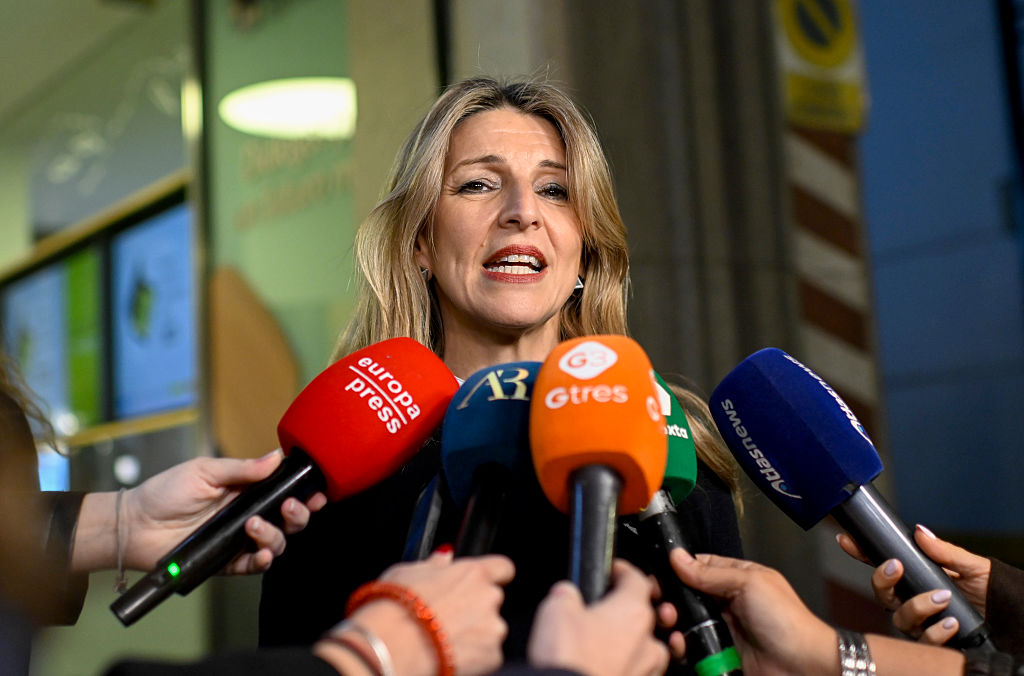
The radical left is divided between Podemos and Yolanda Díaz’s Sumar, both rock bottom in polls. (Alberto Ortega / Europa Press via Getty Images)
On Wednesday, Spanish labor minister Yolanda Díaz announced that she won’t be a candidate for office again in 2027. Long a popular representative of the radical left, Díaz’s decision to step back strikingly illustrates the troubled waters in this political space ahead of next year’s general election.
Díaz is the founder-leader of left-wing alliance Sumar, the junior partner in the national government headed by Pedro Sánchez’s Socialists (PSOE). Her presence in government alongside four other Sumar ministers has been key in pushing Sánchez’s administration toward better positions than his European counterparts on both domestic and foreign policy.
For many on the European radical left, Díaz — and even the government as a whole — has an enviable record. Since 2020, after all, this government has strengthened workers’ rights, raised the minimum wage, pushed the green agenda, imposed a partial arms embargo on Israel, and done much more than other NATO states to resist the rise in military spending imposed by Donald Trump.
However, a closer look reveals a less flattering picture. The radical left is divided between Podemos, which is unsuccessfully trying to articulate a left-wing opposition to the government, and Sumar, which is today unable to impose ambitious policies on the PSOE to stop the rise in housing prices and the cost of basic goods. Both Podemos and Sumar are at rock bottom in polls, with Díaz’s coalition around 6 percent of voting intention and Irene Montero’s party at 4 percent. This adds to the weakness of the PSOE, today polling around 26 percent. In short, despite good news that can be cited, the electorate is no longer happy with this government.
Right-Wing Offensive
All polls show that if there were a general election (scheduled for the summer of 2027), the conservative Partido Popular and far-right Vox would win a majority, totaling around 50 percent of the vote. No one doubts they would govern together, as they already have in several regions. It’s not just the polls: the PSOE scored the worst results in its history in the recent regional elections in Extremadura and Aragon, where Vox surged. The former is a traditional PSOE stronghold, while Aragon is considered the “Ohio” of Spain — a bellwether whose own election results most closely mirror national ones. In both regions, the Partido Popular governs with the support of Vox, a pattern that will likely again be replicated.
The Partido Popular and Vox have mounted a fierce opposition to Sánchez and his government since the 2023 elections, when the Partido Popular leader, Alberto Núñez Feijoo, already imagined that he was on the brink of becoming prime minister. The Partido Popular was the single most-supported party in 2023, but it failed to secure a parliamentary majority even with the help of Vox’s MPs. Defying the odds, Sánchez managed to assemble a complex parliamentary alliance with left-wing Sumar as well as Catalan and Basque nationalist parties.
Despite good macroeconomic data and a relatively positive balance sheet on public policies, the PSOE’s electoral prospects have plummeted due to its inability to solve the housing crisis — Spaniards’ number-one concern — and inflation. Added to this are corruption scandals involving PSOE leaders and cases of sexual harassment within the party organization. Besides, the PSOE’s concessions to Catalan nationalist parties — not necessarily allies — on issues like regional financing are being exploited relentlessly by the Right. They are starting to be criticized by parts of the PSOE itself, who believe Sánchez is sacrificing the party’s electoral future to maintain the nationalists’ support and hold onto power in the short term.
To add fuel to the fire, the conservative media and judiciary have launched a full-fledged campaign to delegitimize Sánchez and his government. The attorney general, appointed by Sánchez, was disqualified in November 2025 for revealing secrets, in a highly controversial ruling by the Supreme Court, which has a conservative majority and close ties to the Partido Popular. Sánchez’s wife and brother have also been targeted with dubious corruption accusations clearly aimed at weakening the premier and his government. The lawfare is mixed with solid indications of corruption affecting two former PSOE secretaries-general, ex-minister José Luis Ábalos and ex-MP Santos Cerdán, both close to Sánchez.
This tangle of scandals does not directly affect Sumar, but the continued presence of Díaz and four other ministers in the government contributes to the public lumping the two left-wing camps together. Furthermore, the ineffectiveness of the government’s measures to stop the rise in rents particularly punishes Sumar, which has a younger electorate with a higher proportion of tenants. At a time of great political disaffection in Spanish society, Vox is capitalizing on the discontent with corruption and the political class, while Sumar is perceived as just another party of the system, despite its only recent creation in 2022.
The division on the Left also feeds disenchantment. Sumar and Podemos reached a last-minute agreement in 2023 to run together in the general election, but it was only a brief pause in the clashes between the two groups. Podemos’s former leader, Pablo Iglesias, designated Díaz as his successor in 2021, but they soon grew apart, and the Podemos founder has spent years using his online television channel, Canal Red, to attack Sumar. Podemos, led by former equality minister Irene Montero, broke with Sumar shortly after the 2023 elections and has adopted a line of radical opposition to the coalition government, with little electoral success.
Alliances in the Making
Panic is spreading on the Spanish left at the prospect of a future national government including the far right for the first time since the democratic transition of the 1970s. Díaz has been an effective minister — she has passed labor reform that strengthens workers’ rights and has considerably increased the minimum salary, among other improvements — but she has been unable to obtain electoral benefits from government participation nor to maintain good relations between the diverse groupings on the Left.
The general feeling is that more than a reissue of Sumar is needed to avoid an electoral debacle that could result in the neofascist Vox leader, Santiago Abascal, becoming deputy prime minister. Compounding this is the pressure from the Spanish electoral system, which penalizes division. If there is more than one option to the left of the PSOE next time around, the number of seats for the broad-left bloc will be considerably reduced, making a further Sánchez government impossible.
The main parties that currently make up Sumar — Izquierda Unida, the Sumar movement, the Comuns in Catalonia, and Más Madrid — announced on Saturday that they will re-form the coalition for the next general elections, but they have not decided yet who will be their candidate. Some names that have been mentioned to succeed Díaz are the minister of social rights and consumption, Pablo Bustinduy; the former vice president of the Valencian regional government, Mónica Oltra; and the former mayor of Barcelona, Ada Colau. The decision will be made later, as the four parties are now focused on attracting more groups to their coalition, especially Podemos.
The embryo of a Sumar 2.0 coexists with a more surprising initiative taken by Gabriel Rufián, an MP in the Spanish Congress for the Catalan pro-independence party Esquerra Republicana de Catalunya (ERC). At a time when far-right discourse is occupying an increasing space in Spanish public debate — especially on immigration — Rufián has managed to carve out a niche for himself in the media and on social networks, where the far-right is stronger than the Left. Polls are showing his popularity on the rise. The Catalan MP has pushed independence into the background to adopt a combative class rhetoric, focused on issues like the cost of living and housing, which appeal to left-wing voters throughout Spain.
Rufián has called for the creation of a broad alliance of left-wing forces, including both nationwide and regional parties — which would be unprecedented. His first public event, alongside Madrid politician Emilio Delgado, has received a lot of attention, but his own party is wary of the initiative, which has also been rejected by both Bildu — the Basque pro-independence left-wing party — and Podemos. Rufián has received kind words from Sumar, but it is unclear whether it will be possible to reconcile the two proposals and to unite the Left to stand up to the far right at the polls.
Such is the complex situation on today’s Spanish radical left. Amid a lack of clear leadership and a wider polling decline, we now again have strong calls for unity and a diversity of possible solutions for building a more effective alliance. Yet there is also an open question over the timescale. The general election is scheduled for summer 2027, but pressure is growing for a weakened Sánchez to prompt an early vote. Only he knows whether he will make a surprise call for snap elections, as in 2023, or serve out the term despite his great parliamentary and political weakness. It’s another reason for the radical left to be uncertain about what its future holds.