On Strike for a Different Spain
Spain will see a general strike on Wednesday, following mass protests around housing. A member of Marxist group Coordinadora Juvenil Socialista discusses how these protests have cohered a militant class-based movement for more sweeping change.
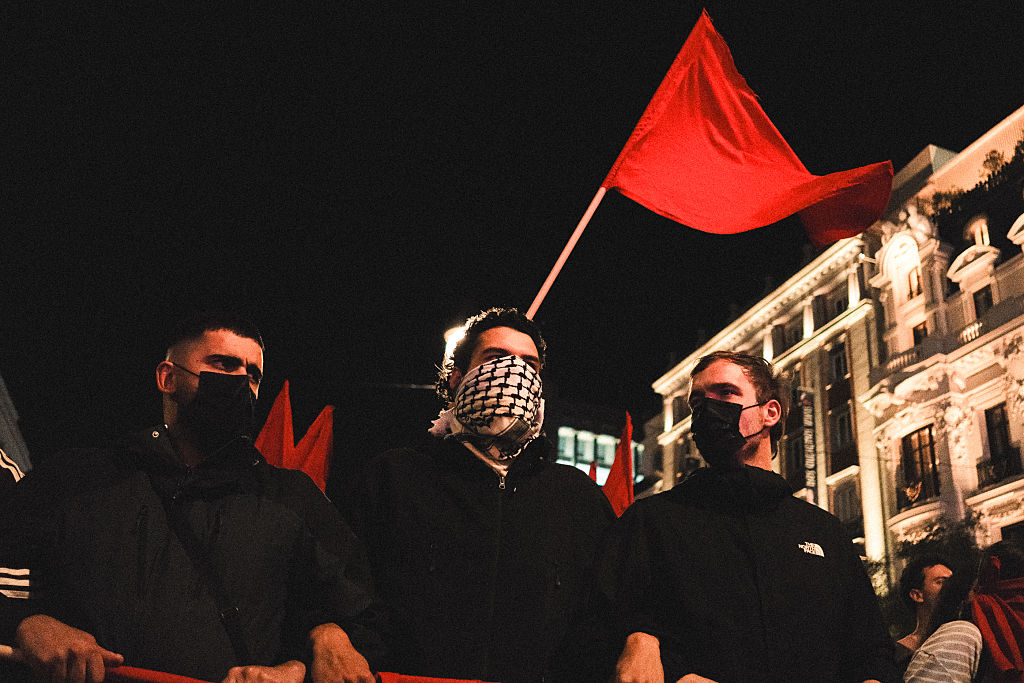
Marxist youth organization Coordinadora Juvenil Socialista has been a major force in the recent protests in Spain. (Enrique Romanos Tardio / NurPhoto via Getty Images)
- Interview by
- Chris Mills Rodrigo
Spain’s streets and town squares have been flooded with protesters this fall, since the brutal eviction and subsequent death of eighty-seven-year-old María del Carmen Abascal, known as Maricarmen. This September, she was removed from her Madrid apartment of some seventy years, after an investment fund quintupled her rent.
The marches and encampments, first called by Madrid’s tenants’ union, have primarily focused on Spain’s housing crisis. The situation has intensified over the last decade as rents have nearly doubled while wages have remained largely stagnant. The protests have already triggered a general strike this Wednesday, November 11, and snap elections called by Pedro Sánchez’s center-left Partido Socialista (PSOE) for November 29.
The promise of a strike and elections did not quell the protests. The encampment in Puerta del Sol in Madrid that kicked off this cycle remained active until police tore it down last week. Spin-off strikes focused on disinvestment in public education have closed down major motorways.
Comparisons to the Indignados protests (also known as 15-M) of 2011 come easily. Both kicked off with encampments in the center of Madrid and centered on housing affordability. And yet things are markedly different this time around. While 15-M aimed to include everyone regardless of class position and was organizationally anarchic, today’s protesters are speaking much more openly of class struggle and organizing themselves into people’s assemblies.
The prominent presence of the Coordinadora Juvenil Socialista (CJS, Socialist Youth Coordination) in the current protest movement is both emblematic of those changes and critical to understanding them. CJS is a Marxist revolutionary organization and part of the broader Movimiento Socialista (MS), a communist current that originated in the Basque Country in a 2018 split from the local left-nationalist front. Since its national inception in 2024, CJS has grown to over a thousand members all across Spain. It has been the most visible organization in the recent protests apart from the tenants’ unions and represents a militant left-wing flank not satisfied with letting this moment of upheaval be tranquilized by elections or tepid strikes.
Ahead of November 11, CJS has organized over a hundred youth strike committees aimed at ensuring the demonstration will be a class-based action that challenges rent-seeking, the current government, and capitalism itself. In an interview for Jacobin, Chris Mills Rodrigo spoke with a member of CJS, Mario Arguiriano, about the organization’s role in the recent protests and how it hopes to direct the anger and energy of the Spanish public into structural change. This interview was translated from Spanish by the author and lightly edited for length and clarity.
Chris Mills Rodrigo
Let’s start with the immediate context of what’s happening in Spain. Who was Maricarmen?
Mario Arguiriano
Maricarmen was a sick eighty-seven-year-old woman who had rented an apartment in the center of Madrid for seventy years. Not very long ago, the apartment was bought by a Spanish company called Urbagestión that basically wanted to kick her out to make money.
It tried to raise her rent by 500 percent, which she could not afford living on a modest pension, and a judge ordered an eviction. Maricarmen’s eviction was a brutal one in which over two hundred police participated. There was a lot of violence toward the people there defending her.
It makes sense that Maricarmen has become a symbol of a fight that confronts the public’s needs with the needs of the housing market and the minority of parasites that live off of speculation and extracting ever more of workers’ salaries.
Chris Mills Rodrigo
Why did her eviction provoke such a visceral response?
Mario Arguiriano
I believe that there exists and has been forming for years among the working class, especially among the youth of the working class, a wide dissatisfaction — with housing conditions, salaries, rising military spending, the genocide in Palestine, the authoritarianism of capitalist states, and also a dissatisfaction with [Pedro Sánchez’s] so-called progressive government. That dissatisfaction has taken on various forms when it comes to protests. Last year, there were massive solidarity protests with Palestine in Spain.
We could call Maricarmen’s eviction the spark that lit the prairie of dissatisfaction. After that, it was a good decision to steer the protests toward a more permanent form in the shape of encampments, which have allowed for the accumulation of strength and energy in the context of the fight for housing, which also goes further than housing to a more general indictment of the system.
Chris Mills Rodrigo
Housing has been a major focus of the protests and their coverage. But it sounds like your analysis is broader. How do you all understand the current conjuncture for the Spanish working class?
Mario Arguiriano
For us, the housing problem is an expression of both the functioning of capitalism and the crisis of capitalism in decline. We have low interest rates, which creates the conditions for overaccumulation of capital, causing idle capital to tend toward speculation on things like housing. The current “progressive” government in Spain is very comfortable targeting vulture funds, but if you look at the data, vulture funds represent a small portion of the housing market. What we have instead is a bourgeoisie and also a petty bourgeoisie, so to speak, that has found housing to be a comparatively lucrative investment and a way to suck the blood of those who need it.
The housing market under capitalism generally has an inflationary tendency because it’s based on a logic of rent extraction in which the best way to make the most profit is to have prices rise constantly. And, without grand historical struggles, that’s the way the market normally functions.
Today the market around housing is stimulated by governments exactly because it offers opportunities for business to a portion of capital that would otherwise be idle. These days in Spain — although this happens practically everywhere — basically any rich person you can think of owns fifty, one hundred, two hundred homes. [Diego] “Cholo” Simeone, the coach of Atlético Madrid, for example, owns more than 180 apartments. Amancio Ortega, the richest man in Spain, has a ridiculous number of apartments. It’s a general practice that can’t be reduced to vulture funds.
On the other hand, I’d say that the housing problem is also the problem of salaries. Salaries in Spain have been stagnant for decades, and, in fact, low salaries have been a structural element of Spain’s capitalist model forever. One of the primary elements that Spain offers international capital, at least since [Francisco] Franco’s time, is a structurally precarious labor market with low wages. We have had unending housing price increases like other European countries — especially in the last eight years with the progressive government. Even after it approved housing laws that it promised were historic, nothing has changed.
The problem of housing is also a problem of the authoritarian character of capitalist states. Without going too deep into it, the housing movement in Spain is one of the primary victims of the repressive laws that were passed by the last right-wing government and maintained by the progressive one. The Ley Mordaza (Gag Law) has permitted an increase in police power and fines. The housing movement has had to pay millions and millions of euros in fines over the last ten years based on this law that the PSOE and Podemos governments have maintained. So, as you see, if you start pulling on the thread of housing, you end up coming to more structural questions.
In fact, in the final instance, the problem of housing is the problem of capitalism and the capitalist form of the state. A government of workers could resolve the problem of housing quickly via measures like nationalizing land or other proposals we’ve made like expropriating speculators, prohibition of speculation on housing, and planning and distribution of housing geared toward social needs. That would solve the problem of housing and has happened in other countries starting with worse conditions. But those solutions aren’t accessible, aren’t feasible, at least not fully, under the capitalist form of the state.
It’s important to fight for short-term improvements without selling smoke to the public and without pretending that the resolution to these problems is simple, because while in the short term that can generate excitement, in the medium term it can generate demobilization, disengagement, and disenchantment.
Chris Mills Rodrigo
I’d like to hear a little more about what infrastructure CJS developed before the protests and how you put it into action.
Mario Arguiriano
CJS has had a brief existence, yet from the start we have insisted that our goal is to generate a mass communist organization, based on militancy and discipline. We’re radically opposed to forms of political parties opposed to what the working class needs, like the parties that keep popping up in Spain, formed of four famous people with wide media presence but lacking militant bases. So, from early on we have made clear that our objective, and the only route the working class has to reach revolutionary objectives and build strategic strength, is permanent, disciplined, and constant work out of the spotlight, out of the daily trends. This type of organization can later act appropriately in moments of rupture. I think we’ve had a strategy of patience and slow accumulation of strength aimed at building a revolutionary project.
We believe that recent events have shown that our model works — that an organization with clear strategic objectives, strong messaging, and a hardworking and disciplined membership that remains tactically flexible can make good use of big protest moments to share its message, reinforce itself organizationally, and reinforce the movement in general. We have presence in the majority of cities in Spain and are looking to reinforce our reserves in those cities and others where we don’t have a presence, in villages, and ultimately in all environments and spaces.
Chris Mills Rodrigo
What’s your relationship with the tenants’ unions that have also played a big role in these protests?
Mario Arguiriano
The tenants’ unions were the ones who organized against Maricarmen’s eviction, who initiated the protests, and even led on the creation of the encampments. We have never hidden that we have strategic differences with the tenants’ unions, which are a project more oriented toward reform than revolution. We have insisted to them that reform is important and we don’t reject it, but it’s important to orient them toward a revolutionary, emancipatory, or socialist project.
However, it’s clear that despite these differences, there’s space for joint work and unity of action in terms of protest and mobilization for worker interests. We’ve seen that these past days, and not just with tenants but also with many other actors. We have differences and strategic debates, but we can and should work toward basic common objectives without obscuring those differences, maintaining debate, and with liberty for everyone to espouse their own analysis and lift up their own projects.
Chris Mills Rodrigo
I’ve seen a lot of comparisons to 15-M. In what ways is that comparison accurate, and how is this movement distinct?
Mario Arguiriano
During the first few days of the encampments, the comparisons with 15-M were everywhere, but over time they started to disappear. Even the mass media, which is normally a medium of organized idiocy, has realized that this is something different, or at least that there are important differences.
I believe that the key social and historical difference is that in the last fifteen years we’ve seen a change in the composition of classes, or a change in class relations, that has essentially been a process of proletarianization of a sector of the middle class, especially in the sector that remains prominent in the protests: young people, normally with college degrees, that are part of, in their working conditions and in their relationships with capital, the working class.
In 2011, although we experienced a difficult crisis, the generation that led 15-M still lived accustomed to a period of expansion of the middle class and expansion of certain expectations. The best way to illustrate it is to say that during 15-M people protested not being able to buy a house, and today people protest not being able to rent a room. It’s normal that that difference generates a different political consciousness.
So in the current protests we see a much more positive opinion toward organization, working-class consciousness, the concept of the working class, and socialism. We’ve seen the normalization of red flags, chants like “Socialism or Barbarism,” and radical critiques of capitalism. This would have been unthinkable during 15-M. Communism was frowned upon, and there was broad skepticism toward the concept of organization.
There was also a much more interclass and less politically developed consciousness, without wanting to exaggerate the consciousness of the current encampments and protests — which remain a pluralistic space where many sectors, different organizations, and different levels of consciousness coexist. There are notable differences [with respect to 15-M] that even the smartest bourgeois thinkers are acknowledging.
Chris Mills Rodrigo
One impact of the protests is that there will now be general elections in November. How is CJS approaching those?
Mario Arguiriano
We will not participate in the elections, and we maintain a critical perspective on existing parties. We insist on the need to keep constructing a party of workers, and that none of the existing parties represent the interest of workers or are at the level needed to confront a capitalism that is increasingly catastrophic, linked to wars, genocides, and ecological crisis.
Chris Mills Rodrigo
Before the elections, there will be a general strike. How are you preparing for that day, and what are your objectives?
Mario Arguiriano
The general strike that has been called, which we will support with all our resources, is one where there will be two models of strike in dispute. One is the government’s strike, which is the model being pushed by the major unions — the Comisiones Obreras (CCOO) and the Unión General de Trabajadores (UGT) — which work like transmission cables for the state and the government. That is a strike against the political opposition and is part of a political campaign.
We believe that that model is an embarrassment, an insult to the concept of a general strike. Instead what should be created, by all organizations with a focus on class, is a class-based strike against the whole capitalist government. Strikes are spaces for working-class struggle against capital and capitalist states. That’s a general strike. Any model that supports one or another capitalist government is a farce and an insult to the Spanish working class. We want to insist on that in all kinds of spaces. Right now, you have to put in a lot of effort to impose a baseline of rationality in Spanish public debate, because we’re living through a process of the dumbing down of the public via crude lies.
Maricarmen was evicted with a PSOE law, under a PSOE government, by police under the PSOE, and it’s talked about like the [conservative] opposition killed her. This is not true. Any party in charge of the capitalist state will enact evictions because all of them reinforce the model of housing as a market, and we’re not going to let any of them off the hook. A few years ago, Podemos, which now presents itself as a left-wing party, argued that the current housing law was a panacea, that it had practically saved the working-class public of Spain with it. It’s delirious that it now wants us to forget that.
This strike by itself will not impose major demands. This strike should serve to build class power with the aim of an independent project and to stimulate fights for housing, improved salaries, and against the authoritarianism of capitalist states.
Within the strike, CJS will push the need to construct an alternative political structure for workers — not just strong unions but a party for workers. To achieve that, we will participate in broad committees and promote strike youth committees open to whomever.
Chris Mills Rodrigo
What’s the role of unions in the Spanish working-class struggle? I understand that the major unions are quite linked to the government, but is there a future where unions can be part of the fight that you’re starting?
Mario Arguiriano
Of course, there are numerous unions in Spain that have a focus on class and are engaged in righteous struggles for workers’ rights. And even in the membership of major unions like the CCOO, there are people who fight daily for workers.
We criticize the leadership of unions, which doesn’t represent the needs of workers. Unions are very important in working-class struggle; they should be organs for that and not for collaboration between classes. The leader of CCOO, Unai Sordo, wrote an article about the strike that is essentially apologia for the PSOE’s economic policy. How is it that you are going to go on a strike defending the government and its economic policies? We can’t accept this; it’s essentially an insult.
That’s how we approach the question of unions. We don’t denounce or disregard union work. In fact, we will work with class-focused unions to try to drive mobilizations separate from the mobilizations that will be apologia for the government, or that might even include government ministers. The idea that there could be ministers protesting against their own government could make anyone go nuts.
Chris Mills Rodrigo
When the protests and the encampments end, what’s the plan to keep the critiques that have been levied going?
Mario Arguiriano
In Movimiento Socialista, we plan to work around two axes. The first is to strengthen the working-class movement, collaborating with other actors like labor unions and tenants’ unions toward shared objectives. For example, it’s very important for us to create a wide front for political rights capable of confronting the state, its authoritarianism, militarism, and new repressive laws.
Our other axis of work, complementary with the first, is to keep working to build a mass revolutionary party, not only in Spain but across Europe and, ultimately, around the world. That requires diversified work: exposition of strategies, development of different tactics, and the production of a revolutionary political program in favor of a different form of state, a different mode of production, and a different way to live that the working class can coalesce around. We believe that is absolutely urgent. We have to fight at all levels, which includes the political. We have to counter-propose a workers’ program, a socialist program, against the program of capital.