Pedro Sánchez Makes His Last Gamble
Pedro Sánchez’s coalition won reelection in 2023 based on a real record of measures to rein in the cost of living. Pulling off the same trick now may be much harder, after three years of institutional inertia.
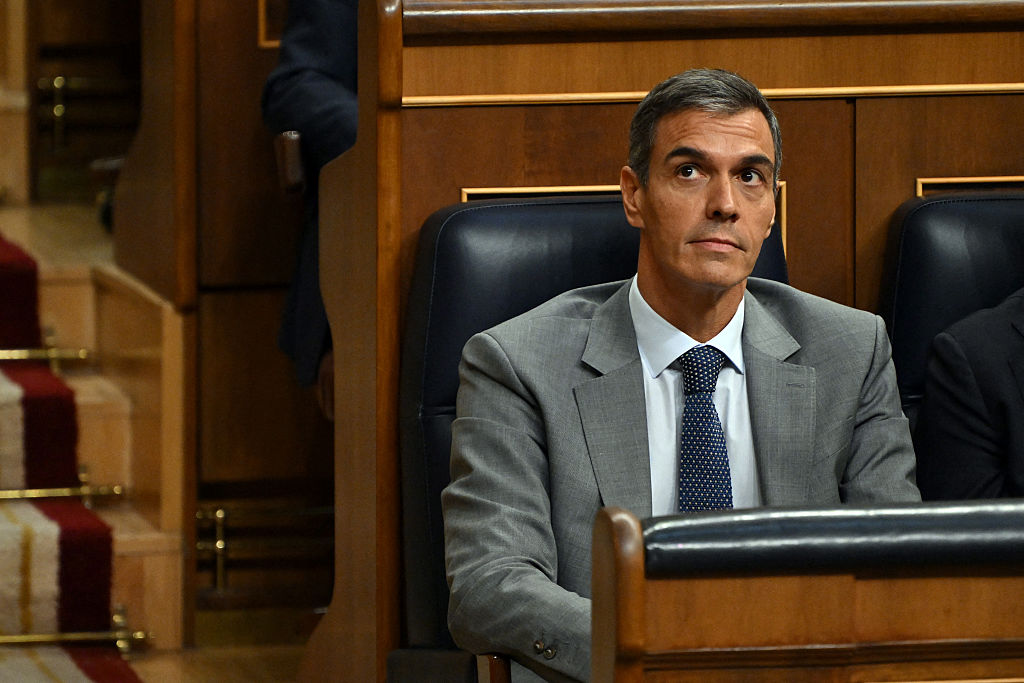
A critic of Elon Musk and Israel, Pedro Sánchez takes stronger moral stances than most social democrats. But his government has done little to meaningfully shift power in Spanish society and may pay the price for it in next month’s snap elections. (Javier Soriano / AFP via Getty Images)
Less than two weeks after a wave of housing protests broke out across Spain, on Monday center-left Prime Minister Pedro Sánchez called an early general election. Upending the country’s political agenda in just days, the protests created an opportunity for an embattled Sánchez to go to the polls on more favorable terms. He is now framing the election as a choice between his defense of the social majority and right-wing parties aligned with speculators and vulture funds.
This was a remarkable turn of events, especially as Sánchez’s government had been in the firing line of housing protests just days before. The eviction of eighty-seven-year-old Maricarmen Abascal from her Madrid apartment on September 23 had ignited the largest protests Sánchez has faced from his left flank during over eight years in office. Tens of thousands marched through Madrid three days later, before the Sindicato de Inquilinas (the city’s tenants’ union) set up a sprawling protest camp in the iconic Puerta del Sol square, with similar encampments then springing up in other cities — echoing the Indignados occupations of fifteen years before.
Protesters demanded to know “Where is the progressive government?” and tenants’ union spokesperson Valeria Racu warned: “Either rentierism ends, or the government falls.” They were right to be angry: rental prices in Spain have increased 87 percent in the last decade, nearly three times as fast as wages.
Yet by last Friday, attention had shifted to Congress, where Sánchez’s minority coalition government looked to rush through a raft of measures to offer tenants necessary but temporary relief, such as a two-year extension on all expiring leases and stronger eviction protections up through 2030. The package also included changes aimed at plugging some of the holes of the existing rent control legislation. With the tenants’ union calling on lawmakers to support the measures, Sánchez laid down his marker, claiming the vote was “the moment of truth” to see whose side parties were actually on.
As the right-wing Catalan nationalist Junts cast their swing vote to block the measures, Sánchez had his opening. Having been on the back foot over his management of the Ceuta migrant crisis since the summer and trailing in the polls, he is betting that in a snap election, his Socialist Party (PSOE) can rally a broad progressive electorate amid a moment of intense social mobilization. But fighting his sixth general election in eleven years, he will need to pull off his most impressive comeback yet to ensure a hard-right coalition is not installed by Christmas.
Housing or Migration
Indeed, the latest polling from El País (conducted prior to the elections being called) shows the conservative Partido Popular (PP) and far-right Vox on a combined 50 percent of the vote compared to 36 percent for the broad-left bloc, with the remaining votes largely going to regional parties and a further two percent for the fringe alt-right Se Acabó La Fiesta (“The Party Is Over”). Vox looks likely to be the major beneficiary of the November 29 election, jumping from 12.4 percent of the vote in 2023 to 18.4 in the El País poll.
In recent months, this far-right party has continued to gain ground against a backdrop that, until the housing protests, had been dominated by the fallout from the mass influx of migrants to Ceuta this summer. The dramatic images, late this July, of an estimated 72,000 people streaming in from Morocco to Spain’s north African exclave were immediately seized upon by Vox and its media allies as they imposed a narrative of invasion and national betrayal across the broader right-wing bloc.
In this respect, the election campaign looks set to largely play out around two competing frames: an anti-migrant narrative seeking to stoke further moral panic over Ceuta, and a class-based one targeting landlordism and housing speculation. Vox leader Santiago Abascal set out on Monday the three conditions for a right-wing coalition government with the PP, insisting it accept its policies of “national priority,” i.e., giving Spaniards preferential access to public services and welfare benefits, deregulation, and forced “remigration.” Furthermore, with at least ten thousand migrants still in Ceuta and the tiny exclave’s resources under considerable strain, the unresolved crisis remains a flash point the far right is likely to further exploit during the campaign.
Yet with the housing protests reaching new heights over the weekend, and with Spain’s two main trade unions agreeing to a one-day general strike for early November in support of their demands, the Right may struggle to shift the focus away from housing in the weeks before polling day. For Sánchez and his left-wing coalition partner Sumar, however, turning this opening into electoral support requires winning back voters demoralized by their grueling second term in office, which has failed to deliver the kind of substantive social policies seen in its first term. The coalition government’s dependence on parties outside the Left for its parliamentary majority since 2023 has blocked much of its reform agenda, and PSOE corruption scandals have only compounded voter frustration. Meanwhile, its principled stands against the genocide in Gaza and the US-Israeli war on Iran have provided only intermittent political momentum.
As a social democratic politician whose instincts were honed through a near decade-long battle to hold off Podemos’s left-populist challenge, Sánchez is the center-left leader in Europe most attuned to the need to represent and mobilize rather than simply retreat behind claims of responsible governance. In his address to announce the early election, he framed his decision as a bid for “a much broader, progressive majority with which to bring the elites to heel. . . . and continue transforming Spain.”
Sánchez deployed this type of anti-elite rhetoric earlier this year against what he described as “the techno oligarchs” and relished online confrontations with Elon Musk. Now it is being extended to also confront the vulture funds and large landlords. Sánchez is adept at projecting moral conviction, no matter the contradictions of his own record. The test now is whether he can convince broadly left-wing voters that naming these enemies signals a new willingness to push through reforms that challenge their power. Even in the coalition’s first term, when it had a more favorable majority, his party operated as a constant break on his partners’ demands for comprehensive rent controls.
A Broad Front?
In this respect, the housing protests should, in theory, represent a particular opportunity for the radical left. Yet after six years as junior coalition partner to PSOE, it is bearing the brunt of progressive voters’ disillusionment. Unlike in the 2023 election, when Sumar’s Deputy Prime Minister Yolanda Díaz could run on her record of pro-worker labor reforms and cost-of-living measures, the radical left has very little to show for having remained at cabinet for the last three years.
Now, eight weeks out from polling day, the radical left lacks both a clear leader and an agreed electoral formula that can bring together Sumar, Podemos, and various regional left-wing parties after years of debilitating factional conflict. As before the 2023 elections, it faces a race against the clock to negotiate a viable arrangement before the October 16 deadline.
The candidate with the broadest appeal across the rival factions, Minister of Social Rights Pablo Bustinduy, has repeatedly ruled himself out, including in an interview just last weekend in El País. Choosing another Sumar figure already in government, such as Minister of Health Mónica García or Minister of Culture Ernest Urtasun, risks tying the new alliance too closely to Sánchez and the coalition’s record, making it harder to offer disillusioned left-wing voters a distinct political alternative. In this respect, a ticket led by former Barcelona mayor Ada Colau could offer a different profile, combining her roots in housing activism and evident political charisma to reengage the Left’s base.
Colau has made her candidacy dependent on the negotiation of a “truly broad” left front that would also include Podemos. Yet securing joint lists remains difficult, particularly in the capital, where Más Madrid (one of the leading forces in the old Sumar alliance) has been the most resistant to both an agreement with Podemos and its proposal for open primaries. Given the tight time frame, organizing such primaries looks difficult. On Wednesday, Más Madrid publicly backed Colau as the national candidate for the first time, but as a quid pro quo in which it insisted it get the first four spots on the Madrid list, which would essentially exclude Podemos from securing representation there.
Even as these negotiations seem stuck, a last-minute move by the popular Catalan left-nationalist Gabriel Rufián cannot be ruled out as an alternative to Colau topping the list. One of the few left-wing politicians able to break through with younger voters and compete with the Right on social media platforms like TikTok, he is once again flirting with the idea of breaking with his party Esquerra Republicana to front the Left’s list. That would be quite the leap for a figure who first became a household name nearly a decade ago as a leading voice of the 2017 Catalan independence referendum — underscoring just how chaotic the Spanish left’s position is as it seeks to put together a viable candidacy.
In polling, Sumar is currently on 5.6 percent and Podemos 2.7 — down from their combined 12.3 percent vote in 2023. Any hope of an upset, again holding off the right-wing bloc, would require a surge back to these past scores, and quickly. The stakes of overcoming those divisions are clear. As political strategist Iván Redondo argues, Sánchez has “no chance whatsoever of forming a government” if the combined PP-Vox vote exceeds 47 percent, whereas pushing it a little below that would reopen the possibility of a progressive majority perhaps again reliant on hardly-left-wing regional parties.
This is a daunting task even as the housing movement has given the Left a chance to fight the election on favorable ground. The right-wing bloc’s lead is currently double what it was in 2023, when the left-wing coalition parties pulled off a major upset to deny the PP-Vox duo the chance to govern. Without a dramatic shift in the coming weeks, Spain’s run as an outlier in Europe looks set to end.