Spain Shows Europe How to Oppose Trump’s Illegal War in Iran

Donald Trump is angry because Spain’s prime minister, Pedro Sánchez, hasn’t backed the war on Iran. Sánchez’s stand is hardly radical, but it seems like it now that almost all of Europe has fallen in behind Trump.
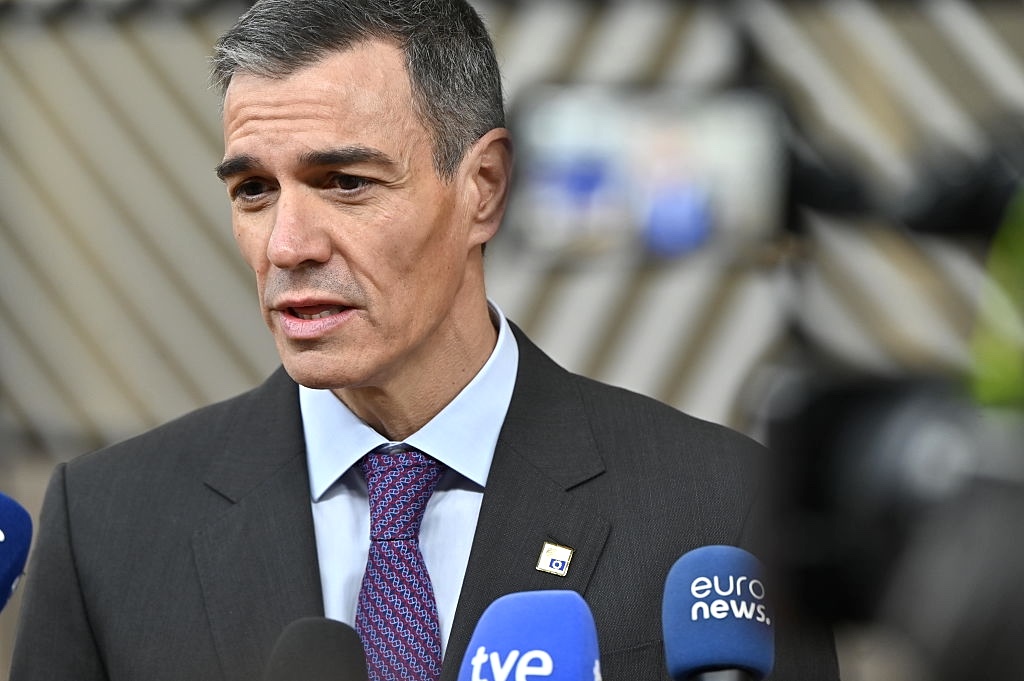
The response of Pedro Sánchez’s Spanish government to the US and Israeli attack on Iran differs radically from that of other European countries. (Daniel Pier / NurPhoto via Getty Images)

Pedro Sánchez has done it again. The Spanish prime minister has once more become the sole voice among major European countries standing up to Donald Trump, this time over the war launched by the United States and Israel against Iran.

The Madrid government has denied Washington the use of the bases the Pentagon maintains in the Spanish towns of Rota and Morón. It argues that the “unilateral action” does not comply with international law — even as it clearly condemns Iran’s repressive dictatorship. The US president’s response was not long in coming. Furious, Trump threatened to break off all kinds of relations with Spain and impose a trade embargo. However, as both the Spanish government and European Union authorities have pointed out, the United States does not have the ability to impose targeted tariffs on Spain, as the country is part of the EU trade bloc.

The response of the Spanish government — made up of Sánchez’s Socialists (PSOE) and the leftist Sumar coalition — to the US and Israeli aggression differs radically from that of other European countries and the EU itself. In the empty, hypocritical language that has become the hallmark of her politics, European Commission president Ursula von der Leyen called for “respecting international law” after the first bombings, but she remained silent on the illegal nature of the attack and branded Iranian retaliation “unacceptable.”

For its part, the British government under Keir Starmer initially denied the use of its base on Diego Garcia (an island in the Indian Ocean) for the first US bombings on Saturday, due to doubts about the attack’s legality but later changed its position. This was too late for Trump, who proclaimed himself “very disappointed” with the British prime minister while nonetheless using the bases. The emperor does not tolerate delays in the fulfilment of his wishes.

French president Emmanuel Macron, meanwhile, reacted by announcing plans to expand France’s nuclear arsenal and by sending a nuclear aircraft carrier to the eastern Mediterranean for “defensive” purposes. Macron stated that the US attack is “outside international law” only after Sánchez’s statements and Trump’s threats against Spain, thus breaking his initial silence. Nonetheless, Macron has allowed the use of French military bases for the US-Israel-led attack, running into another of his habitual contradictions between words and facts.

Even more lamentable was the action of German chancellor Friedrich Merz, who met with Trump at the White House on Tuesday. He said he was “on the same page” as the US president on the goal of overthrowing the Iranian regime — and urged him to do it quickly. All analysts agree that it’s impossible to eliminate a structure as deeply rooted as the Islamic Republic through bombings alone, and Trump has cast doubt on whether this is even his true objective. Yet reality seems a secondary obstacle for Merz.

The German chancellor, nominally a champion of Europe’s independence, was present when Trump pronounced his insults and threats against Spain. Still, his sole response was to insist that he would try to convince Sánchez to meet the US leader’s demands on hiking military spending, thus repeating the acts of submission that various Western leaders have displayed during recent White House visits.

Spain’s foreign minister protested to his German counterpart for failing to defend such a close partner as Spain; Madrid did, however, receive support from European Council president (and former Portuguese premier) António Costa, among a smattering of European leaders.

Spain’s stance is not ever so radical. What it does represent is a clear defense of international law, which strictly forbids unilateral and unprovoked attacks like the one that the United States and Israel launched against Iran, and advocacy for dialogue to resolve conflicts. It is “the same position we have maintained in Ukraine or Gaza,” Sánchez said on Wednesday. This is not entirely true: Spain has sent billions in weapons to Ukraine to defend itself from the Russian invasion, and on Gaza, it has limited itself to imposing a partial arms embargo against Israel.

Yet even the relative consistency of Spain’s position contrasts sharply with the gibberish emanating from other European capitals chasing Trump’s favor. The will to keep the United States engaged on Kyiv’s side in the war in Ukraine can partially explain European submission, but it does not justify it. It does not even guarantee Trump’s support to Ukraine, which he could still interrupt at any moment, independently of Europeans’ opinion.

The EU likes to pose as a moral power to the world, yet the discredit it has suffered on the international stage in recent years is unsurprising. There is a blatant hypocrisy between its rhetorical and practical solidarity with Ukraine on the one hand and its explicit or implicit support for the Israeli genocide in Gaza, the US attack against Venezuela and kidnapping of Nicolás Maduro, and now the bombing of Iran on the other.

Less than two months ago, it seemed that Trump’s direct threats against Greenland — a territory under EU member Denmark’s sovereignty — had managed to wake European elites from their daydream, finally convincing them that Washington is no longer a reliable ally but an unpredictable rival. Even the European Parliament suspended the application of the humiliating trade deal that Trump imposed on von der Leyen at his Scottish golf course in July 2025.

It was a mirage: both the European Commission president and the continent’s main heads of state remain incapable of emancipating themselves from the United States’ imperialist agenda, unable to see that by supporting Trump’s military interventionism, they are feeding a monster that might eventually turn against Europe.

A Free Agent

The government headed by Sánchez has already deviated from a calamitous EU consensus before. Regarding the Gaza genocide, Sánchez combined severe rhetoric — he was one of the first Western leaders to use the term genocide — with great resistance to taking concrete boycott actions against Israel, as demanded from the outset by social movements and by his more avowedly leftist government and parliamentary partners. The government eventually approved a partial arms embargo this past September, an insufficient gesture that nonetheless placed Spain among the most unenthusiastic supporters of Israel in the EU.

Sánchez also broke ranks regarding the increase in military spending. The Spanish government assumed the commitment to devote 2 percent of GDP to defense, decided by NATO in 2014. According to the military alliance’s calculations, Spain reached the target this past August, after several increases in previous years. However, at the Atlantic Alliance summit in August last year, Sánchez was the only head of government who did not accept Trump’s demand to raise military spending to 5 percent of GDP. This would add €500 billion in extra spending per year across European NATO members — i.e., twice what the United Nations’ Food and Agriculture Organization (FAO) estimated in 2015 was needed to eradicate hunger by 2030. In response, Trump threatened tariffs, a warning that came to nothing due to Spain’s membership in the EU trade bloc.

Trump’s attack against Venezuela and the kidnapping of Maduro was another occasion where Spain chose international legality over submission to Washington. While the commission issued another of its empty communiqués without a hint of criticism of the illegal US intervention, Sánchez joined Latin American partners — including Brazil, Chile, Colombia, Mexico, and Uruguay — in a joint statement condemning the military incursion and the kidnapping of the Venezuelan head of state.

Explaining the Spanish Exception

Spain’s successive confrontations with Trump are often portrayed in the international press as displays of Sánchez’s personal heroism, presented as a kind of David willing to stand up to the Goliath of Mar-a-Lago at any cost, with the sole and noble objective of defending international law and peace. It’s impossible to know how many values and how much calculation goes into a politician’s decisions. But without doubt, with a figure as politically astute as Sánchez, calculation is always present. If it takes courage to stand up to the most powerful man in the world when others do not, several factors in Spanish domestic politics also help explain his international positioning.

Sánchez governs with Sumar, a leftist coalition that continuously pressures him to adopt more radical positions against Trump’s imperialism and Israel’s crimes. In particular, it is quite probable that the incomplete arms embargo imposed on Tel Aviv would not have occurred without the presence of Labor Minister (and outgoing Sumar leader) Yolanda Díaz and her colleagues in Sánchez’s cabinet. Also key was the strength of popular mobilizations in defense of the Palestinian people, especially the disruption of the final stage of La Vuelta cycling race to protest the participation of an Israeli team, which went viral worldwide.

Equally important is the government’s parliamentary dependence on other parties, both Spanish-wide and regional, positioned to the left of the PSOE and with a more clearly anti-imperialist and pacifist stance than Sánchez’s party, which has traditionally defended a close transatlantic relationship in line with major conservative, liberal, and social democratic parties in Europe. Sánchez is in fact more pro-American than former European leaders such as France’s François Mitterrand or even Jacques Chirac. Yet the extreme subservience of his contemporaries around Europe makes Sánchez look more radical than he is.

The positioning of Spanish leftist parties responds to the anti-US tradition of their voters. In the 1986 referendum on Spain’s membership in NATO, the “yes” vote won mainly because the then–prime minister, the charismatic Socialist Felipe González, enthusiastically supported this option, which was understood as a price to pay for post-Franco Spain’s integration into the European club, seen as a synonym of modernity and progress. Nonetheless, 43 percent of the electorate voted against NATO and the radical left has never stopped advocating for leaving the alliance and closing the US bases on Spanish territory, now at the center of the dispute between Sánchez and Trump.

The Spanish premier doesn’t have all the political weather on his side. Support for his government has in recent years waned in polls, which points to a future parliamentary majority for the conservative far-right bloc. In galvanizing his base, Sánchez undoubtedly aims to use his conflict with Trump to multiply his popular support. He seeks the “rally-round-the-flag effect” from which Mexico’s Claudia Sheinbaum and Colombia’s Gustavo Petro have already benefited, rewarded by their respective electorates for standing relatively firm against the Republican billionaire.

According to a recent poll, 80 percent of Spaniards consider Trump a danger to peace, a percentage that reaches 90 percent among the progressive citizens that Sánchez hopes to mobilize and approaches 70 percent among voters for the conservative Partido Popular, which doesn’t know how to position itself in a context where Sánchez presents himself as a defender of Spanish sovereignty against US interference.

In fact, some analysts have speculated that Sánchez might call early elections to benefit from the rally effect. It is no coincidence that in his speeches, the PSOE leader has used the simple phrase “No a la guerra” (“No to war”), the slogan with which millions of Spaniards demonstrated in 2003 against the invasion of Iraq, in which conservative premier José María Aznar involved Spain. The first decision of his successor, the Socialist José Luis Rodríguez Zapatero, was to withdraw troops from Iraq, sparking a moment of anti-imperialist patriotic pride that Sánchez is now trying to revive.

Whatever his reasons, the Spanish premier has demonstrated that submission to Washington is not the only possible path for Europe in the new geopolitical era opened by Trump. The longer the rest of Europe’s leaders take to follow his lead, the greater the damage to Europe’s already battered international prestige and the slimmer the chances that the continent will be taken seriously as an autonomous actor committed to an international order based on rules, not brute force.