High School Protests Have French Establishment on the Ropes
The start of the school year drew attention to disastrously dilapidated classrooms in the Paris suburbs. Rather than listen to students’ complaints, the government has responded with violent repression.
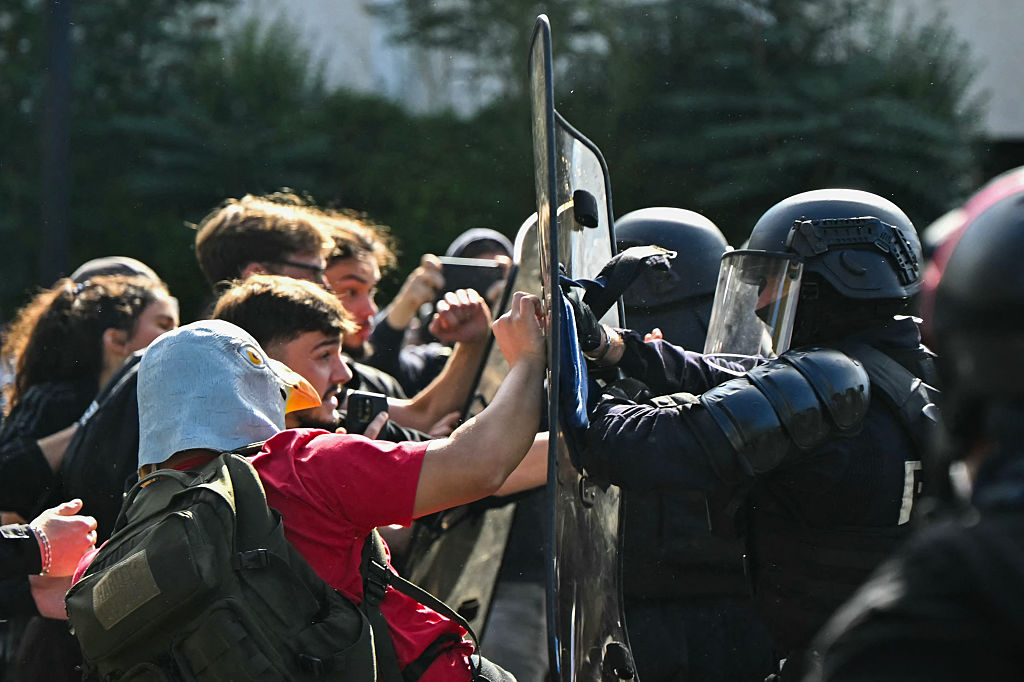
Scenes of clashes with police have drawn establishment condemnations of high schooler protests in France. But much of French society sympathizes with students railing against a dismally underresourced education system. (Lou Benoist / AFP via Getty Images)
It only took a spark to set France ablaze. Protests broke out as the new school year had barely begun, as lycéens (high schoolers, aged roughly fifteen to eighteen) voiced their anger at what they see as neglect and contempt from the government. This deep-rooted discontent recalls earlier episodes. As the movement tries to spread to universities, the authorities’ only answer is repression, and accusations against La France Insoumise (LFI). The radical-left party wants to ride the wave of youth anger in its campaign for next spring’s presidential election, while its opponents hope the movement fizzles out as quickly as possible.
France faces zero growth, rising unemployment, soaring fuel prices, the abandonment of ecological policies just as climate change accelerates, and a new austerity budget. Until now, the 2027 presidential election had seemed to be channeling that anger. Ultimately, however, the social explosion is coming from a group that votes little or not at all and feels it has nothing to lose: high schoolers in the Paris region, who were quickly imitated by their peers in the rest of the country. And they have plenty of reasons to be angry.
Crumbling Schools and Teacher Shortages
It’s no coincidence that the mobilization began in high schools in the poorer towns of the Île-de-France region around Paris, with the first blockades on September 17 in Créteil. Here the new school year was once again marked by extremely degraded teaching conditions. Buildings are often dilapidated: at Paul-Éluard High School in Saint-Denis and Blaise-Cendrars High School in Sevran, videos filmed by students and teachers show, for instance, collapsing ceilings, rats, water leaks, and a shortage of chairs and tables. At Georges-Politzer Middle School in Bagnolet (a collège, for ages eleven to fifteen, in another Seine-Saint-Denis town), murky water containing fecal matter came out of every tap, and the school was informed only four months after the tests had been completed.