High School Protests Can Transform France’s Election Campaign
The protests in schools across France have highlighted “rural deserts” of underfunded services. Massive in scale, the movement is reenergizing the election campaign by bringing social issues of left-behind areas more sharply into focus.
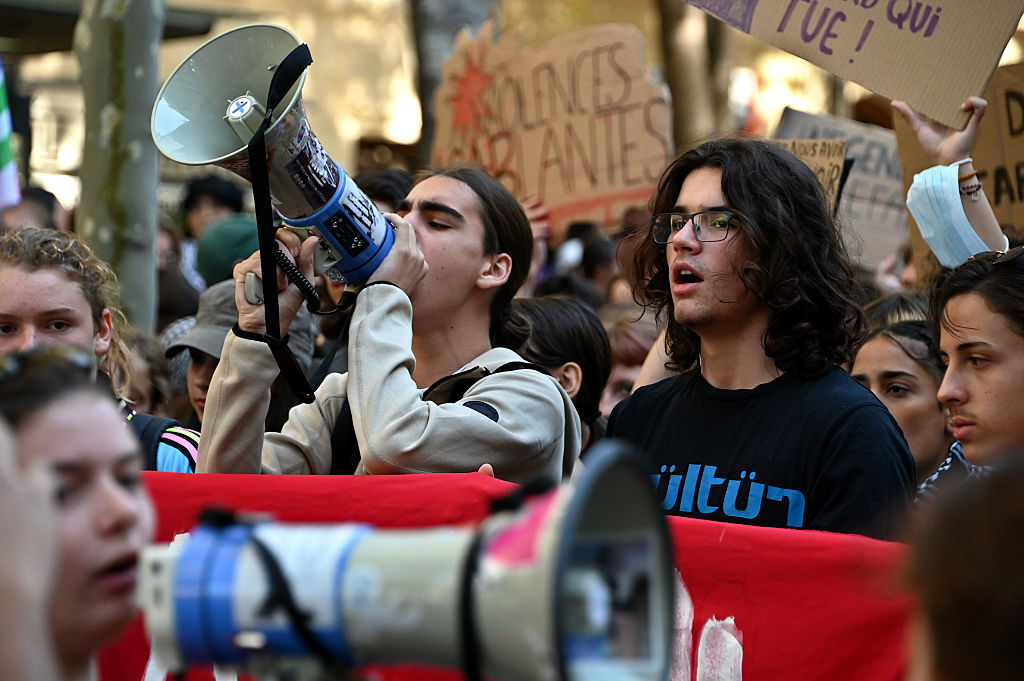
Saturday is set to mark a new height for France’s high-schooler-led protest movement. Its sheer scale and breadth is forcing all presidential candidates to talk about underfunded services — a terrain where Jean-Luc Mélenchon is strongest. (Gérard Bottino / SOPA Images/LightRocket via Getty Images)
Since the outbreak of high school blockades and students protests in French Guiana and Mayotte this September, Jean-Luc Mélenchon’s party, La France Insoumise, has continued to rise in the polls. After a rally in Clermont-Ferrand last Sunday, filling the city’s biggest arena — the third-largest in France — Mélenchon was for the first time projected to make it to the runoff of the 2027 presidential election, in all possible scenarios lining up different candidates.
Marine Le Pen, projected to win 35 percent of the vote in the first round, will almost certainly be his opponent in the final showdown for power. As the movement has yet to reach its peak, these figures could still radically change. On Tuesday, 480,000 people protested across France. With over a million people having already taken to streets in a mere three days of strikes, May ’68 has become a recurring reference by the press and protesters alike. As calls for a convergence between the “yellow vests” (gilets jaunes) and the student movement multiply, this Saturday will see one of the most impressive social movements in France gain further momentum. The Left is now significantly better organized than in successive recent waves of protest.
It is quite possible that Mélenchon could become president next year on the wave of this social movement. In anglophone media, some are quick to sound the alarm about the dangers this involves, revealing their blatant disconnect from the material conditions not only of students but from most working people in France and their disregard for the frustrations with a centralized, top-down political system.
Talk of twin “extremes” of right and left is rampant, yet seemingly ignorant of the extreme exercise of power under Emmanuel Macron. The infamous Article 49.3 of the constitution, which allows the government to pass legislation without having to seek the Assemblée Nationale’s approval, has been used a record number of times to push through extremely unpopular budget cuts under Macron, including the pension reforms of 2023 (a decision that has since been suspended).
Comparisons are often drawn with Michel Rocard, prime minister under Socialist President François Mitterrand, who still holds the record for invoking the much-contested provision twenty-eight times. The crucial difference, however, is that Rocard never resorted to it amid mass protests. With France Insoumise’s new program due to be published on November 6, it is likely to reassert its proposal to abolish Article 49.3 as part of a broader effort to put an end to what the party calls the country’s “presidential monarchy.”
Applied to a party broadly comparable to the vision of Zohran Mamdani, or reminiscent of Jeremy Corbyn’s leadership of the Labour Party, this ill-founded demonization of “extremism” tastes suspiciously of newspeak. For we know that France Insoumise’s campaign will run on tackling inflation, investing in the green transition, and reinvigorating left-behind rural areas.
The fear of the far right is understandable. However, seeing it as all-powerful reflects a misreading of the French political landscape and of the waves of social resistance that have emerged over the past decade.
In this sense, it is also important to realize that the current protests cannot be understood in isolation from the yellow vests movement. The Left, and especially trade unions, are still living with the guilt of not having sprung into action when the yellow vests’ protests and occupations first erupted in November 2018. Due to the unrecognizable nature of its protesters, some of whom had never been politically active before their involvement in this movement, there was considerable political disdain for the yellow vests, who mainly came from France’s nonurban populations.
The Confédération Générale du Travail (CGT) trade union, generally considered to be the furthest to the left, was initially very cautious, referring to the outbreak of protests as an instrumentalization of people’s exasperation, orchestrated by an ill-defined far right. The CGT is now taking steps to avoid repeating the same mistake, calling for a “yellow-vest–inspired” mass mobilization against the rising cost of living this coming Saturday. Likewise, whereas the Left, politicians, intellectuals, and activists largely remained focused on urban centers during the yellow vests movement, France Insoumise now visibly addresses these past shortcomings by giving greater attention to rural France.
One strand of France Insoumise’s program specifically addresses France’s left-behind rural areas and recalls the yellow vests’ contribution in revealing the inequalities that divide city and country. This also answers criticism of the party being too focused on the main cities. The countryside has been crippled by reduced access to health care — commonly referred to as France’s “medical desert” — public transportation, education, and an erosion of local stores, businesses, and social isolation. In order to invest in these areas, France Insoumise plans to decentralize decision-making on the regional level by prioritizing local politics, investing in public meeting spaces, and by making the countryside the driving force behind the party’s ecological planning ambitions.
This also concerns the overseas territories where the current protests first emerged. In the first round of the 2022 presidential elections, Mélenchon was the top candidate in these territories, which the party also described as left-behind, neglected areas. The second round, however, saw the reversal of what happened in metropolitan France, with Marine Le Pen winning by a landslide over Emmanuel Macron. Given the remarkably high abstention rates among these same populations, France Insoumise should not forget these overseas territories. With the protests having started in French Guiana and Mayotte, the student movement has significant potential to drive up the vote. In this respect, it is crucial for the Left not to remain focused on those already politically closest to it but to stand in solidarity with the social movement overseas.
Given Le Pen’s strong polling position, the prospect of her winning in 2027 cannot be ruled out. Yet it should also be recognized that the conditions are now radically different from those of the previous presidential election, where she again came in second place. In 2022, when Mélenchon already came close to reaching the second round, there were no ongoing mass protests coinciding with the presidential campaign. By then, the yellow vests movement had already begun to lose momentum, with participation dwindling rapidly following the mass police violence on May Day 2019, before eventually fizzling out during the pandemic. The arrival of COVID-19 also, perhaps ironically, weakened strikes in the health care sector that had overlapped with the yellow vests movement.
Now the ground has shifted. The Left appears to have understood whose voices it needs to listen to: those of the voters who formed the backbone of the yellow vests movement — working-class people living outside major urban centers. After all, young people are already primarily voting on the Left and for Mélenchon, discrediting claims that the far right is dominant among young people. A clear direction is emerging, spearheaded by young people who, like the yellow vests before them, have little reason to feel optimistic about their future.